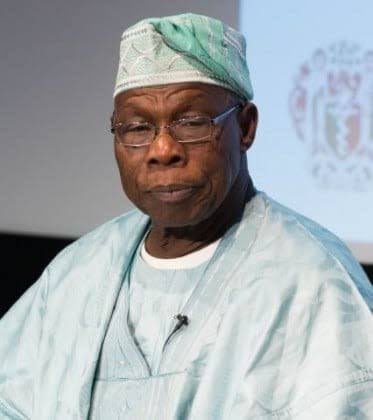
Former Nigerian President Olusegun Obasanjo has spoken about his decision to return to formal education later in life, saying age and social position should not prevent anyone from continuing to learn.
Obasanjo, who served as Nigeria’s military head of state from 1976 to 1979 and later as an elected president from 1999 to 2007, pursued theological studies at the National Open University of Nigeria (NOUN) after leaving political office.
He explained that his decision was driven largely by a desire to deepen his knowledge of Christianity and improve his understanding of God.
“Some years ago when I decided to register as a student of NOUN, I did it for a number of reasons,” Obasanjo said. He identified Christian theology as his primary area of interest, explaining that his goal was to know God better and serve Him better.
Obasanjo returned to school after presidency
Obasanjo's decision to return to the classroom attracted attention because of his age and the senior positions he had previously occupied.
After serving as Nigeria's president for eight years, he enrolled at NOUN to study Christian Theology.
Rather than viewing education as something that should end with age or professional achievement, Obasanjo used his own experience to argue for continuous learning.
He said one of his reasons for enrolling was to demonstrate that there should be no barrier to learning based on a person's age or position.
“Secondly, I wanted to make a statement that no matter one’s age or position, there should be no barrier to continuous learning,” he said.
His decision also reflected his belief that education could serve purposes beyond career advancement.
In his case, the subject he chose was closely connected to his personal faith and desire for greater theological understanding.
His motivation was Christian theology
Obasanjo's return to education was not primarily driven by the need for another professional qualification.
He specifically chose Christian Theology because he wanted to understand his faith more deeply.
In explaining his decision, he said he was not studying theology because he intended to become a pastor. Instead, he wanted to acquire knowledge that would help him understand God and worship better.
That distinction was central to his explanation.
For the former president, formal education remained valuable even when it was not directly connected to employment or political advancement.
His experience illustrates one of the broader purposes of adult education: allowing people to pursue subjects because of intellectual curiosity, personal development or spiritual interests.
Age did not stop his academic journey
Obasanjo's academic journey continued well beyond his initial degree.
The Nation reported that he obtained a master's degree in Theology from NOUN in January 2016, when he was 79 years old. He subsequently continued his studies and earned a doctorate in Christian Theology in 2018 at the age of 81.
His progression from master's study to doctoral research demonstrated that his decision to return to school was not simply symbolic.
He continued through an advanced academic programme and ultimately earned a PhD.
The achievement placed him among prominent Nigerians who have pursued formal education later in life.
‘There is no age to learning’
In a 2016 interview marking his 80th birthday, Obasanjo was asked specifically what had motivated him to return to school to study theology.
His response was direct.
“Because there is no age to learning,” he said, adding that he wanted to learn more about God so he could worship Him better.
The comment captured the philosophy behind his decision.
Rather than regarding education as something reserved for young people, Obasanjo described learning as a lifelong process.
His academic choices also demonstrated that returning to school does not necessarily have to be connected to changing careers.
A person can return to formal education simply because there is a subject they want to understand more deeply.
He wanted to make a statement about lifelong learning
Obasanjo also said his enrolment at NOUN was intended to make a broader statement about education.
According to him, he wanted to show that a person's age or position should not become a barrier to acquiring knowledge.
That message was particularly significant given his own background.
By the time he enrolled, he had already occupied some of the highest political offices in Nigeria. He had also accumulated decades of military, political and public-service experience.
Yet he was willing to become a student again and be evaluated within an academic institution.
He reportedly asked the university's management to treat him like any other student, despite acknowledging that his position might naturally attract special courtesy.
His approach challenged the assumption that senior public figures or accomplished professionals should stop learning once they reach a certain level of achievement.
Obasanjo's academic journey continued after public office
The former president's return to education also came during a period when he was no longer occupying political office.
He left the presidency in 2007 after completing his second term and subsequently became involved in various activities involving international diplomacy, agriculture, peace initiatives and public affairs.
His academic work represented another dimension of his post-presidential life.
Rather than limiting his activities to public engagements, he pursued a subject that had personal significance to him.
The fact that he eventually progressed to doctoral level further demonstrated the seriousness of the academic pursuit.
Education beyond career advancement
Obasanjo's comments raise a broader issue about the purpose of education.
Formal education is frequently associated with employment, professional qualifications and career progression. For younger students, obtaining a degree is often closely connected to entering the labour market.
But lifelong learning can have different objectives.
Older students may return to school to explore subjects they could not study earlier, deepen existing knowledge, pursue personal interests or engage with questions that become important later in life.
Obasanjo's theological studies fit into that broader category.
He had already achieved a long public career before returning to university. His stated motivation was instead connected to his Christian faith and his desire to gain a deeper understanding of it.
His story has relevance for adult learners
Obasanjo's experience also provides an example for people who believe they have missed their opportunity to pursue formal education.
His decision to enrol at an advanced age demonstrates that returning to school can remain possible even after decades away from formal academic life.
The challenges can be different for older learners, particularly for people balancing family, professional and other responsibilities. However, his example illustrates that age itself does not necessarily prevent someone from undertaking a new academic programme.
His academic journey also shows that education can remain relevant after someone has already established a successful career.
From student to doctoral graduate
The culmination of Obasanjo's theological studies came in 2018, when he earned a PhD in Christian Theology from NOUN at the age of 81, according to The Nation.
The achievement followed his master's degree in the same broad field and represented several years of continued academic work.
It also gave concrete meaning to his earlier argument that learning should not be restricted by age.
At 81, Obasanjo was still completing formal academic work and earning a doctoral qualification.
His academic path therefore extended far beyond the traditional period in which most people complete university education.
A message about continuous learning
Obasanjo's comments ultimately centre on the idea that education can remain a lifelong pursuit.
His own decision to study theology after decades in public service was motivated by a personal desire to understand his faith more deeply.
At the same time, he used the experience to make a wider point about the accessibility of learning.
For him, being older or holding a prominent position should not automatically bring an end to education.
His journey from enrolling as a mature student to earning a doctorate provides a concrete example of that philosophy.
The former president's experience also demonstrates that learning does not always have to be pursued for a job, promotion or political advantage. Sometimes, as he explained in his case, the motivation can simply be the desire to understand something better.
For Obasanjo, that something was Christian Theology and his relationship with God.