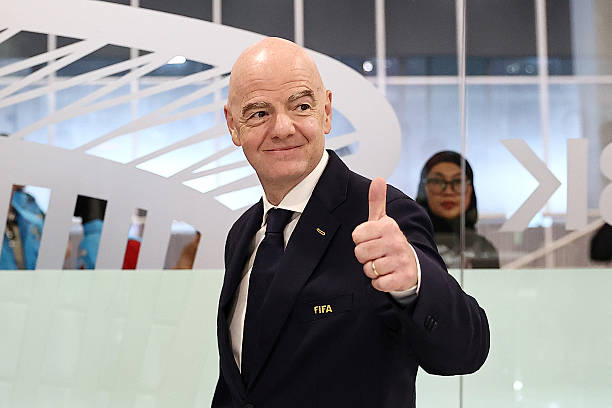
FIFA President Gianni Infantino has received a significant boost to his bid for a fourth term after the Asian Football Confederation (AFC) publicly endorsed his re-election, reversing its position just two months after joining criticism of the FIFA chief.
AFC President Sheikh Salman bin Ibrahim Al Khalifa announced the confederation's support for Infantino at an extraordinary congress in Tokyo on October 23, declaring that Asian football was united behind the FIFA president as he seeks another mandate.
The endorsement is politically important because Asia has 46 FIFA votes, making it one of the largest voting blocs in the FIFA presidential election. The election is scheduled to take place in Rabat, Morocco, in March 2027, with candidates required to submit their nominations by November 18.
Infantino, who has led FIFA since 2016, is seeking what would be his fourth and final term, taking his presidency through 2031.
AFC Reverses Earlier Position
The Asian football body's backing represents a major change from its position earlier in 2026.
In August, the AFC joined UEFA and CONCACAF in criticising Infantino over the now-abandoned FIFA Forward Enterprise (FFE) proposal. The plan involved attracting private investment into a new entity that would control commercial rights linked to major FIFA competitions.
The three confederations accused Infantino of a "fundamental breach of trust" and criticised what they described as deception and a failure of judgement in the handling of the proposal.
But relations have since improved.
Addressing the AFC Extraordinary Congress in Tokyo, Sheikh Salman acknowledged that the two sides had previously disagreed but said the issue should not prevent them from moving forward.
He told delegates that the AFC was ready to move forward as a united Asian football family in support of Infantino.
The announcement was made in Infantino's presence, giving the endorsement additional political significance.
Infantino subsequently thanked the AFC and described the support as evidence of the strength of the relationship between FIFA and Asian football.
Asia Holds 46 FIFA Votes
The AFC's backing matters because of the structure of FIFA's presidential election.
Each FIFA member association has one vote, giving the organisation's 211 members equal voting rights regardless of the size or financial strength of their domestic football markets.
The current distribution of votes by confederation is:
• UEFA: 55 votes
• CAF: 54 votes
• AFC: 46 votes
• CONCACAF: 35 votes
• Oceania: 11 votes
• CONMEBOL: 10 votes
That means Africa and Asia together account for 100 votes, while UEFA controls 55.
The AFC therefore represents a substantial voting bloc in the election.
Infantino has already received support from the Confederation of African Football, while CONMEBOL is also broadly supportive. Reuters reported that the AFC endorsement, combined with African support and divisions within CONCACAF, has strengthened Infantino's position ahead of the election.
However, the confederations themselves do not formally cast bloc votes at the FIFA election. Individual national associations ultimately determine how they vote.
No Major Challenger Has Emerged
Another factor shaping the election is the absence of a confirmed heavyweight challenger.
The deadline for candidates to submit their nominations is November 18, but no major opponent had formally filed against Infantino as of the latest reports.
Potential names have circulated, including UEFA President Aleksander Čeferin and CONCACAF President Victor Montagliani, but BBC reported that neither is currently a candidate.
That leaves Infantino as the only confirmed candidate at this stage.
The absence of an established challenger does not by itself determine the election outcome, but it means the political contest currently centres heavily on Infantino's record and the level of support individual FIFA member associations are prepared to give him.
Infantino Faces European Opposition
The renewed support from Asia comes while some European football associations continue to challenge Infantino's leadership.
The controversy surrounding the FIFA Forward Enterprise proposal has not disappeared.
UEFA has demanded that FIFA release key documents and answer questions relating to the proposal's development, governance and decision-making. According to BBC, UEFA set a November 2 deadline for FIFA to provide the requested information.
Infantino apologised at a FIFA Council meeting in Zurich in October over mistakes connected to the failed project.
The FIFA president has nevertheless rejected suggestions that he should step aside.
Speaking to the BBC, Infantino said he had been elected by FIFA's 211 member associations and argued that different views should be respected within the organisation.
He also pointed to the support he says he has received from football associations around the world.
Infantino Points to FIFA's Global Funding
Infantino has also used FIFA's development funding programme as part of his argument for continued support.
FIFA said its Forward programme provided $495.5 million between 2016 and 2022, funding more than 200 projects in Asia, including 96 infrastructure projects.
A further $394.1 million was made available through FIFA Forward 3.0 between 2023 and 2026. FIFA said Asian member associations have undertaken 44 projects under the programme so far, with each association eligible for funding of up to $8 million.
FIFA has subsequently proposed increasing the amount available to member associations significantly under the next phase.
The organisation says each member association could become eligible for up to $25 million through FIFA Forward 4.0 and the proposed FIFA Surplus Solidarity Programme.
Infantino has argued that increased financial support for football development has helped expand infrastructure, competitions and youth academies across the world.
The funding model is particularly relevant to smaller and developing football associations, many of which rely heavily on FIFA's development programmes.
Asia's Growing Influence in World Football
The AFC's endorsement also reflects the increasing importance of Asian football within FIFA.
Asia has hosted some of the world's biggest football tournaments, most recently the 2022 FIFA World Cup in Qatar. Saudi Arabia is scheduled to host the 2034 World Cup, while Asian nations have increasingly invested in football infrastructure, domestic competitions and international club football.
The AFC has also expanded its commercial and sporting footprint, with countries across the region increasing their involvement in the global football economy.
FIFA has sought to strengthen its relationship with Asian football during Infantino's presidency, and the FIFA president has repeatedly highlighted the continent's development as part of the organisation's global strategy.
At the Tokyo congress, Infantino praised the transformation of Asian football and thanked the AFC for its support. FIFA said the president viewed a united Asian football community as an important partner in the organisation's efforts to grow the sport.
The Politics Behind the U-Turn
The AFC's decision has attracted attention because of how quickly the political relationship changed.
Only weeks earlier, the Asian confederation had joined UEFA and CONCACAF in openly challenging Infantino over the FFE proposal.
The change illustrates the complexity of FIFA politics, where national associations and confederations have different interests and priorities.
Sheikh Salman indicated that the previous disagreements had been discussed and that both sides had agreed to move forward.
The AFC president also stressed unity within Asian football and said the region was ready to support Infantino.
The reversal has consequently weakened the appearance of a united opposition front against the FIFA president.
UEFA remains critical, while CONCACAF has shown divisions, but the AFC's return to Infantino's camp removes one of the largest potential voting blocs from the opposition side.
Infantino Says Decision Belongs to FIFA Members
Despite the support he has received, Infantino has acknowledged that the final decision belongs to FIFA's member associations.
He has presented the election as a democratic process in which every association has an equal vote.
Speaking after the AFC endorsement, he said differing opinions were part of an organisation as large as FIFA and that the member associations would ultimately decide who should lead world football.
That distinction is important because confederation endorsements do not legally determine the votes of individual national associations.
The AFC has 47 members, but 46 are FIFA members, meaning the Asian confederation's endorsement does not automatically translate into 46 guaranteed votes for Infantino.
Nevertheless, the public declaration of support provides a strong political signal.
A Fourth Term Would Extend Infantino's FIFA Era
Infantino became FIFA president in 2016 after the corruption crisis that forced Sepp Blatter from the organisation's leadership.
He was re-elected in 2019 and again in 2023.
FIFA's presidential term limits would normally restrict a president to three terms, but Infantino has been allowed to seek another mandate because FIFA determined that his initial partial term from 2016 to 2019 did not count toward the limit.
If re-elected in March 2027, Infantino would remain FIFA president until 2031.
His fourth-term campaign is therefore taking place against a complicated backdrop: strong support from significant parts of world football, continuing criticism from some European associations and unresolved questions surrounding the abandoned FFE project.
The AFC's endorsement has nonetheless changed the political landscape.
What Happens Before the Election?
The immediate focus will now shift to the November 18 nomination deadline.
Potential challengers must decide whether to enter the race and whether they can assemble sufficient support among FIFA's 211 member associations.
Meanwhile, UEFA is continuing to demand answers from FIFA over the abandoned investment proposal.
Infantino will likely continue campaigning on FIFA's development funding, global expansion of football and the financial benefits that have flowed to member associations during his presidency.
The AFC endorsement provides an important part of that campaign narrative.
For now, the political picture is clear but not final: Infantino has secured public backing from Asia, retains African support and has no confirmed heavyweight challenger, while significant opposition remains within parts of Europe.
The final decision, however, will be made by FIFA's individual member associations when they vote in March.