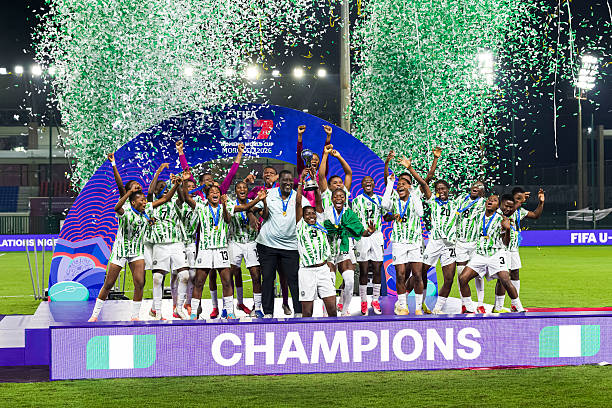
Nigeria's Flamingos have made history by defeating Japan 2-1 in the final of the 2026 FIFA U-17 Women's World Cup in Morocco, becoming the first African nation to win the competition.
The Nigerian team secured the historic victory on Saturday, November 7, at the Mohammed VI Football Complex in Rabat, ending Africa's long wait for the women's youth world title.
Goals from Awawu Bashiru and Oluebube Umejiaku gave Nigeria a two-goal advantage before Japan responded late in the match. Despite facing considerable pressure in the closing stages, the Flamingos held on to secure the trophy and deliver one of the biggest achievements in Nigerian women's football.
The triumph also made Nigeria the first country to win both the men's and women's FIFA U-17 World Cup competitions, following the Golden Eaglets' previous successes in the boys' tournament.
Bashiru and Umejiaku deliver historic final victory
Nigeria started the final with attacking intent, creating opportunities against a Japanese side that had reached the championship match after a dramatic semi-final victory over defending champions North Korea.
The Flamingos eventually broke the deadlock in the 39th minute through Bashiru.
The Nigerian midfielder attempted a long-range effort that appeared manageable for Japan goalkeeper Kou Kadowaki. However, the ball slipped through her gloves and crossed the goal line, giving Nigeria a crucial advantage before half-time.
The goal changed the atmosphere of the contest, with the Nigerian players gaining confidence as they approached the interval.
Nigeria returned for the second half determined to extend their lead, and they did not have to wait long.
Just two minutes after the restart, Umejiaku doubled the advantage with an excellent finish in the 47th minute.
Esther Stephen supplied a long pass that allowed Umejiaku to move beyond the Japanese defence. The forward controlled the ball before lifting a delicate finish over the advancing goalkeeper to make it 2-0.
It was a significant moment for the Flamingos, who had put themselves in a strong position to claim their first world title.
Japan fight back but Nigeria hold their ground
Despite falling two goals behind, Japan refused to surrender.
The Asian side increased the pressure as the match progressed, searching for a way back into the contest. Nigeria goalkeeper Jane Ijirigho was also called into action as Japan attempted to take advantage of opportunities around the penalty area.
Japan eventually reduced the deficit in the 80th minute.
A corner created an opportunity for Anri Ito to direct the ball across the goal, where Fuki Ito arrived to volley home and make the score 2-1.
The goal gave Japan renewed hope and set up a tense final period.
The Japanese players pushed forward in search of an equaliser, but Nigeria defended their advantage and prevented their opponents from taking the match into extra time.
When the final whistle sounded, the Flamingos celebrated a historic victory that placed Nigeria at the top of the competition for the first time.
From opening defeat to world champions
One of the most remarkable aspects of Nigeria's campaign was the team's recovery from a disappointing start.
The Flamingos began their tournament with a 2-1 defeat against Poland in the group stage. The result immediately placed pressure on the players and coaching staff, forcing them to respond quickly if they wanted to remain in contention for the trophy.
Rather than allowing the defeat to derail their campaign, the Nigerian team recovered with victories over Puerto Rico and defending champions North Korea.
Their 3-1 victory over North Korea was particularly important because it ended the defending champions' remarkable unbeaten run in regulation time at the competition.
Nigeria subsequently progressed into the knockout stages, where they continued their impressive performances against some of the tournament's strongest teams.
They defeated Mexico and Venezuela to reach the semi-finals, where they faced Brazil.
The Flamingos produced another impressive performance, scoring three second-half goals to defeat Brazil 3-1 and secure their first-ever appearance in the FIFA U-17 Women's World Cup final.
That victory had already guaranteed Nigeria a historic achievement, as no African country had previously reached the final of the competition.
However, the players were not satisfied with simply reaching the championship match. They went on to defeat Japan and complete an extraordinary turnaround after their opening loss to Poland.
Nigeria therefore became the first team in the competition's history to lose its opening match and still go on to win the title.
Flamingos finish tournament with 14 goals
Nigeria's attacking contribution was another major feature of their championship campaign.
The Flamingos scored 14 goals throughout the tournament, demonstrating their ability to produce goals against different opponents and in high-pressure knockout matches.
Their scoring performances included the victories over North Korea and Brazil, as well as the two goals that secured the final against Japan.
Umejiaku was among the standout performers, finishing the competition with four goals and receiving the Golden Ball award as the tournament's outstanding player.
Her contribution in the final was particularly important. Besides doubling Nigeria's lead, she consistently troubled Japan's defence with her movement and attacking runs.
The team's success was not dependent on one player, however. Different members of the squad contributed at important moments, helping Nigeria progress through the competition and overcome difficult situations.
The ability to recover after the Poland defeat and maintain their performances across six consecutive victories highlighted the team's collective determination.
Nigeria become Africa's first U-17 women's world champions
The victory represents a major breakthrough for African women's football.
Before the 2026 tournament, Nigeria's best performance at the FIFA U-17 Women's World Cup was a third-place finish in 2022.
Although the Flamingos had consistently represented the country at the competition, the final in Morocco provided their first opportunity to compete for the championship.
By defeating Japan, Nigeria became the first African nation to lift the trophy since the competition began in 2008.
The achievement is also significant because it adds the women's U-17 world title to Nigeria's established history in the boys' competition.
The Golden Eaglets have won the FIFA U-17 World Cup five times, making Nigeria one of the most successful countries in the tournament's history.
The Flamingos have now added another major international milestone, demonstrating that Nigeria's football development has the potential to produce champions in both men's and women's youth categories.
Tinubu and Nigerian sports authorities celebrate victory
Nigeria's historic triumph attracted congratulations from government officials and sports administrators.
President Bola Tinubu congratulated the players, describing their achievement as a source of national pride.
The chairman of the National Sports Commission, Shehu Dikko, also praised the team, saying the victory reflected the importance of sustaining improvements and reforms across the country's sporting structure.
The federal government's delegation at the final included Dikko and other senior officials, while FIFA President Gianni Infantino and CAF President Patrice Motsepe were also present to witness the historic occasion.
The achievement has renewed attention on the importance of investing in women's football, particularly at grassroots and youth levels.
Nigeria has a long tradition of producing talented female footballers, with the senior Super Falcons having won the Women's Africa Cup of Nations a record 10 times.
The Flamingos' achievement provides another indication of the talent available within the country's women's football system.
A new chapter for Nigerian women's football
Nigeria's victory over Japan will be remembered as a defining moment for the Flamingos and African women's football.
The team arrived in Morocco with the ambition of competing for the trophy but faced an immediate setback after losing to Poland in their opening group match.
Six consecutive victories later, they emerged as world champions, defeating some of the competition's strongest teams along the way.
For Umejiaku, Bashiru and their team-mates, the victory represents the reward for a remarkable tournament campaign. For Nigeria, it is another major achievement in the country's football history.
The Flamingos have not only won their first FIFA U-17 Women's World Cup title but have also established a new milestone for the African continent.
Their 2-1 victory over Japan will stand as the moment Nigeria became the first African nation to conquer the world at the FIFA U-17 Women's World Cup.