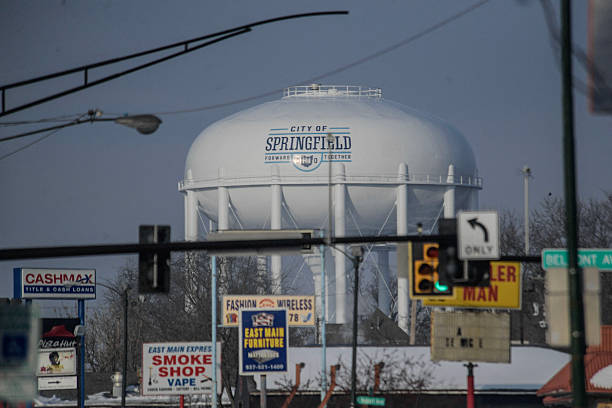
Springfield, Ohio — A small Midwestern city that experienced a dramatic demographic and economic transformation after thousands of Haitian migrants arrived is now undergoing another major change as the Trump administration’s immigration enforcement campaign puts many of those residents at risk of detention, job loss and deportation.
Springfield, Ohio, became internationally known during the 2024 US presidential campaign after then-candidate Donald Trump and other Republicans drew national attention to the city’s growing Haitian population. Trump repeated a false claim that Haitian immigrants were eating household pets, turning Springfield into a symbol of the country’s wider immigration debate.
Two years later, the political controversy has translated into a more immediate reality for many Haitian residents. The Trump administration ended Temporary Protected Status (TPS) for Haitians after the US Supreme Court cleared the way for the termination in June 2026. The change left hundreds of thousands of Haitians across the United States vulnerable to losing work authorization and, depending on their individual immigration circumstances, detention or removal.
For Springfield, the consequences are particularly visible because the Haitian community became deeply integrated into the city's workforce, neighborhoods, businesses and institutions.
From industrial decline to an influx of Haitian workers
Springfield had already been struggling for decades before the recent arrival of Haitians.
The southwestern Ohio city was once an important manufacturing center, but industrial decline gradually emptied factories and contributed to population loss. Businesses closed, houses were abandoned and many younger residents left in search of opportunities elsewhere.
That began to change as migrants started arriving.
Reuters reported in 2024 that an estimated 12,000 to 15,000 Haitians had moved to Springfield within roughly three years, a significant increase for a city whose population was around 58,000 at the time. The newcomers were attracted largely by employment opportunities, relatively affordable housing and family and community networks.
The growth was rapid enough to be felt throughout the city.
Haitian workers filled positions in manufacturing plants, warehouses, restaurants, healthcare, caregiving and other service industries. Some established businesses of their own, while churches and community organizations became important meeting places for the expanding population.
Local officials and business owners described the influx as an important source of workers at a time when employers were struggling to fill jobs.
The newcomers also increased demand for housing, schools and public services. That created challenges for a city that had been accustomed to a shrinking population, while simultaneously giving local businesses a larger customer base.
The transformation was therefore complicated: economic opportunities emerged alongside pressure on infrastructure and services and growing cultural tensions.
Springfield became a national political symbol
The city's transformation might have remained largely a local story were it not for the 2024 presidential campaign.
Springfield suddenly became a national political talking point after false claims about Haitian immigrants and household pets were amplified by Trump and other political figures.
The claims were not supported by evidence. Springfield officials and police rejected the allegations, while Reuters found no evidence of a general increase in violent or property crime attributable to the Haitian population.
At the same time, legitimate local concerns existed around the speed of population growth, housing, public services, translation needs and infrastructure.
A fatal 2023 school-bus crash involving a Haitian-born driver also became part of the political debate. The driver's lack of a valid US licence was established, but the boy's father, Nathan Clark, subsequently criticized politicians for using his son's death as a political tool against immigrants, describing the crash as an accident.
The political attention placed Springfield under an extraordinary national spotlight.
But after the election campaign ended, many Haitian residents continued working, raising families and building lives in the city.
That changed again in 2026.
The end of Temporary Protected Status
Temporary Protected Status is a US humanitarian immigration program that allows nationals of designated countries experiencing extraordinary and dangerous conditions to remain legally in the United States and obtain work authorization.
Haitians had received TPS following the devastating 2010 earthquake, and the protection was repeatedly extended as conditions in Haiti remained dangerous.
The Trump administration moved to terminate Haiti's designation.
The dispute eventually reached the Supreme Court. In June 2026, the court ruled that Haitian TPS holders were not entitled to court orders postponing the termination while their legal challenge continued. The ruling effectively cleared the way for the administration to end the designation.
A federal judge subsequently allowed the termination to take effect, meaning approximately 350,000 Haitians nationwide could lose the protection they had previously relied upon.
The administration argues that TPS was intended to be temporary and that successive extensions had effectively allowed some migrants to remain for years.
Immigration advocates and some employers, however, argue that many TPS holders had become established members of American communities and were legally working, paying taxes and supporting families.
The consequences have been particularly significant in Springfield.
A city now feeling the economic consequences
The loss of legal protection has not meant that every Haitian resident of Springfield is automatically subject to deportation.
The city's Haitian population includes people with different immigration statuses, including US citizens, permanent residents, people with other legal protections and TPS holders.
But for those who depended on TPS, the end of the program can mean losing the legal authorization to work and increasing exposure to immigration enforcement.
The Washington Post reported in August that about 200,000 Haitian TPS holders nationwide were employed, with workers concentrated in sectors including healthcare, food service, warehousing, retail and long-term caregiving.
In Springfield, businesses that once depended on Haitian customers and workers have begun feeling the difference.
PBS reported that some businesses serving the Haitian community had closed or seen dramatically reduced activity after the loss of TPS. Community organizations were also dealing with growing demands for food, diapers and other assistance as families struggled with the loss of employment and uncertainty over their future.
The impact is not limited to Haitian-owned businesses.
When workers lose jobs, businesses can lose customers. When families stop spending, restaurants, grocery stores and other retailers feel the decline. When employers lose workers, they may struggle to maintain staffing levels.
That creates an unusual situation for Springfield: a community that arrived partly because of economic opportunity is now being pulled out of the local economy through immigration enforcement.
Deportations and ankle monitors
The enforcement campaign has already moved beyond uncertainty.
The Ohio Capital Journal reported in October that five Haitians from Springfield had been deported to Haiti following the end of their protected status. The publication also reported that Haitian residents were receiving instructions to report to Immigration and Customs Enforcement offices and that some were being placed under electronic monitoring.
The BBC reported that some Haitians in Springfield had been fitted with ankle monitors as part of the government's Alternatives to Detention program.
For residents who had spent years building lives in Ohio, the monitoring has become a visible symbol of their uncertain status.
One Springfield resident interviewed by the BBC, a warehouse worker who had lived in the city for years, showed the reporter his ankle monitor and described being required to report regularly to immigration authorities.
The enforcement has also affected people's willingness to leave their homes.
The Ohio Capital Journal reported that some Springfield families were increasingly afraid to attend church, shop or participate in normal community activities because of concerns about immigration enforcement. Local churches and community organizations have responded by providing food, helping families with rent and assisting children whose parents are afraid to travel.
A community under pressure
The human consequences have become particularly stark following the death of Pierre Damas Bel, a 20-year-old Haitian migrant who had been living in Springfield.
Bel had arrived in the United States in 2024 and received TPS, according to the BBC. After losing that protection, he was required to report to ICE and was fitted with an ankle monitor. He later died after walking into traffic near Springfield.
His family and supporters attributed his death to the psychological pressure surrounding his immigration situation and the ankle monitor. US immigration authorities rejected attempts to blame ICE for the death.
The case has become a deeply emotional issue within Springfield's Haitian community.
It also illustrates the wider uncertainty facing families who do not know whether they will be able to remain together in the United States.
Some Haitian parents have US-born children who are American citizens. Others have spouses or relatives with different immigration statuses.
The termination of TPS therefore creates consequences that extend beyond the person whose legal protection has expired.
Some Springfield residents support the crackdown
The city's reaction is not uniform.
Some long-time Springfield residents support the Trump administration's deportation campaign and believe migrants who no longer have legal authorization to remain should leave.
The BBC spoke to Springfield resident Rick Johnson, a former Marine who said he supports ICE's efforts. Johnson told the BBC that his concern was primarily about the scale and speed of Springfield's demographic transformation and argued that immigrants should enter the country legally.
His position reflects a concern shared by some residents who believe the city's rapid population growth placed pressure on roads, housing and public services.
But even among people who support stricter immigration enforcement, there is recognition that the Haitian population has become part of Springfield's social and economic fabric.
Others say Springfield cannot afford to lose them
Ohio Governor Mike DeWine, a Republican, has repeatedly expressed concern about ending TPS for Haitians.
In July, DeWine said deporting Haitians would be a blow to Springfield and Ohio, arguing that many had come specifically because jobs were available and were filling positions that employers struggled to staff.
That tension is central to Springfield's current situation.
The debate is no longer simply about whether migrants should be allowed to enter the country.
It is also about what happens when migrants have already lived in a community for years, worked in local factories, rented homes, opened businesses, attended churches and schools, and formed families.
Removing them can change the economic and social structure of the same town that had previously benefited from their arrival.
Springfield's second transformation
The changes now taking place in Springfield represent a reversal of the demographic trend that began several years ago.
The Haitian population helped expand the city's workforce and customer base. It also brought new restaurants, churches, shops and cultural institutions to neighborhoods that had experienced decades of decline.
Now immigration enforcement is producing a different kind of movement.
Some residents are leaving. Others are staying inside their homes. Businesses that depended on Haitian customers are losing trade. Employers face uncertainty over their workforce. Churches and community organizations are taking on additional responsibilities.
The Washington Post reported that Springfield lost 1,100 manufacturing, leisure and hospitality jobs in 2025, while local businesses have reported declining customer numbers and revenue amid the community's uncertainty.
The full long-term effect remains difficult to measure.
Some Haitian residents may obtain other forms of legal immigration status. Others may leave voluntarily, while some could face removal proceedings. Meanwhile, US citizens and other legally protected Haitians are likely to remain part of Springfield regardless of what happens to TPS recipients.
What is already clear is that the city's Haitian community has become much more than a temporary population.
It has become part of Springfield's modern identity.
A town caught between two visions
Springfield now sits at the intersection of two competing visions of America's immigration future.
The Trump administration describes the removal of migrants whose temporary protections have expired as the restoration of immigration enforcement and the return of control over communities that experienced rapid population growth.
For many Haitian residents and their supporters, the same process represents the dismantling of families and communities that were built over years of legal residence and employment.
The difference between those perspectives is visible on Springfield's streets.
A grocery store that once served a busy Haitian customer base can now sit quiet. A church that once welcomed dozens of Haitian worshippers may have only a handful attending. Families who once moved freely around the city may now worry about encountering immigration authorities.
Yet Springfield's older problems have not disappeared.
Factories and vacant properties remain reminders of the industrial decline that preceded the Haitian migration. The economic challenges that existed before the newcomers arrived cannot simply be attributed to immigration.
The city is therefore confronting two realities at once: the long-term consequences of deindustrialization and the immediate consequences of a dramatic immigration reversal.
As the United States heads toward the 2026 midterm elections, Springfield remains a potent symbol of the national argument over immigration.
For the Haitians who built new lives there, however, the debate is much more personal.
It is about jobs, homes, families, churches, businesses and whether the community they helped rebuild will continue to have a place for them.