
LAGOS — A formal counselling advisory issued by the Student Affairs Division at the University of Lagos (UNILAG) has sparked intense public discussion across Nigerian digital platforms and academic circles. The guidance document, designed to offer practical tips for female students on avoiding sexual harassment and assault, has drawn sharp reactions over gender dynamics, campus safety protocols, and institutional responsibility.
The official notice, titled "Counselling Tips for Ladies," was circulated across university communication channels to encourage heightened personal vigilance among undergraduate and postgraduate female students on campus.
However, the specific framing of several recommendations has divided public opinion. While supporters view the advisory as a pragmatic, preventative effort to safeguard young women in high-risk situations, critics contend that the guidelines inadvertently shift the burden of preventing sexual violence onto potential victims rather than addressing systemic perpetrator behavior.
Core Contents of the Institutional Advisory
The advisory published by the University of Lagos Student Affairs Division outlines a series of behavioural guidelines aimed at minimizing personal vulnerability in academic and residential settings.
The institutional notice explicitly advises female students to observe the following measures:
Refrain from indiscriminate physical contact, such as shaking hands casually with men without establishing clear personal boundaries.
Avoid indiscriminate social mingling or placing oneself in isolated, unmonitored locations alone with male acquaintances or staff members.
Decline frequent gifts, financial favors, or unnecessary material assistance from men that could carry implicit expectations or pressure.
Avoid participating in the viewing of pornographic films, explicit pictures, or adult media in mixed-gender settings.
Refuse untrusted intoxicants, remain cautious when served drinks at social gatherings, and maintain personal assertiveness when resisting social or peer pressure.
Develop clear boundary-setting skills, emphasizing the critical importance of learning to say no in high-pressure situations.
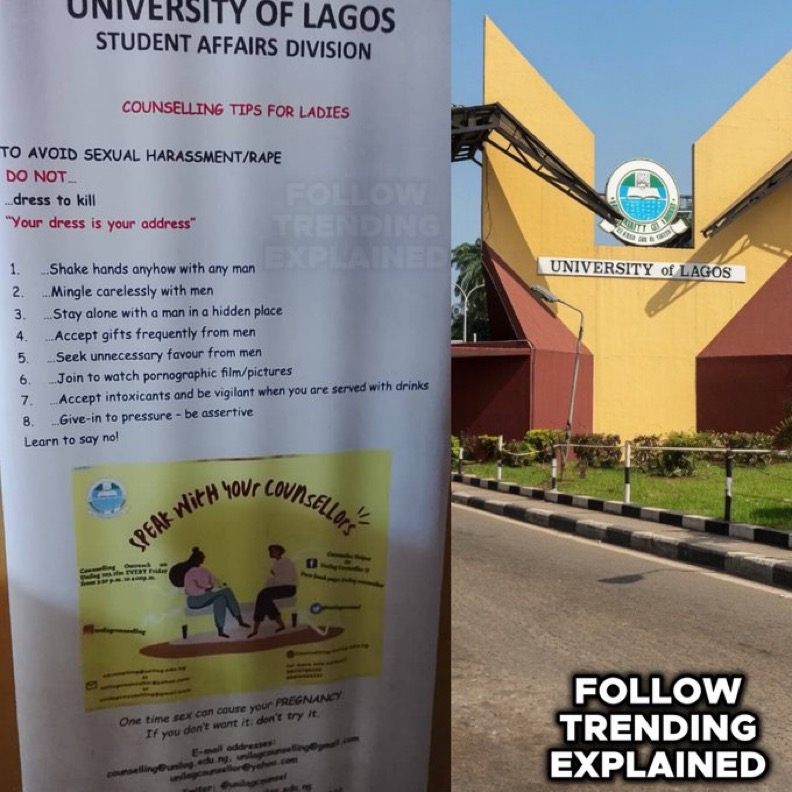
“Stop shaking hands anyhow with men.”
“Mingle carelessly with men.”
“Stay alone with a man in a hidden place.”
“Accept gifts frequently from men.”
“Seek unnecessary favour from men.”
“Join to watch pornographic film/pictures.”
“Accept intoxicants and be vigilant when you are served with drinks.”
“Give in to pressure – be assertive.”
“Learn to say no!”
Divided Public Response: Safety Guidance Versus Victim-Blaming Debates
The public dissemination of the UNILAG advisory has triggered widespread commentary across digital media, reflecting broader societal debates regarding campus security, personal ethics, and gender equity in Nigerian higher education institutions.
Advocates of the guidance, including conservative social commentators and institutional alumni, argue that the advisory provides realistic, traditional wisdom tailored to the complex social dynamics of university life. Proponents maintain that promoting personal vigilance, avoiding compromised environments, and discouraging financial dependency on male peers or older individuals are sensible precautions that reduce exposure to predatory behavior.
Conversely, gender rights advocates, student activists, and civil society organizations have raised concerns regarding the underlying narrative of the circular. Critics assert that focusing predominantly on the dress, movements, and social choices of female students risks perpetuating victim-blaming attitudes.
Human rights analysts emphasize that effective anti-harassment strategies must prioritize rigorous institutional enforcement against abusers, clear reporting mechanisms, administrative transparency, and mandatory consent education for male students and university staff.
Digital Reactions Reflecting Social Polarization
The debate has produced a wide spectrum of commentary across social media platforms, highlighting contrasting perspectives on institutional guidance and personal liberty.
Several commentators defended the university's initiative as a necessary moral check, asserting that moral discipline and personal boundaries have eroded in modern academic environments and that precautionary guidance is entirely justified.
Other users responded with satirical critique, questioning the practical implementation of such sweeping restrictions and arguing that telling adult students to avoid shaking hands or accepting gifts oversimplifies the root causes of sexual misconduct on university campuses.
Additional discussions centered on the socioeconomic aspects of campus life, pointing out that economic vulnerabilities often drive students into situations where accepting gifts or favors becomes a survival strategy, which institutional advice alone cannot solve without broader financial support systems.
Institutional Governance and the Broader Context of Campus Security
The controversy comes at a time when tertiary institutions across West Africa are under heightened pressure to reform their handling of gender-based violence, administrative exploitation, and sexual harassment.
Over recent years, Nigerian universities have faced public scrutiny regarding allegations of transactional relationships, "sex-for-grades" scandals, and power imbalances between academic personnel and students. In response, many institutions have established specialized gender units, published anti-harassment policies, and implemented anonymous reporting portals.
Educational administrators note that while student affairs divisions routinely publish safety advisories covering general security, physical health, and personal safety, framing such guidance requires a delicate balance. Experts stress that advisory notices should clearly distinguish between personal risk-reduction strategies and the primary legal and moral accountability that rests entirely on perpetrators of assault.
As the debate continues across academic forums and online platforms, the University of Lagos management faces calls from student bodies and gender rights advocates to complement its student-directed safety tips with comprehensive, policy-driven enforcement mechanisms that guarantee a safe, secure, and equitable learning environment for all members of the campus community.