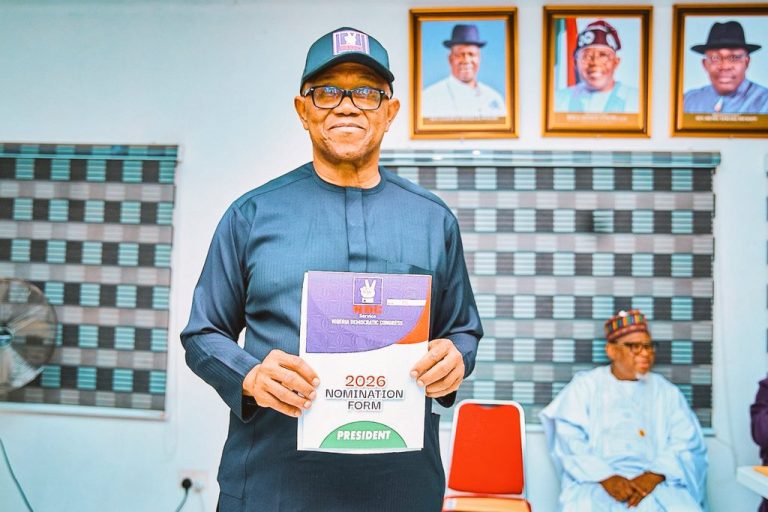
ABUJA — Presidential candidate of the Nigeria Democratic Congress (NDC), Peter Obi, has criticized the recent ruling by the Federal High Court in Lokoja, which set aside a previous judgment directing the Independent National Electoral Commission (INEC) to register the NDC. Obi characterized the decision as an unnecessary setback for Nigeria’s democracy, warning that such judicial actions further weaken the integrity of the country’s democratic institutions.
Federal High Court in Lokoja has vacated its December 10, 2025, judgment that had previously compelled the Independent National Electoral Commission (INEC) to register the Nigeria Democratic Congress (NDC) as a political party. The ruling, delivered on June 26, 2026, by Justice Isah Dashen, has effectively suspended the NDC’s legal status, throwing the party’s preparations for the 2027 general election into a state of profound uncertainty.
The Grounds for Nullification: A Procedural Oversight
The court’s decision was prompted by an application from the Peace Movement Party (PMP), which challenged the NDC’s registration on the basis of intellectual property and procedural rights. The PMP argued that the logo adopted by the NDC in its registration filings was an infringing mark that belonged to the PMP.
Justice Dashen held that the original 2025 judgment was constitutionally defective because it was delivered without the participation of the PMP. The court emphasized that as the proprietor of the contested logo, the PMP was a "necessary party" whose right to a fair hearing had been violated by its exclusion from the initial proceedings. Consequently, the court set aside all administrative actions taken by INEC pursuant to the earlier judgment, ordering that the parties revert to the status quo as it existed prior to December 2025.
Peter Obi’s Reaction: A Warning Against "Institutional Decline"
Peter Obi, the presidential candidate of the NDC, expressed deep concern over the ruling. Speaking from Imo State, Obi characterized the decision as an unnecessary and alarming setback for Nigeria’s political landscape. He warned that such judicial actions are indicative of a broader pattern of "institutional decline," where the independence and integrity of critical democratic bodies are increasingly being questioned.
Read Also: Obunike Ohaegbu Refutes Allegations Against Peter Obi Regarding Party Primary Finances
"This judgment represents another setback for our democracy and the institutions upon which our future depends," Obi stated in a message shared across his social media platforms. He urged Nigerians to prioritize the stability and credibility of national institutions over partisan interests, asserting that the survival of the country’s democratic framework is inextricably linked to the strength of its judicial and electoral systems.
The Path Forward: Administrative Limbo and Legal Recourse
The court's ruling does not serve as a final determination of the NDC’s eligibility for registration; rather, it nullifies the previous mandate and directs that the substantive case be heard afresh. This "de novo" (fresh) trial will require the inclusion of all necessary parties—INEC, the NDC, and the PMP—to ensure that all competing claims to political branding are adjudicated with transparency.
For the Nigeria Democratic Congress, this development necessitates immediate administrative and legal responses:
-
Compliance with INEC Directives: The electoral commission is expected to comply with the court’s order, which involves withdrawing the party’s certificate of registration and removing it from official records pending the outcome of the new trial.
-
Appellate Review: The NDC’s legal team is currently reviewing the judgment, with expectations that the party will pursue an appeal to challenge the court’s decision to vacate the initial registration order.
-
Political Continuity: Despite the suspension of its official recognition, party leadership continues to maintain its operational integrity as it seeks to resolve the litigation and restore its standing on the ballot ahead of 2027.
As the legal battle shifts to the substantive trial, the case remains a litmus test for Nigeria’s electoral environment. It highlights the complexities of party registration in a litigious climate, where intellectual property disputes and procedural technicalities can wield significant influence over the political aspirations of millions of Nigerians.