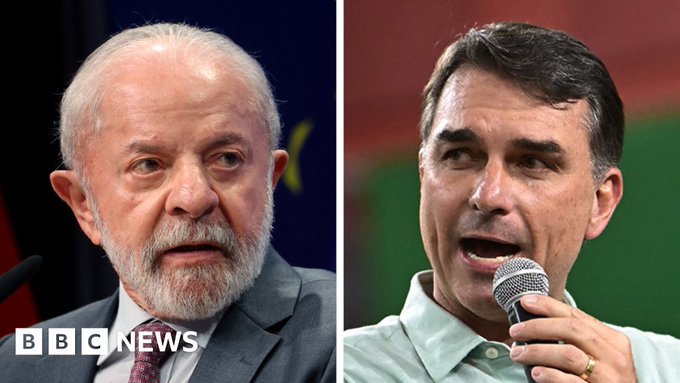
Brazil’s presidential election has entered a decisive second round, with incumbent President Luiz Inácio Lula da Silva facing right-wing Senator Flávio Bolsonaro, the eldest son of former President Jair Bolsonaro.
The contest follows a closely fought first round in which Flávio Bolsonaro finished ahead of Lula, setting up a political rematch that echoes Brazil’s deeply polarised 2022 election. Brazil’s Superior Electoral Court said Flávio received 47.03% of valid votes, compared with 45.16% for Lula, with more than 99.99% of ballots counted.
Neither candidate secured the more than 50% of valid votes required to win outright, meaning Brazilians will return to the polls on October 25 for the runoff.
Who are Lula and Flávio Bolsonaro?
Luiz Inácio Lula da Silva
Lula, 80, is seeking another term as president after returning to power in 2023.
The former metalworker and longtime leader of Brazil's Workers' Party previously served as president from 2003 to 2010. His political career has made him one of the country's most influential figures on the left.
He is seeking a fourth non-consecutive presidential term and is campaigning on a platform that includes social welfare, economic relief and protecting Brazil's environmental policies.
Lula's political history has also been marked by controversy. He was imprisoned following corruption convictions, but those convictions were later annulled on procedural and jurisdictional grounds, allowing him to return to electoral politics and defeat Jair Bolsonaro in 2022.
Flávio Bolsonaro
Flávio Bolsonaro, 45, is a senator representing Rio de Janeiro and the eldest son of former President Jair Bolsonaro.
He is running for president for the first time and has positioned himself as the candidate carrying forward his father's conservative political movement.
The elder Bolsonaro is currently serving a 27-year prison sentence following his conviction over a coup plot after losing the 2022 election. Flávio's campaign has consequently become closely associated with his father's political legacy.
Brazil's Superior Electoral Court lists Flávio as a former state lawmaker and current senator, with Alfredo Gaspar as his vice-presidential running mate.
Flávio unexpectedly led the first round
The first-round result was significant because several pre-election surveys had shown Lula either ahead or in a very close contest.
Flávio ultimately received 56.1 million votes, representing 47.03% of valid ballots, while Lula received approximately 53.9 million, or 45.16%.
The result means Flávio enters the runoff with a narrow numerical advantage, although the first-round result does not determine the winner.
The candidates must now attempt to attract voters who backed the other presidential contenders, as well as voters who did not participate in the first round.
Why is the election so polarised?
Brazil has been deeply divided between supporters of Lula's left-wing Workers' Party and the conservative movement associated with the Bolsonaro family.
The 2026 election has effectively continued that political divide.
The Council on Foreign Relations described the contest as a kind of proxy rematch of the 2022 election, with voters often choosing between the two political camps rather than simply between individual candidates.
The stakes are particularly significant because the election comes after the dramatic events surrounding the 2022 election.
Jair Bolsonaro refused to accept defeat and his supporters later stormed government buildings in Brasília in January 2023. His subsequent conviction and imprisonment have made questions about democracy and the limits of political power important issues in the current campaign.
Economy and cost of living are major issues
Economic conditions are another important factor in the election.
Brazilian voters have expressed concerns about inflation, household debt, government spending and the broader cost of living.
Lula has highlighted social programmes and economic assistance, seeking to appeal particularly to lower-income voters.
Flávio has focused more heavily on conservative economic and security themes while presenting himself as an alternative to Lula's administration.
Crime is also a major campaign issue.
Flávio has proposed tougher measures against organised crime, including the expansion of prison capacity and treating certain transnational criminal organisations as terrorist groups.
Flávio has support from Brazil's conservative movement
Flávio's campaign benefits from the political network established by his father.
The Bolsonaro family remains influential among conservative voters, particularly evangelical Christians and voters in parts of southern Brazil and higher-income groups.
Flávio has also developed close political links with US conservatives and has received support from figures associated with the American right.
However, his campaign has also faced controversy.
Flávio has been connected to allegations involving campaign financing and a banking scandal. He denies wrongdoing.
Lula faces a stronger conservative Congress
The presidential race is not the only important contest taking place in Brazil.
The 2026 congressional elections produced significant gains for the Bolsonaro-aligned Liberal Party.
According to Reuters, the party increased its Senate representation from 15 to 28 seats and is projected to win 121 seats in the lower house, up from 98. Together with allied right and centre-right parties, the broader bloc could control close to 250 lower-house seats and more than 30 Senate seats.
That could have major consequences for whoever wins the presidency.
A Lula victory, for example, would potentially leave his administration facing a much stronger conservative congressional opposition than in the current political environment.
Flávio, meanwhile, could enter the presidency with considerably stronger legislative support from his political allies.
Foreign policy is also at stake
Brazil is Latin America's largest country and one of the world's major emerging economies, making the election important beyond its borders.
The next government will have to manage relationships with major trading partners including the United States and China, while continuing Brazil's engagement with the wider Global South.
The election has also attracted attention because of tensions between Brazil and the United States and allegations of foreign influence in Brazilian politics.
Those issues could affect trade, diplomacy and Brazil's approach to international organisations during the next presidential term.
What happens next?
The first round is now over, but the election is not.
Lula and Flávio Bolsonaro will face each other directly on October 25.
Both campaigns will now seek to expand their coalitions by appealing to voters who supported the other candidates in the first round and those who stayed away from the polls.
The first-round result gives Flávio a narrow lead, but the runoff will be a separate contest with only two candidates.
Brazil's 2026 election is therefore entering its most consequential stage: a direct contest between Lula's left-wing political project and the conservative movement represented by Flávio Bolsonaro.
The outcome will determine Brazil's next president and could also shape the country's approach to the economy, public security, social welfare, foreign policy and its relationship with the Bolsonaro political movement.