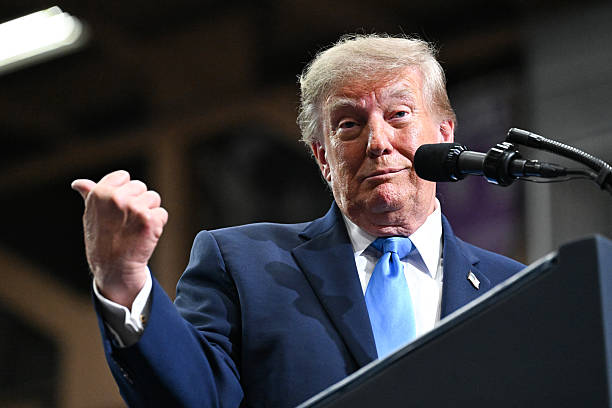
U.S. President Donald Trump has suggested renaming the strategically important Strait of Hormuz the “Trump Strait,” saying the waterway should carry his name now that he believes the United States has control over it.
Trump made the proposal in a September 2 post on his Truth Social account amid the ongoing military confrontation between the United States and Iran and heightened tensions around the vital shipping route.
“Now that we have it under U.S.A. control, should we change the name Hormuz Strait to TRUMP STRAIT?” Trump wrote, adding that the new name would be “hotter” than ever.
The suggestion quickly attracted international attention because the Strait of Hormuz is not a U.S. territory. It is an international waterway between Iran and Oman and is one of the world's most important routes for oil and gas shipments.
Trump says the strait is under U.S. control
Trump's proposal came as his administration continued military operations connected to the conflict with Iran.
The president has repeatedly asserted that the United States has established control or security over the waterway, while Iranian authorities have disputed Washington's claims and continued to assert their own authority over shipping in the area.
The disagreement is occurring against the backdrop of a wider military confrontation that has severely disrupted energy markets and commercial shipping.
The Strait of Hormuz connects the Persian Gulf with the Gulf of Oman and the Arabian Sea. It is a critical passage for energy exports from several Gulf countries.
Recent fighting has reduced commercial traffic through the waterway and contributed to sharp movements in oil prices. The International Energy Agency has warned that disruptions around the strait are contributing to a major shock to global oil supply and demand.
Trump later played down the renaming idea
Although Trump publicly floated the “Trump Strait” name, he later indicated that he was not necessarily making a formal proposal.
According to AFP, Trump was asked about the suggestion after making the Truth Social post and responded that it had simply been “thrown out there.” He reportedly appeared to treat the idea humorously.
That distinction is important because changing the internationally recognized name of a major maritime waterway is not something the U.S. president could simply accomplish through a social-media announcement.
The waterway is internationally known as the Strait of Hormuz, a name connected to the historic region of Hormuz and used on international maps, maritime documents and by governments around the world.
Trump's comments therefore amount to a political and symbolic suggestion rather than an internationally recognized name change.
Strait of Hormuz is crucial to global energy supplies
The significance of the controversy goes far beyond the proposed name.
The Strait of Hormuz is one of the world's most important maritime chokepoints because enormous quantities of oil and other energy products normally pass through it.
Any sustained disruption can affect crude oil prices, fuel costs, shipping rates and inflation well beyond the Middle East.
The current conflict has already demonstrated those risks. Oil prices have risen sharply as fighting and attacks on shipping have disrupted exports from the Gulf. Reuters reported that Brent crude moved above $100 a barrel amid concerns over further supply disruptions.
The situation has also increased pressure on alternative shipping routes.
The Bab el-Mandeb Strait, which connects the Red Sea with the Gulf of Aden, has also become increasingly important as Iran-backed Houthi forces expand their presence along Yemen's coast. Reuters reported that the Houthis recently advanced toward the strategic waterway, raising fears that another major global shipping route could be affected.
Trump has previously proposed changing geographic names
The “Trump Strait” proposal is not an isolated example of the president seeking to attach American or personal branding to geographic names.
During his second term, Trump has promoted several controversial geographic renaming initiatives.
His administration renamed the Gulf of Mexico as the Gulf of America for U.S. government purposes in 2025, although Mexico and other countries have continued using the internationally recognized name Gulf of Mexico.
Trump has also promoted the name “Lake America” for Lake Ontario and has suggested changing the name of New Mexico to “New America.”
The proposals have generated political debate because geographic names can have different official uses in different countries and international organizations.
The Strait of Hormuz would present an even more complicated case because it is an international maritime passage rather than a geographic feature located entirely within U.S. territory.
Iran rejects U.S. claims over the waterway
Iran has strongly opposed any suggestion that Washington could take control of the Strait of Hormuz.
The issue has become a central point of tension between Tehran and Washington during the current conflict.
Earlier in the year, Trump said the United States would act as the “guardian” of the Strait and suggested that Washington should be compensated for providing security for ships passing through the waterway.
The International Maritime Organization rejected the idea of mandatory transit fees, saying there is no legal basis for imposing tolls simply for passage through an international strait.
Trump later moved away from the proposed shipping fee and said the United States would instead pursue trade and investment arrangements with Gulf countries.
The episode nevertheless demonstrated how central control of the waterway has become to the administration's strategy toward Iran.
Shipping and oil markets remain under pressure
The debate over the name of the waterway comes at a time when global markets are already dealing with major uncertainty.
The Strait of Hormuz is normally a major artery for oil exports from the Gulf region. When vessels face attacks, restrictions or uncertainty over safe passage, shipping companies can delay voyages, reroute vessels or demand higher insurance premiums.
Those additional costs can eventually reach consumers through higher fuel and transportation prices.
The current crisis has already pushed global oil prices higher and raised concerns about inflation in countries that depend heavily on imported energy.
The International Energy Agency recently warned that disruptions associated with the conflict had created an unusually severe shock to global oil markets, with Gulf production significantly affected.
No official international name change
Despite Trump's comments, there has been no internationally recognized decision to rename the Strait of Hormuz.
The name remains Strait of Hormuz in international usage.
Trump's proposal also does not automatically alter how other governments, maritime organizations, shipping companies or international institutions identify the waterway.
For now, “Trump Strait” remains a name suggested by the U.S. president rather than an official replacement for the established geographic name.
The proposal nevertheless reflects the increasingly personal and symbolic nature of Trump's approach to the dispute over the waterway.
What Trump's proposal means
The “Trump Strait” suggestion is unlikely to change the legal or navigational status of the waterway, but it highlights the broader dispute over who controls and guarantees shipping through one of the world's most strategically important maritime routes.
For the Trump administration, securing the strait has become part of its broader campaign to pressure Iran and protect international shipping.
For Iran, any suggestion that the United States could claim control represents a challenge to its sovereignty and regional influence.
And for global markets, the more important question is not what the waterway is called, but whether commercial vessels can safely pass through it.
As fighting continues and tensions remain high, the Strait of Hormuz will remain a major focus for governments, energy companies, shipping operators and financial markets around the world.
For now, however, the historic name remains unchanged: the Strait of Hormuz.