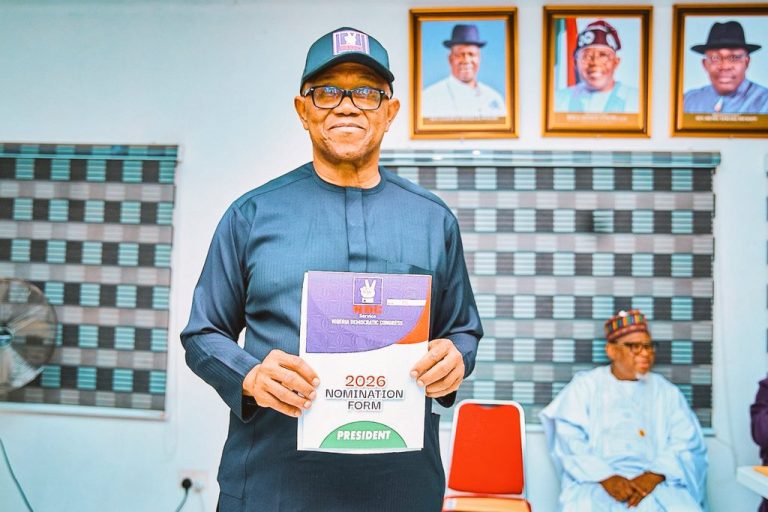
The Nigeria Democratic Congress says Peter Obi will defeat President Bola Tinubu in Lagos State by a wider margin in the 2027 presidential election, citing the former Labour Party candidate’s 2023 performance in the state.
The Nigeria Democratic Congress has expressed confidence that its presidential candidate, Peter Obi, will defeat President Bola Tinubu in Lagos State in the 2027 presidential election, predicting a larger margin than the one recorded in 2023.
The claim was made by the party’s National Publicity Secretary, Osa Director, during discussions about the NDC’s preparations for the 2027 general elections.
Director argued that Obi’s victory in Lagos during the 2023 presidential election reflected the voting preferences of residents rather than being an isolated political development.
“Obi didn’t win Lagos by magic. It was a political reality.”
He said the party expected an even stronger performance from Obi in 2027 if the election is conducted without voter intimidation, inducement or other irregularities.
NDC confident of stronger performance
According to Director, the NDC believes the political circumstances that produced Obi’s narrow victory over Tinubu in Lagos in 2023 can be replicated, with a larger margin, in the next presidential election.
He challenged political opponents to allow a contest in which voters can participate freely.
The NDC spokesman also said the party had learned from the 2023 election and was preparing to protect its support and votes during the next election.
His comments came as political parties and their candidates intensify preparations for the 2027 presidential contest.
What happened in Lagos in 2023?
The 2023 presidential election provides the principal electoral reference for the NDC's claim.
According to figures declared by the Independent National Electoral Commission, Obi, who contested the 2023 election on the Labour Party platform, received 582,454 votes in Lagos State.
Tinubu, then the presidential candidate of the All Progressives Congress and a former Lagos governor, polled 572,606 votes.
The difference was 9,848 votes in Obi's favour.
Obi won nine of Lagos State's 20 local government areas, while Tinubu won 11.
Obi's victories came in Ajeromi-Ifelodun, Amuwo-Odofin, Eti-Osa, Ikeja, Kosofe, Oshodi-Isolo, Somolu, Ojo and Alimosho, according to the results reported by The PUNCH.
Tinubu won Agege, Apapa, Badagry, Epe, Ibeju-Lekki, Ifako-Ijaiye, Ikorodu, Lagos Island, Lagos Mainland, Mushin and Surulere.
The result was significant because Lagos has traditionally been closely associated with Tinubu and the political structure of the APC.
NDC points to political realignment
The NDC's Lagos Central senatorial candidate, Ladipo Johnson, also expressed confidence that Obi could improve on his 2023 result.
Johnson attributed the expected improvement partly to what he described as the performance of the Tinubu administration and the strengthening of opposition forces.
He also said the party had gained additional political support from people who previously belonged to other political movements.
Johnson said he was previously associated with the Kwankwasiyya Movement and described the NDC's current political alignment as stronger than it was in 2023.
The comments reflect the broader political realignment taking place ahead of the 2027 presidential election, although the eventual electoral strength of the different alliances will only be established through voting.
APC rejects the prediction
The Lagos State chapter of the All Progressives Congress has rejected the NDC's prediction.
APC Lagos spokesman Seye Oladejo described the claim as “wishful thinking” and argued that Obi's 2023 victory should not automatically be interpreted as a permanent political advantage.
Oladejo acknowledged the 2023 figures, including Obi's 9,848-vote margin, but stressed that the next election would be a separate contest.
He said Lagos voters would ultimately determine the outcome when they cast their ballots and argued that political parties should focus on presenting their candidates, policies and records rather than declaring victory before the election.
The APC spokesman also pointed to the difference between the 2023 political environment and the circumstances that will exist in 2027.
Electoral concerns raised
Both sides have raised concerns about the conditions under which the 2027 election will be conducted.
The NDC said voter intimidation, harassment, inducement and violence were among the issues it expected to face and called for a free and fair contest.
Johnson similarly identified vote buying and voter intimidation as potential challenges.
The APC, however, argued that political parties should concentrate on persuading voters and competing through organisation, policies and their records.
These competing positions show that electoral integrity is already becoming part of the political debate surrounding the 2027 election. The allegations made by individual parties should be distinguished from independently established findings about the conduct of the future election.
2027 remains undecided
The NDC's prediction is a political claim about an election that has not yet taken place. It does not establish the eventual result.
The 2023 Lagos figures demonstrate that Obi narrowly defeated Tinubu in the state in that election, but they do not by themselves determine how Lagos voters will vote in 2027.
The political landscape has also changed since 2023, with Obi moving from the Labour Party to the Nigeria Democratic Congress and new alliances and political structures emerging ahead of the next election. Africa Check previously reported that Obi joined the NDC in May 2026 and was seeking the party's presidential ticket.
For now, the NDC says it expects Obi to widen his Lagos victory, while the Lagos APC disputes that assessment.
The final result will depend on the votes cast and officially declared during the 2027 presidential election.