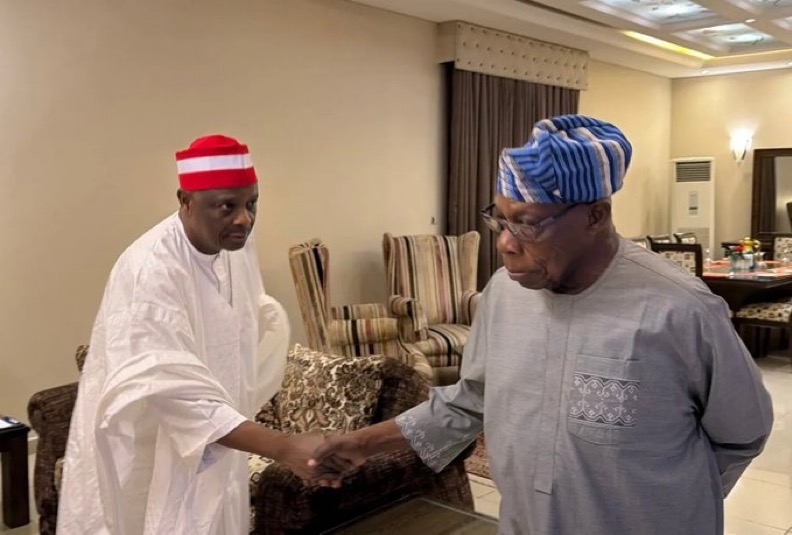
KANO — Former President Olusegun Obasanjo paid a significant courtesy visit to Senator Rabiu Musa Kwankwaso, the Vice-Presidential candidate of the Nigeria Democratic Congress (NDC), at his private residence in Kano on Thursday. The visit, which brought together two of the most influential power brokers in the nation’s contemporary political history, was marked by a atmosphere of cordiality and deep-rooted respect.
A Meeting of Veteran Political Titans
Senator Kwankwaso, a former two-term Governor of Kano State, welcomed the former President alongside the NDC governorship candidate for Kano State, Comrade Aminu Abdulsalam Gwarzo. The meeting was officially confirmed by Saifullahi Hassan, the media aide to Senator Kwankwaso, who described the encounter as a warm exchange between two veteran statesmen.
While the official communique from the meeting remained intentionally brief, the gravity of the visit is difficult to overstate. The relationship between Obasanjo and Kwankwaso spans over two decades, most notably during the Obasanjo administration (1999–2007), where Kwankwaso served as the Minister of Defence. This period cemented a professional and personal bond that has endured the shifting tides of Nigerian partisan politics, surviving various political realignments and electoral cycles.
The 2027 Political Chessboard
The timing of this visit is hardly accidental. With the 2027 general election cycle already in its preliminary stages, political analysts are viewing this high-level meeting as a potential blueprint for opposition strategy. The Nigeria Democratic Congress (NDC) has quickly emerged as a formidable vehicle for opposition forces, and the alignment of key figures within this movement suggests a deliberate effort to consolidate influence in Northern Nigeria.
Obasanjo, whose political influence remains substantial despite his formal retirement from partisan office, is widely regarded as a kingmaker. His public support for Peter Obi during the 2023 electoral cycle played a pivotal role in shifting the national conversation toward a third-force movement. The fact that he is now engaging directly with Senator Kwankwaso—the NDC’s Vice-Presidential nominee—suggests that Obasanjo continues to play an active, if informal, role in advising and shaping the trajectory of the opposition coalition.
Strengthening Opposition Collaboration
Analysts suggest that this meeting serves as a clear signal of strengthened collaboration within the NDC. By visiting the stronghold of the "Kwankwasiyya" movement, Obasanjo is effectively validating the party’s presence in Kano, a state that remains one of the most significant electoral prizes in the country due to its massive voter population.
Read Also: Rabiu Kwankwaso Rubbishes Claims of Secret Alliance with President Tinubu Ahead of 2027
The presence of Comrade Aminu Abdulsalam Gwarzo, the party’s gubernatorial hopeful in Kano, further underscores the strategic intent of the visit. It demonstrates a unified front between the national leadership of the NDC and the state-level aspirants, signaling to the electorate that the party is organized, supported by high-level statesmen, and prepared to challenge the status quo in the North-West zone.
Private Discussions, Public Implications
While the door remained closed to the press and the specific details of their conversation were not disclosed, the visit acts as a "political semaphore." In the context of Nigerian elections, such meetings are rarely about social pleasantries. Instead, they are forums for the assessment of national security, the recalibration of electoral strategies, and the strengthening of cross-regional alliances.
Obasanjo’s visit suggests that the NDC is actively positioning itself to capitalize on the systemic grievances and policy shifts that have defined the current administration. For Kwankwaso, the meeting provides a strategic boost, reaffirming his stature as a central pillar of the opposition and an indispensable partner in the NDC’s drive for the 2027 mandate.
The Legacy of "Third Force" Politics
The alliance between Peter Obi, as the presidential standard-bearer, and Rabiu Kwankwaso as his running mate, already represents a potent combination of South-Eastern intellectual appeal and Northern grassroots mobilization. With the tacit, high-profile approval of a figure like Obasanjo, the NDC is attempting to build a narrative of "institutional continuity" combined with "radical reform."
As the political landscape continues to evolve, the public will be watching to see if this visit leads to further concrete actions, such as joint campaign rallies or the expansion of the NDC’s outreach programs in the North. For now, the image of Obasanjo and Kwankwaso sitting across from each other in Kano serves as a stark reminder that the 2027 race is already well underway. The opposition, energized by the endorsement of the nation's elder statesmen, is signaling that they are not just aiming to participate—they are aiming to capture the center of gravity in Nigeria's political power structure.
Given the historical and political weight of both figures, do you believe that this visit indicates a solidified opposition front for the 2027 elections, or is it simply a gesture of respect between two veteran politicians?