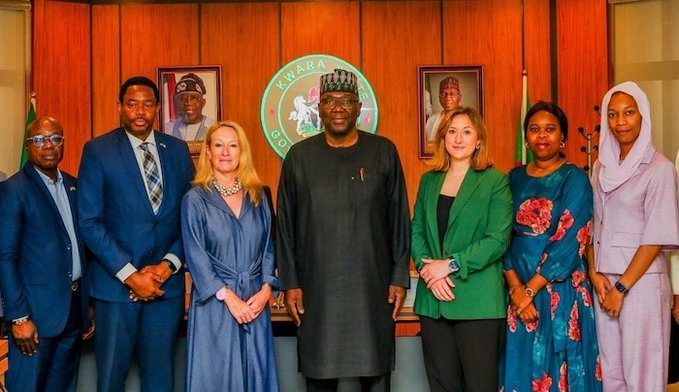
ILORIN — In an official diplomatic declaration ahead of Nigeria’s upcoming political cycle, the British Government has reaffirmed its strict neutrality regarding the 2027 general elections. The British Deputy High Commissioner to Nigeria, Gill Lever, explicitly stated that Downing Street does not possess a preferred political party, ideological platform, or presidential candidate, emphasizing that the United Kingdom will firmly resist any form of domestic political interference.
Lever made these remarks during a high-profile courtesy visit to the Kwara State Government House in Ilorin, where she met with the Executive Governor of Kwara State and Chairman of the Nigeria Governors’ Forum (NGF), Mallam AbdulRahman AbdulRazaq. The visit formed part of a comprehensive three-day working tour of the North-Central state aimed at strengthening bilateral trade, educational partnerships, and regional security cooperation.
The Economic Imperative of Credible Balloting
Addressing state executives and diplomatic correspondents, Lever emphasized that the UK’s primary institutional interest lies solely in the structural integrity, inclusivity, and peaceful execution of the electoral process. She tied the success of Nigeria's democratic landscape directly to its macroeconomic stability and capacity to attract long-term foreign direct investment.
"The British Government, as you’ll understand, Excellency, is entirely neutral," Lever stated directly to Governor AbdulRazaq. "We do not favor one party or another, and we would never be in the business of telling Nigerian people how to vote. But peaceful and credible elections, of course, are not only a democratic objective. This is not only about the Commonwealth values and the values of democracy that we’ve long shared; they’re also an economic objective or imperative as well."
The envoy further noted that a transparent electoral cycle reinforces global investor confidence, safeguards property rights, and stabilizes market dynamics. She stressed that the UK remains committed to supporting Nigeria's independent electoral bodies through technical assistance and institutional capacity building, ensuring ample space for youth, women, and marginalized communities to participate safely in the democratic process.
Countering the Opposition: AbdulRazaq Defends His Track Record
Responding to the British diplomatic team, Governor AbdulRazaq utilized the platform to present a rigorous defense of his administration's performance since taking office. Deflecting recent criticisms from regional opposition elements, the NGF Chairman detailed the extensive structural deficits his team inherited in 2019 and contrasted them with the state's current fiscal health.
"When we came in 2019, things just weren’t working in the state," AbdulRazaq stated plainly. "We met staggering backlogs of pensions and gratuities, a civil service demoralized by the payment of half-salaries, and a complete institutional blacklist of Kwara State by the Universal Basic Education Commission (UBEC) due to the misappropriation of funds by previous administrations."
The Governor highlighted several critical milestones achieved through his administration's sustained policy interventions:
-
Educational Infrastructure: Kwara has fully paid its counterpart funding to UBEC, reversing its blacklisted status and enabling mass rehabilitation of basic schools. This reversed a dismal 2019 metric where 99% of public schools lacked functional Water, Sanitation, and Hygiene (WASH) facilities and proper boundary fencing.
-
Healthcare Expansion: By the conclusion of his second constitutional term in 2027, Kwara State is on track to establish five fully functional teaching hospitals, drastically bridging the medical manpower shortage and halting rural brain drain.
-
Higher Education: Access to tertiary learning has been decentralized with the successful completion and operationalization of two new campuses for the Kwara State University (KWASU) in both the Kwara North and Kwara South senatorial districts.
Wage Reforms and Agrarian Industrialization
On workers' welfare and macroeconomic coping strategies, AbdulRazaq dropped a significant policy announcement, revealing that the state government is currently finalizing plans to increase the provincial minimum wage to N100,000 later this year to insulate the public workforce from inflationary pressures.
The Governor also detailed how Kwara is aligning with federal agricultural directives championed by President Bola Ahmed Tinubu to achieve sustainable food security. He pointed to the upcoming commissioning of a massive Shea processing factory in Kaiama. Once fully operational, the industrial facility will rank as the second-largest Shea processing hub in the entire West African sub-region, creating thousands of direct rural livelihoods and generating valuable foreign exchange through agro-aligned exports.
The strategic meeting concluded with bilateral discussions on rural security frameworks, with Lever’s delegation later meeting with the Kwara State First Lady, Amb. Dr. Olufolake AbdulRazaq, to evaluate ongoing state-sponsored social empowerment, healthcare advocacy, and gender-inclusion initiatives.