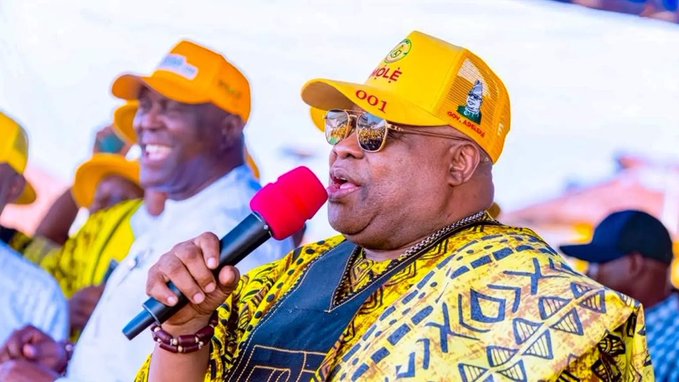
The Independent National Electoral Commission (INEC) has officially declared the incumbent Governor of Osun State, Ademola Adeleke, the winner of the 2026 gubernatorial election. Returning Officer Joshua Ogunwole formally announced the final figures at the INEC State Collation Centre in Osogbo early Sunday morning following the continuous aggregation of certified returns from all thirty local government areas.
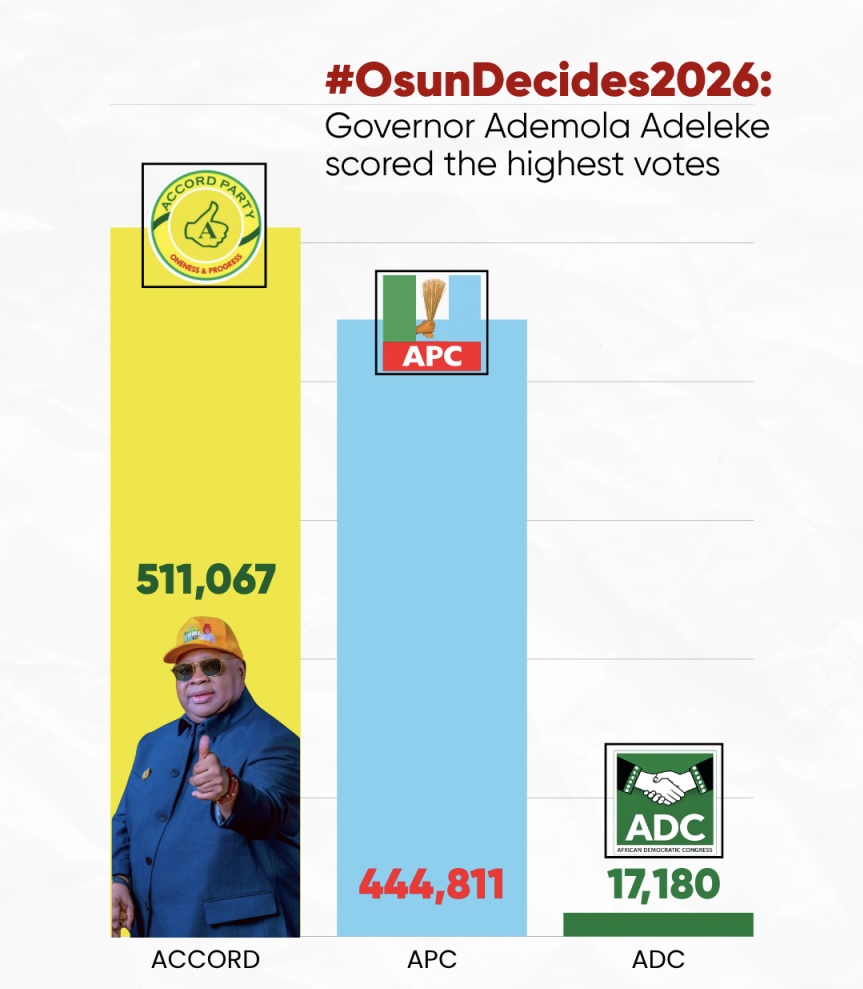
Contesting on the platform of the Accord Party, Adeleke secured a decisive victory by polling 511,067 votes statewide. He defeated his primary challenger, Bola Oyebamiji of the All Progressives Congress, who garnered 444,815 votes, representing a winning margin of 66,252 votes. Najeem Salaam of the African Democratic Congress finished in a distant third position with 17,180 votes. The official declaration grants Adeleke a second four-year mandate to steer the executive affairs of the state through 2030.
INEC declares Accord’s Ademola Adeleke winner of governorship election
Complete Electoral Breakdown and Voting Distribution
Official voter participation metrics released by the electoral commission reveal that out of 2,339,544 total registered voters across Osun State, 1,010,684 voters were accredited to cast their ballots. Total votes cast reached 1,005,800, with 985,079 recorded as valid votes while 20,721 ballots were rejected for procedural irregularities.
Adeleke achieved broad geographical dominance by winning 19 of the 30 local government areas, whereas Oyebamiji prevailed in the remaining 11 local government areas. The Accord Party candidate established massive leads in his traditional political strongholds within the Ede federal constituency, securing 35,427 votes in Ede North against the APC's 10,283, and gathering 26,188 votes in Ede South compared to Oyebamiji's 6,219. Adeleke also claimed victory in Osogbo, the state capital, polling 36,480 votes against the APC's 30,474.
The Accord candidate maintained solid leads across several key population hubs, winning Ife East with 27,201 votes against 18,600, Iwo with 27,085 votes against 19,660, Egbedore with 19,278 votes against 11,194, and Oriade with 21,343 votes against 14,863. Additional victories for Adeleke were recorded across Boluwaduro, Ife North, Ilesa West, Ifedayo, Ife Central, Orolu, Odo-Otin, Ifelodun, Ila, Aiyedire, Aiyedaade, and Ejigbo.
Conversely, the All Progressives Congress performed strongly across its traditional bases in the Ijesa and Irewole zones. Oyebamiji recorded his highest single-LGA victory in Irewole, polling 29,972 votes against Adeleke's 10,934. The APC candidate also secured narrow and decisive margins across Boripe with 19,963 votes to 12,448, Ilesa East with 16,208 votes to 12,280, Obokun with 16,120 votes to 12,023, and Olorunda with 24,671 votes to 23,514. Further victories for the APC were achieved in Irepodun, Atakunmosa West, Atakunmosa East, Isokan, Ola-Oluwa, and Ife South.
A Remarkable Political Realignment
The 2026 victory marks a historical precedent in Nigerian political history, demonstrating unprecedented party fluidity at the state level. Adeleke originally assumed executive office following the 2022 governorship election, where he contested under the banner of the Peoples Democratic Party and successfully defeated the then-incumbent APC governor, Gboyega Oyetola.
However, internal party realignments and structural disputes led Adeleke to defect from the PDP prior to the 2026 cycle. Choosing to seek re-election under the Accord Party, Adeleke built a broad cross-party coalition that successfully transferred his personal voter base to a previously minor party structure. His ability to secure over half a million votes on a newly adopted platform underscores the growing influence of personality-driven politics and localized patronage networks over rigid party loyalty in regional Nigerian elections.
Deciphering Accreditation Metrics and Rejected Ballots
To understand the legal validity of the election outcome, observers must analyze the administrative relationship between voter accreditation and ballot processing under the Electoral Act. Accredited voters refers to the exact count of individuals whose identities were successfully verified at polling units using the Bimodal Voter Accreditation System before receiving official ballot papers.
In this election, 1,010,684 voters were successfully accredited out of more than 2.3 million registered citizens, representing an effective voter turnout rate of approximately 43.2 percent among registered voters. The recording of 20,721 rejected ballots—representing roughly 2.06 percent of total votes cast—indicates instances where markings were unclear, crossed multiple party logos, or lacked official security stamps. Because total valid votes (985,079) combined with rejected ballots equal total votes cast (1,005,800), and remain strictly below the total accredited voter count, the returns satisfy fundamental statutory checks against over-voting.
National Implications Ahead of General Elections
The conclusion of the Osun State election carries far-reaching political and economic ramifications across Nigeria. As the final off-cycle gubernatorial poll prior to the 2027 general elections, the result provides crucial data regarding voter behavior, party mobilization efficiency, and institutional performance.
From a national political standpoint, the APC's inability to reclaim Osun State highlights persistent competitive dynamics within the South-West geopolitical zone. For the federal government and opposition movements alike, the outcome signals that incumbent executive power at the central level does not automatically guarantee regional electoral success without localized popular support.
Economically, the peaceful declaration of results and public acceptance of the outcome prevent prolonged civil disruptions that historically accompany disputed elections. Maintaining political stability in Osun State protects commercial activities, reassures small business owners in urban trading centers like Osogbo and Ilesa, and ensures the uninterrupted execution of state infrastructural projects and public sector expenditures.
Legal Next Steps and Final Administrative Closure
With the official declaration completed by Returning Officer Joshua Ogunwole, the Independent National Electoral Commission has formally concluded its administrative responsibilities regarding the 2026 Osun governorship election. The commission is scheduled to issue an official Certificate of Return to Governor Ademola Adeleke within the statutory timeframe mandated by law.
Under the provisions of the Nigerian Constitution and the Electoral Act, aggrieved candidates and political parties retain the legal right to challenge the election results before the Election Petition Tribunal within 21 days of the declaration. While Bola Oyebamiji and the All Progressives Congress have not yet formally declared an intention to contest the outcome, legal teams from major parties routinely audit polling unit result sheets (Form EC8A) and digital uploads on the IReV portal to evaluate potential grounds for legal petitions. Unless overturned by judicial tribunals, Adeleke’s victory solidifies his political leadership over Osun State for the next four years.