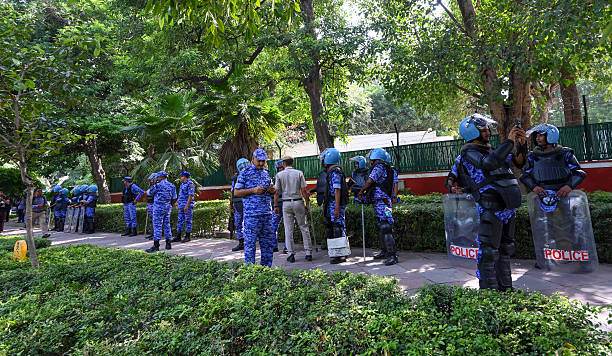
New Delhi has been placed under heavy security as authorities prepare for another day of protests led by the youth-driven Cockroach Janta Party (CJP), with thousands of police and paramilitary personnel deployed across the Indian capital.
The demonstrations are centred on demands for the resignation of Chief Election Commissioner Gyanesh Kumar over allegations surrounding the revision of India's electoral rolls. The Election Commission and India's ruling Bharatiya Janata Party (BJP) have rejected allegations of wrongdoing.
More than 25,000 police and paramilitary personnel were deployed during the initial crackdown, while reports on Sunday indicated that the security presence had increased to more than 30,000 personnel as authorities prepared for further demonstrations.
Thousands Detained in Delhi
The heavy security operation follows Saturday's mass protest attempt in central Delhi.
Police detained more than 2,000 people on Saturday as authorities attempted to prevent demonstrators from reaching Jantar Mantar, where the CJP had planned to hold a major rally. Most of those detained were later released, according to police.
Roads were barricaded, checkpoints were established and security forces were deployed at key entry points into central Delhi.
Authorities also temporarily shut dozens of Metro stations and restricted mobile internet services in parts of the city. The measures were intended to prevent large crowds from gathering at the protest site. Metro services and mobile internet access were restored as the second day of protests approached.
‘Cockroach’ Movement Leaders Released
The crackdown also targeted senior figures in the youth movement.
CJP founder Abhijeet Dipke and fellow leaders Saurav Das and Ashutosh Ranka were detained after arriving in Delhi on Saturday. A court later ordered their release, with the leaders required to maintain public peace for a specified period.
Following his release, Dipke said the movement would continue its protests.
The CJP has emerged as a significant youth-led protest movement in India, organising demonstrations around employment, education and political issues. The movement has now made electoral reform and the resignation of the chief election commissioner a central part of its campaign.
What Is the Protest About?
The immediate dispute concerns India's Special Intensive Revision (SIR) of voter lists.
Critics say the process has resulted in millions of names being removed from electoral rolls and allege that the deletions could disproportionately affect certain groups of voters.
Opposition parties and CJP supporters are demanding the resignation of Chief Election Commissioner Gyanesh Kumar, who oversaw the electoral-roll revision.
The Election Commission has denied wrongdoing, saying names were removed for legitimate reasons including deaths, relocation and records that could not be verified. The BJP has also rejected allegations that the exercise was designed to influence elections.
The dispute has become particularly significant with important state elections approaching.
Delhi Turned Into a Security Zone
The security measures have significantly disrupted normal life in parts of the capital.
Police checkpoints have been established around major roads leading into central Delhi, while barricades have been placed around areas close to Jantar Mantar.
During Saturday's operation, authorities also used buses to transport detained protesters to temporary detention facilities.
More than 6,000 people were reportedly detained during the wider crackdown according to accounts cited by The Guardian, although police later reported that more than 2,000 people were detained on Saturday. Different figures have therefore been reported depending on the period and definition of detention.
Businesses, transport operators and residents have also faced restrictions as authorities attempt to prevent protesters from reaching central Delhi.
Protests Continue Despite Crackdown
Despite the extensive security operation, small demonstrations continued in Delhi and other Indian cities.
Reuters reported that protesters gathered in parts of Delhi on Sunday, while smaller demonstrations were also reported in Mumbai, Kolkata, Panaji and Pune. Police detained some demonstrators as the protests continued.
The CJP has maintained that the crackdown will not end its campaign.
Dipke said after his release that the movement would continue taking to the streets, despite the conditions imposed on those released from detention.
UN Raises Concerns Over Detentions
The crackdown has also attracted international attention.
The United Nations human rights office expressed concern over reports of mass detentions involving protesters, organisers, civil society members, lawyers and journalists, and called on Indian authorities to respect the right to peaceful assembly.
India rejected those concerns, describing the UN body's intervention as unwarranted interference in the country's internal affairs.
India's Ministry of External Affairs said the country's constitution protects peaceful assembly while allowing reasonable restrictions for public order and safety.
More Protests Expected
Delhi remains on high alert as the CJP and allied student groups indicate that their campaign will continue.
The release of the movement's senior leaders has removed one immediate point of tension, but authorities continue to maintain a substantial security presence across the capital.
The demonstrations have developed into a wider confrontation over electoral reforms, voter-list revisions and the right to protest, with the government and Election Commission rejecting accusations of manipulating the electoral process.
As thousands of security personnel remain deployed, the coming days will determine whether the movement can sustain large-scale demonstrations despite the restrictions imposed by authorities.