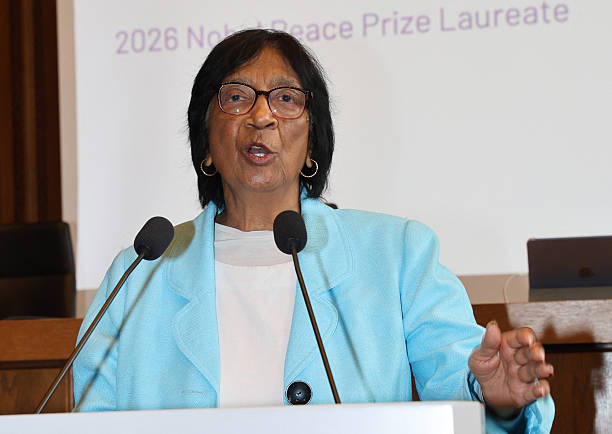
South African jurist and veteran human rights advocate Navi Pillay has won the 2026 Nobel Peace Prize for her efforts to promote peace, strengthen international law and ensure accountability for war crimes, crimes against humanity and genocide.
The Norwegian Nobel Committee announced the award on Friday, October 9, recognising Pillay's decades-long career defending human rights and advancing international justice through national and international courts.
The 85-year-old jurist has served as a judge at several international tribunals, led the United Nations' human rights office and worked on cases involving some of the world's most serious human rights violations.
The committee said her career demonstrates the importance of legal institutions in preventing violence and resolving international conflicts peacefully.
Nobel Committee Highlights Pillay's Contribution to International Justice
Announcing the award in Oslo, the Norwegian Nobel Committee said Pillay had played an important role in expanding the reach of international law and strengthening institutions responsible for prosecuting serious crimes.
The committee highlighted her work at the International Criminal Tribunal for Rwanda, where she contributed to landmark legal developments recognising that rape and sexual violence can constitute crimes against humanity and genocide.
It also praised her efforts to establish accountability for individuals responsible for mass atrocities and violations of human rights.
The committee said international law was facing significant pressure, warning that growing reliance on political and military power at the expense of legal frameworks threatened global stability and peaceful coexistence.
The award places renewed attention on Pillay's long-standing argument that international law must apply consistently, regardless of the political influence or power of the individuals and governments involved.
From Apartheid-Era South Africa to International Courts
Born in Durban, South Africa, in 1941 to a family of Indian Tamil origin, Pillay began her legal career during apartheid, when racial discrimination was embedded in the country's political and legal systems.
She became a pioneering lawyer, defending anti-apartheid activists and challenging discriminatory practices at a time when non-white South Africans faced significant restrictions.
Her early legal work included defending activists associated with the movement against apartheid, including individuals connected to Nelson Mandela.
In 1995, Pillay became the first non-white woman appointed to South Africa's High Court, marking a significant milestone in the country's legal history.
She subsequently moved into international judicial work, serving at the International Criminal Tribunal for Rwanda from 1999 to 2003. She later became a judge at the International Criminal Court, where she served from 2003 to 2008.
Her work across these institutions helped establish her reputation as a leading figure in international criminal justice.
Role in the Rwanda Genocide Tribunal
One of the most significant chapters of Pillay's career was her service at the International Criminal Tribunal for Rwanda, established to prosecute those responsible for the 1994 genocide.
The tribunal helped develop international criminal law through prosecutions involving genocide, sexual violence and incitement to mass violence.
Pillay played an important role in the landmark case against Jean-Paul Akayesu, a former Rwandan mayor convicted of genocide and crimes against humanity.
The case was historically significant because it helped establish that rape and sexual violence could constitute acts of genocide when committed with the required intent to destroy a protected group.
The Nobel Committee highlighted this contribution as an important development in the recognition and prosecution of sexual violence under international law.
The legal principles developed through such cases have since influenced international efforts to investigate and prosecute atrocities committed during armed conflicts.
Former UN Human Rights Chief
Pillay served as the United Nations High Commissioner for Human Rights from September 2008 until August 2014.
During her tenure, she worked on issues involving discrimination, freedom of expression, armed conflict, political repression and the protection of vulnerable populations.
The position placed her at the centre of international debates over human rights obligations and the responsibility of governments to protect their citizens.
Her work frequently involved responding to allegations of serious abuses while navigating disagreements between governments and international institutions.
After leaving the role, Pillay continued to participate in international legal and human rights initiatives.
She currently serves as an ad hoc judge at the International Court of Justice in a case concerning allegations of genocide against Myanmar over its treatment of the Rohingya minority.
The International Court of Justice and the International Criminal Court are separate institutions: the former principally resolves legal disputes between states, while the latter prosecutes individuals accused of certain international crimes.
Gaza Inquiry Brings Renewed International Attention
Pillay has also attracted international attention for her work investigating the conflict in the occupied Palestinian territory.
She chaired the UN Independent International Commission of Inquiry on the Occupied Palestinian Territory, which concluded in a report published in 2025 that Israel had committed genocide in Gaza.
Israel rejected the commission's findings and disputed its conclusions.
The issue has become a major point of contention in international diplomacy, with governments and legal experts expressing differing views over the interpretation of evidence and the application of international law.
The Nobel Committee's announcement focused on Pillay's broader career and efforts to strengthen international justice, rather than making a separate determination about the findings of the Gaza inquiry.
Israel's Foreign Ministry criticised the decision to award Pillay the Nobel Peace Prize, accusing her of bias in relation to the commission's work. The criticism illustrates the political controversy surrounding some of the international legal investigations in which she has been involved.
The Nobel award does not itself determine the legal status of the allegations against Israel.
South Africa Celebrates a Historic Achievement
South African President Cyril Ramaphosa congratulated Pillay following the announcement, describing the recognition as a tribute to her lifelong commitment to justice, human dignity and peace.
The South African government said her achievements reflect the contribution of South Africans to international efforts to advance human rights and strengthen the rule of law.
Pillay joins a group of South Africans who have received the Nobel Peace Prize, including Albert Luthuli, Desmond Tutu, Nelson Mandela and F.W. de Klerk.
Her award also brings attention to the country's history of resistance to apartheid and the role played by lawyers and human rights advocates in challenging institutionalised discrimination.
Pillay Dedicates Award to Survivors of International Crimes
Following the announcement, Pillay dedicated the recognition to survivors of international crimes and those working to uphold international criminal justice.
She said she intended to continue supporting the principles underpinning the Nuremberg trials, which helped establish modern frameworks for prosecuting individuals responsible for atrocities and other serious violations of international law.
Pillay received the news while attending a legal forum in Nuremberg, Germany, a city closely associated with the post-Second World War trials of Nazi leaders.
She described the award as a surprise and questioned the idea that defending the law should require extraordinary courage, arguing that judges must examine the evidence and apply legal principles impartially.
Her comments reinforced the central theme of the Nobel Committee's decision: the importance of independent legal institutions in holding powerful individuals and governments accountable.
A Message About the Future of International Law
Pillay's Nobel Peace Prize comes amid growing international debate over the authority of global courts and the willingness of powerful states to accept their decisions.
The Nobel Committee said the award was intended to highlight the importance of defending international law at a time when institutions responsible for justice and accountability face mounting pressure.
Her career spans more than five decades, from challenging apartheid-era discrimination in South Africa to serving on international courts dealing with genocide and other grave crimes.
For supporters of international justice, the award recognises the role of legal institutions in protecting human rights and helping prevent future atrocities.
It also places a spotlight on continuing disagreements over how international law should be interpreted and enforced, particularly in conflicts involving powerful states and politically sensitive allegations.
Pillay's recognition underscores the Nobel Committee's position that lasting peace requires more than political agreements: it also depends on accountability, respect for legal obligations and the protection of human dignity.