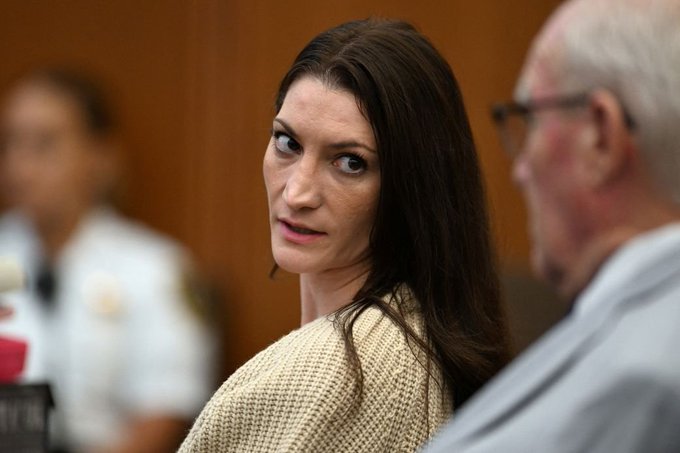
Jurors in the high-profile murder trial of Massachusetts mother Lindsay Clancy have spoken publicly for the first time about the emotional and increasingly difficult deliberations that ended without a verdict.
Three female jurors, including the jury foreperson, told NBC that the panel had been close to reaching a verdict finding Clancy not guilty by reason of insanity before a lone male juror refused to agree.
The revelations provide new insight into the final days of a case that lasted nearly six weeks and focused heavily on Clancy's mental health at the time she killed her three young children in January 2023.
Jurors describe an “emotional rollercoaster”
The jury consisted of nine women and three men. After the trial ended in a mistrial, three of the female jurors agreed to discuss what happened during deliberations.
The foreperson, a retired fifth-grade teacher, described the experience as an “emotional roller coaster” and said the deliberations involved intense emotions, including crying, arguments, tears and hugs.
She said the jury was deeply affected by the case and that she was heartbroken when the panel could not reach a unanimous decision.
The jurors said they had been close to completing the verdict forms when the holdout juror refused to agree to an insanity-based acquittal.
According to the foreperson, the man acknowledged that he had reasonable doubt about Clancy's criminal responsibility but nevertheless said he would not vote to find her not guilty by reason of insanity.
That disagreement ultimately prevented the 12-person jury from reaching the unanimous verdict required under Massachusetts law.
The case was not about whether Clancy killed her children
One of the most important points raised by the jurors was that they were not debating whether Clancy was responsible for the physical acts that killed her children.
Clancy has admitted to killing her three children.
Instead, the central legal question was whether she was criminally responsible at the time because of her mental state.
Her defense argued that she was suffering from severe postpartum psychosis and other serious mental-health problems and therefore could not understand right from wrong when she killed her children.
Prosecutors presented a different interpretation, arguing that Clancy had deliberately planned the killings and understood the nature and wrongfulness of her actions.
The foreperson explained that the jurors were essentially trying to determine whether Clancy knew right from wrong when the killings occurred.
Under Massachusetts law, the defense did not have to prove Clancy's mental illness. Prosecutors had to establish beyond a reasonable doubt that she was criminally responsible at the time of the killings.
Holdout juror became central to deliberations
The disagreement became increasingly serious as the jury spent almost 40 hours deliberating over seven days.
At one point, the jury informed the judge that one member was not following the court's instructions concerning reasonable doubt.
Clancy's defense team asked Judge William Sullivan to remove the juror, but the request was rejected.
The Massachusetts Supreme Judicial Court also declined to intervene, leaving the original jury in place.
The jurors ultimately remained deadlocked, leading Judge Sullivan to declare a mistrial on September 4.
The three women who spoke publicly said the disagreement was not simply a difference of opinion over one piece of evidence.
They described arguments and shouting during deliberations, with some of the conflict reportedly audible outside the jury room.
Medication became another point of disagreement
One of the jurors who spoke to NBC, a government defence contractor, said the holdout juror had questions about the medication Clancy was taking.
The juror said the panel had access to toxicology evidence showing the levels of medications in Clancy's system.
She also said nurses on the jury discussed the medical information but believed the holdout juror did not accept what they were explaining.
The comments highlight how complicated the medical evidence became during the trial.
Clancy's defense argued that her deteriorating mental health was connected to postpartum psychosis and medication issues. The prosecution, however, argued that her actions demonstrated planning and awareness rather than a complete break from reality.
Juror criticises prosecution's approach
Another juror, who works as a chef at a senior centre, was also critical of the prosecution's presentation.
She described prosecutors as “very, very harsh” toward Clancy and said she felt the prosecution had not adequately presented evidence portraying Clancy as a bad mother.
The jurors said they were persuaded by evidence and testimony indicating that Clancy had loved her children.
The foreperson said the evidence led her to believe that Clancy had suffered a severe mental breakdown rather than knowingly committing the killings while understanding right from wrong.
However, the prosecution's case was built around the argument that Clancy had made a calculated decision.
Prosecutors called numerous witnesses, including medical experts, as they attempted to establish that Clancy understood what she was doing and that her actions were deliberate.
A tragic case that divided the courtroom
The case has attracted national attention because of the circumstances surrounding the deaths of Clancy's children and the central question of mental illness and criminal responsibility.
Clancy was accused of killing her three children — Cora, Dawson and Callan — at the family's Massachusetts home in January 2023.
After the killings, Clancy attempted suicide and survived with serious injuries that left her partially paralysed.
Her defense maintained that her mental health had deteriorated severely in the period leading up to the deaths.
The prosecution, meanwhile, sought to show that the killings were intentional and that Clancy remained capable of understanding the consequences of her actions.
The disagreement over those competing interpretations ultimately became the central issue for the jury.
Why the mistrial happened
A mistrial does not mean Clancy was acquitted.
It means the jury could not reach the unanimous verdict required to resolve the criminal case.
After multiple indications that the jury was deadlocked, Judge Sullivan eventually ended the trial.
The decision left prosecutors with the option of pursuing a new trial with a new jury.
Clancy's lawyer, Kevin Reddington, has said he hopes to reach an agreement with prosecutors instead of forcing Clancy and the families involved through another trial.
The three jurors who spoke to NBC said they also hoped the case would not have to go through another trial.
However, they said that if a retrial takes place, they intend to attend in support of Clancy.
What happens next for Lindsay Clancy?
The case remains unresolved.
Prosecutors must now decide whether to retry Clancy before a new jury. A further court hearing is scheduled for September 29, when the next steps in the case can be considered.
Clancy remains in a psychiatric facility while the legal process continues.
A retrial could revisit much of the evidence presented during the first proceeding, including testimony about Clancy's mental health, medications, postpartum psychosis and her actions before and after the children's deaths.
The mistrial also leaves open a difficult question that the first jury could not unanimously answer: whether Clancy should be held criminally responsible for her actions or whether her mental state at the time meant she was not legally responsible.
For the families involved, the possibility of another trial could mean revisiting one of the most painful periods of their lives.
For the legal system, the case presents another examination of the difficult boundary between severe mental illness and criminal responsibility.
For now, there is no final verdict in the Lindsay Clancy case.