The Independent National Electoral Commission has officially initiated the electronic transmission of polling unit results from the ongoing Osun State governorship election to its public digital repository. In a rapid demonstration of technological processing, real-time data monitoring confirmed that the commission successfully uploaded nearly 77 percent of total expected polling unit results to the INEC Result Viewing portal within hours of ballot counting. The systematic upload marks a pivotal moment for public verification as collation officers across all thirty local government areas process election returns to determine the next executive head of the state.
Systematic auditing of the electronic transmission platform revealed that 2,897 polling unit result sheets out of the expected 3,763 had been fully scanned, uploaded, and made accessible to the public. The pace of digital uploads accelerated sharply during the evening hours, rising from 2,266 uploads—representing approximately 60.22 percent of polling stations—to over 76.99 percent within a single hour. The continuous arrival of fresh documentation from remote and urban centers alike highlights the operational capacity of the electronic transmission infrastructure during high-stakes off-cycle elections.
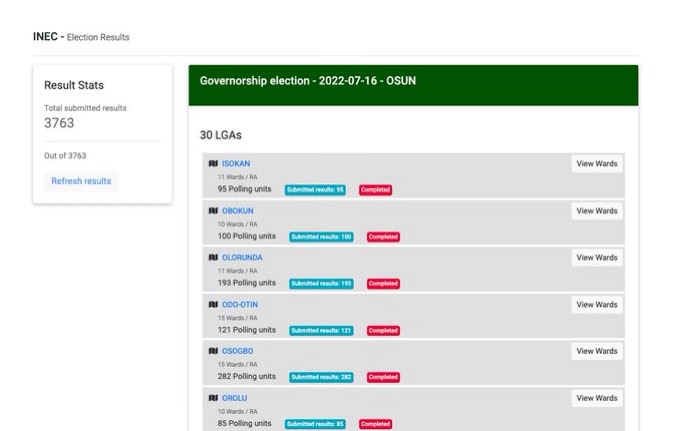
Dynamic Real-Time Transmission and High-Stakes Political Contest
The electoral contest centers on a fierce competition between major political figures, led by incumbent Governor Ademola Adeleke of the Accord Party, who is seeking a second term in office. Challenging the incumbent is Bola Oyebamiji, representing the All Progressives Congress, alongside Najeem Salaam of the African Democratic Congress and twelve other candidates. Because Osun State serves as the final governorship contest prior to nationwide general elections, national political stakeholders, election observation missions, and civil society coalitions are keeping a vigilant watch on the transmission portal to ensure absolute procedural integrity.
As the digital data updates continuously, the portal reflects precise timestamp logs for every arriving image. Among the latest submissions captured during peak collation was an entry logged from polling unit 29/08/08/001 located in Ife North Local Government Area. The automated platform allows accredited party agents, media organizations, and individual citizens to refresh the interface continuously, ensuring that physical counts generated at local polling booths mirror the public database without manual interference.
Understanding the Bimodal System and Electronic Form EC8A
To fully comprehend how modern Nigerian elections maintain verifiable records, it is necessary to examine the administrative workflow connecting physical polling stations to digital servers. The foundational document of Nigerian election counting is Form EC8A, the official paper record on which presiding election officers manually record the total registered voters, accredited voters, valid votes, rejected ballots, and scores earned by each political party at a single polling booth.
Once polling officers, party agents, and security officials sign the physical Form EC8A, officials utilize the Bimodal Voter Accreditation System (BVAS) device to capture a high-resolution digital photograph of the signed document. The device then encrypts and transmits this image file directly to the INEC Result Viewing (IReV) portal. The IReV system does not perform automated tallying or calculate final state totals; instead, it serves as a secure public archive where stakeholders can independently audit scanned copies of original result sheets against the manual tabulations presented at ward, local government, and state collation headquarters.
Evolution: From Manual Collations to Digital Audit Trails
The adoption of real-time electronic result publishing represents the culmination of prolonged legislative reforms aimed at eliminating historic vulnerabilities in electoral administration. Historically, the collation phase—during which physical paper results were transported manually from isolated rural polling units to regional headquarters—was identified by electoral experts as the most vulnerable point for unauthorized alteration, ballot snatching, or numerical discrepancies.
Following statutory changes codified in the Electoral Act of 2022, the commission made electronic image transmission mandatory for all major elections. The introduction of this framework during previous gubernatorial cycles established a digital audit trail that allows election tribunals and monitoring teams to cross-examine physical declarations against cloud-stored evidence. The implementation in Osun State demonstrates how digital documentation serves as an essential safeguard against administrative delays and non-transparent collation procedures.
Popular Culture Influence and Public Vigilance Drive Citizen Engagement
The real-time transmission process gained significant momentum following active public advocacy by high-profile cultural figures and civil society leaders. International Afrobeats artist David Adeleke, popularly known as Davido, engaged his massive digital audience throughout the afternoon to demand immediate adherence to electronic upload protocols. Expressing concern over initial waiting periods following the official 2:30pm close of voting, the musical star issued direct appeals urging electoral officials to update the platform without operational lags.
Public mobilization strategies extended beyond passive observation, as citizens were advised to remain present at their respective polling centers until officers uploaded official result sheets in their direct view. Voters were instructed to photograph physical Form EC8A documents, double-check numerical figures against uploaded files, and transmit backup copies through public verification channels. This widespread civic monitoring created an unprecedented level of local accountability, reinforcing the principle that physical polling unit outcomes must align perfectly with centralized electronic databases.
National Repercussions for Electoral Trust and Institutional Credibility
The successful execution of real-time result uploads holds profound systemic significance for democratic stability and public trust across the nation. Off-cycle elections serve as operational proving grounds where statutory bodies test technical hardware, server bandwidth capacities, and staff readiness under real-world conditions. Demonstrating that thousands of polling unit documents can be uploaded seamlessly within hours rebuilds citizen confidence in democratic institutions ahead of future national electoral cycles.
From a broader social perspective, rapid electronic transparency drastically minimizes political tension and mitigates speculative misinformation. When authentic polling unit records are instantly accessible to political parties, journalists, and international observation missions, the opportunity for unverified rumors to trigger civil unrest is substantially reduced. The Osun State election demonstrates that technological reliability combined with an engaged populace provides a robust defense against electoral irregularities, setting a high benchmark for transparent governance across the region.