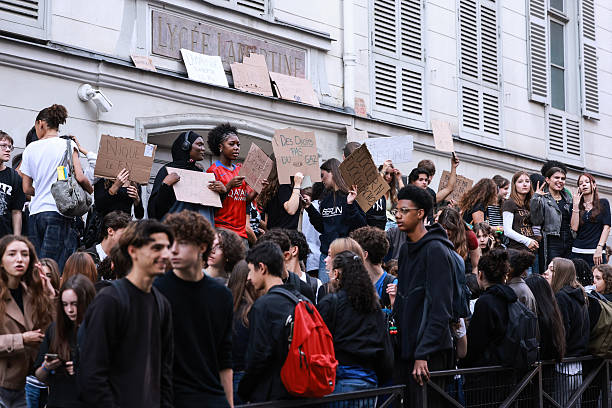
France’s nationwide high-school student protest movement has escalated into violent clashes in several parts of the country, with Paris police chief Patrice Faure warning that the demonstrations have moved beyond the control of those who initially organised them.
Faure made the warning on Saturday, October 3, as authorities prepared for another national day of demonstrations planned for Tuesday. He urged students to abandon school blockades and violence and return to peaceful forms of protest, while warning that police would respond firmly to vandalism and attacks.
The protests began around schools in the Paris region before spreading to cities and towns across France. Students have been demonstrating over teacher shortages, overcrowded classrooms, inadequate school resources, poor infrastructure and demanding better learning conditions.
The unrest has increasingly become a challenge for President Emmanuel Macron’s government, which is under pressure to address students’ grievances while containing the violence that has accompanied parts of the movement.
Thousands arrested as protests spread
According to figures cited by Reuters, around 5,000 people, most of them teenagers, had been arrested nationwide since Monday as of Saturday.
More than 600 police officers had also been injured, according to national police spokesperson Agathe Foucault, who spoke to RTL radio.
Teachers and members of the public have also been attacked during the unrest, while damage to property has been estimated in the tens of millions of euros.
The scale of the disruption has grown rapidly. More than 1,000 high schools were affected by strikes or protests on Thursday, according to figures reported by Le Monde, with more than 200 blockades recorded.
The demonstrations have included school occupations and blockades, fires, vandalism and clashes between young protesters and police. In some locations, officers have used tear gas and other crowd-control measures to disperse demonstrators.
Authorities have also reported injuries among students and education workers. The use of force against young protesters has become a source of controversy, particularly after reports of students suffering serious eye injuries during confrontations with police.
Police chief calls for return to peaceful protests
Faure addressed the situation in an open letter published on X ahead of Tuesday’s planned demonstrations.
The Paris police chief said the people who launched the protest movement no longer appeared to be in control of it. He called on students to stop school blockades and unrest and return to peaceful methods of demonstrating.
“Demonstrating is a right. Violence is not,” Faure said, according to reports of his statement.
He also called on parents to help prevent their children from becoming involved with people he described as “professional rioters” and their supporters.
Faure’s intervention comes as security officials prepare for another potentially tense round of demonstrations in Paris and other French cities.
Student unions have called for a national day of action on Tuesday, raising concerns among authorities that the unrest could intensify.
Security officials have also expressed concern that far-left anarchist groups could attempt to take advantage of the demonstrations, although the protest movement itself includes students with a range of grievances and motivations.
What are French students protesting about?
Despite the violence surrounding some demonstrations, the movement began with concerns about conditions in French schools.
Students have complained about teacher shortages, overcrowded classrooms, long school days, staff absences and deteriorating school buildings.
Some students have also raised concerns about the pressure associated with France’s education system and the uncertainty surrounding their future after secondary school.
The protests initially emerged in schools in disadvantaged areas around Paris, where students said they faced particularly difficult learning conditions.
Reuters reported the example of a 17-year-old student in Aubervilliers who said she had taken a French examination the previous year without having a French teacher. She argued that teachers have an important influence on students’ education and that the conditions were inadequate.
The concerns have since spread beyond poorer Paris suburbs.
Students at schools in cities including Lille and Lyon have raised similar complaints about overcrowding, teacher shortages and infrastructure. Some have also expressed broader anxieties about their future, including employment prospects and the impact of artificial intelligence on jobs.
More than 400 schools affected by disruption
The unrest has caused substantial disruption to France’s education system.
Some schools have been forced to close or move classes online because buildings have been damaged or blockades have made it unsafe or impossible for students to attend.
Euronews reported that around 400 establishments were facing closure or disruption amid the protests.
The Education Ministry has also been monitoring the number of affected schools as the movement has expanded.
The disruption has placed school administrators and teachers in a difficult position. Some educators have expressed sympathy with students’ complaints about educational conditions while condemning the violence.
One teachers’ union leader, Sophie Vénétitay of SNES-FSU, said some student demands were shared by teachers but described the violent elements of the movement as unacceptable.
Government faces pressure over education funding
The protests have created another political challenge for Macron’s government at a time when it is already dealing with financial and political pressures.
The government has argued that students may have legitimate grievances but has maintained that violence and attacks on public property cannot be accepted.
The Interior Ministry has described the deteriorating situation in some areas as resembling urban violence rather than simply a student protest movement. Prime Minister Sébastien Lecornu has also held crisis discussions as the unrest intensified.
Education Minister Edouard Geffray has indicated that the government needs to listen to students’ concerns. Authorities have announced plans for consultation with students, teachers, unions and parents.
However, the government’s response has increasingly focused on restoring order as confrontations have escalated.
Concerns over police response
The growing police presence has itself become part of the controversy.
As demonstrations have spread from school entrances onto public streets, police interventions have increased. In some cases, officers have used tear gas and other crowd-control measures.
French media have reported several cases in which teenagers suffered serious injuries during the unrest, prompting questions about the proportionality of police tactics.
Le Monde reported that local police officers initially handled many of the blockades, but that the situation became increasingly difficult as demonstrations spread beyond school grounds. The Interior Ministry subsequently moved toward deploying riot police and mobile gendarmerie units.
The situation has created a delicate balance for authorities. Police must maintain public order and protect schools and surrounding communities while dealing with protesters who are predominantly minors.
Images and videos of clashes have also spread rapidly on social media, potentially increasing tensions and encouraging further mobilisation.
Another major protest planned for Tuesday
The next major test for the French government and security forces is expected on Tuesday, when student unions have called for another nationwide day of demonstrations.
Authorities are preparing for the possibility of renewed clashes, particularly in central Paris.
The police chief’s warning suggests officials are increasingly concerned that the movement could be taken over by groups or individuals whose actions go beyond the educational demands that initially brought students onto the streets.
At the same time, the scale of the demonstrations means the government cannot easily dismiss the underlying grievances.
The protests have brought attention to long-running concerns over staffing, classroom conditions and resources in French schools. The challenge for the government will be to address those concerns while preventing further violence and disruption.
For students, the coming days will determine whether the movement can return to its original focus on education or whether continued clashes with authorities will dominate the national debate.
With another day of demonstrations scheduled for Tuesday, French officials are preparing for a potentially significant escalation in a protest movement that has already spread far beyond the Paris schools where it began.