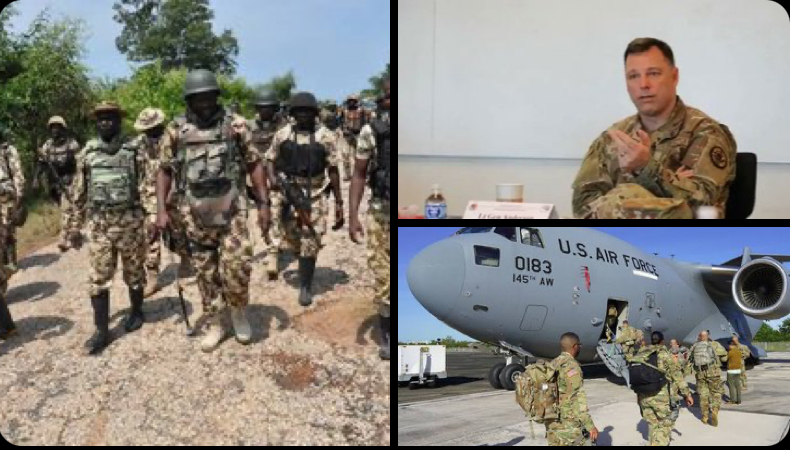
ABUJA — The Nigerian Defence Headquarters (DHQ) has moved to clarify the status of U.S. military personnel operating within the country, distinguishing between the forces deployed for specific, short-term missions and the long-standing, robust bilateral security partnership that continues to underpin counter-terrorism efforts in the Lake Chad Basin.
DHQ Clarification: The Partnership Remains Intact
The military high command issued this statement following widespread reports by foreign media agencies regarding the withdrawal of U.S. troops from Nigeria. These reports, which often conflated a mission-specific redeployment with a broader retreat from the region, prompted a swift rebuttal from Abuja.
The Director of Defence Information, Major General Samaila Uba, emphasized that the forces recently withdrawn were those specifically deployed to execute a targeted counter-terrorism operation in May. He confirmed that the initial contingent of approximately 200 U.S. military personnel—who remain in the country to support ongoing joint intelligence sharing, specialized training, and critical capacity-building operations—is unaffected by the redeployment. This distinction is vital for understanding the current security architecture in the North-East, which relies heavily on a flexible, adaptive model rather than permanent, static combat deployment.
Contextualizing the Withdrawal and Operational Success
The confusion stemmed from a briefing by General Dagvin R.M. Anderson, Commander of U.S. Air Forces in Europe–Air Forces Africa. Following the 2026 African Chiefs of Defense Conference in Luanda, General Anderson noted that the majority of U.S. personnel assigned to the specific Lake Chad Basin operation had concluded their mission and departed.
Major General Uba clarified the strategic necessity of this rotation, stating, "The partnership between Nigeria and the U.S. is unchanged with key information sharing ongoing. Those forces [withdrawn] were intended for short periods of time only. Nigeria and the U.S. continue to work closely together to disrupt and eliminate shared threats, and that remains unchanged." General Anderson echoed this sentiment, confirming that the mission had achieved its immediate objectives—most notably the degradation of the Islamic State’s regional leadership—and that the withdrawal was a planned phase of successful project completion.
Impact on Counter-Terrorism and Global Security
The collaboration between the Nigerian Armed Forces and the U.S. Africa Command (AFRICOM) has been widely credited with significant operational successes against extremist networks, including ISIS/Daesh and its regional affiliates. Recent joint operations have proven highly effective, yielding intelligence-led strikes that resulted in the neutralization of high-ranking figures within the global ISIS hierarchy and the recovery of massive caches of electronic equipment and weaponry.
Beyond the battlefield, the strategic partnership has provided a multi-layered security benefit:
-
Intelligence Fusion: Advanced real-time data sharing that has bolstered the operational readiness of Nigerian troops.
-
Specialized Training: Professional military education and force development programs designed to increase the effectiveness of localized security operations.
-
Logistics and Strategic Communication: A framework that allows for "flexible deployment," meaning both nations can rapidly surge specialized assets to address peculiar missions as they arise.
A Model for Future Cooperation
Both the Nigerian DHQ and AFRICOM leadership have described the recent Lake Chad Basin operations as a model for future security cooperation. By bringing unique U.S. capabilities to support Nigerian-led ground operations, the partnership has demonstrated an effective approach to tackling transnational threats that span across the Lake Chad region—including Nigeria, Niger, Chad, and Cameroon.
The current security cooperation is defined by mutual agreement, driven by the request of the Nigerian government, and focused on prosecuting complex counter-terrorism tasks with greater precision. As the conflict in the North-East evolves, both nations remain firmly committed to this framework. The message from the Defence Headquarters is clear: the U.S.-Nigeria security bond is not retreating; it is maturing into a more focused, intelligence-driven, and highly adaptive partnership. By moving away from a "one-size-fits-all" approach to counter-terrorism, both nations are setting a new standard for how regional powers and international allies can collaborate to neutralize persistent, borderless security threats.