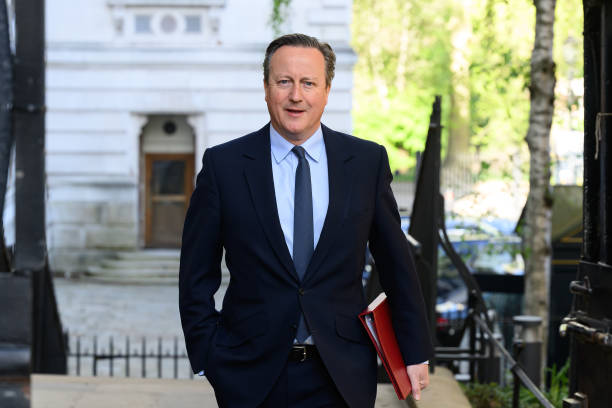
Former British prime minister says Alberta’s October referendum concerns the future of a country, while Brexit concerned the UK’s membership in a political and trade bloc
Former British Prime Minister David Cameron has rejected direct comparisons between Alberta’s upcoming referendum on separation from Canada and Britain’s 2016 Brexit vote, saying the two questions involve fundamentally different constitutional issues.
Cameron made the comments on Monday, September 28, while speaking at an energy leadership conference in Calgary, Alberta, as the Canadian province prepares for a referendum on October 19.
The former British leader, who was prime minister from 2010 to 2016, was in office when the United Kingdom held its referendum on whether to leave the European Union. He had campaigned for Britain to remain in the EU and resigned as prime minister after voters chose Brexit.
Speaking about Alberta’s proposed separation vote, Cameron said the distinction between the two situations was important.
“Brexit was about whether we wanted to stay in a trade association with an element of political union,” Cameron said. “This is about the future of a country.”
His comments come as Alberta’s referendum campaign enters its final weeks, with voters preparing to answer 10 questions covering issues including immigration, provincial powers and the province’s constitutional relationship with Canada.
Alberta vote is not immediately a vote for independence
Despite the political attention surrounding Alberta separatism, the October 19 referendum does not directly determine whether Alberta will leave Canada.
The official wording of Question 10 asks Albertans to choose between remaining a province of Canada and having the Alberta government “commence the legal process required under the Canadian Constitution” to hold a future binding provincial referendum on whether Alberta should separate.
Elections Alberta states that the result of Question 10 is not binding.
That means a vote in favour of beginning the constitutional process would not itself make Alberta an independent country.
The question was introduced by Alberta Premier Danielle Smith after a court ruling complicated efforts to hold a direct binding referendum on separation. Smith has repeatedly said she supports Alberta remaining within Canada.
The province's referendum is scheduled for October 19, with advance voting running from October 13 to 17. Elections Alberta has also been processing special-ballot applications ahead of the vote.
Cameron draws on Scotland independence experience
Cameron also discussed his experience with the 2014 Scottish independence referendum, which took place two years before Brexit.
The former prime minister supported keeping Scotland within the United Kingdom during that campaign. Scotland ultimately voted against independence.
Cameron said he had been nervous about holding the referendum because there was no guarantee that voters would choose to preserve the union.
“I was very nervous about it because if you have a referendum, you can’t guarantee what the results are going to be,” he said.
However, Cameron defended the decision to allow the Scottish referendum to proceed, arguing that refusing to hold the vote could have increased resentment among Scottish nationalists.
He said the experience also demonstrated that holding a referendum does not necessarily settle a separatist movement permanently.
Cameron noted that the Scottish independence question had been presented as a relatively straightforward choice. He contrasted that with Alberta's more complicated referendum structure, which contains 10 separate questions.
Alberta's referendum contains 10 questions
Question 10 has attracted the greatest international attention, but it is only one part of Alberta's October referendum.
According to Elections Alberta, Questions 1 through 9 are yes-or-no questions, while Question 10 gives voters two choices.
The other questions address subjects including increased provincial control over immigration, eligibility for certain provincially funded programs, voting identification requirements and possible constitutional changes involving provincial powers.
Several questions concern Alberta's relationship with the federal government and the division of powers between Ottawa and the provinces.
The referendum therefore goes beyond the issue of independence, reflecting broader political disagreements over federal and provincial authority.
Comparisons with Brexit have been common
Although Cameron said the two votes should not be directly compared, Brexit has repeatedly been used as a reference point in discussions about Alberta's separatist movement.
The comparison partly stems from the political circumstances surrounding the two votes.
Cameron called the Brexit referendum while facing divisions within his Conservative Party over Britain's relationship with the European Union. He personally supported remaining in the EU but agreed to hold the referendum.
Smith has similarly said she supports Alberta remaining in Canada while allowing Albertans to vote on whether the province should begin the legal process toward a future separation referendum.
Canadian Prime Minister Mark Carney has previously drawn a different comparison, describing Alberta's referendum proposal as a potential “dangerous bluff” and pointing to the long-term consequences of Brexit.
Cameron's comments therefore add another perspective from a former leader who personally experienced both the political consequences of a major referendum and the difficulties surrounding questions of national unity.
Smith says she supports Alberta remaining in Canada
Smith has made her own position on the question clear.
In an address announcing the referendum question in May, she said she supported Alberta remaining in Canada and said that would be how she would vote on the separation issue.
She also argued that Alberta's constitutional and political grievances should be addressed without necessarily breaking up the country.
Smith's government says the October vote is intended to provide Albertans with a formal opportunity to express their views following significant public debate over the province's relationship with Ottawa.
The premier has also argued that hundreds of thousands of Albertans had signed petitions calling for votes on the issue, making it necessary for the government to provide a formal mechanism for voters to express their position.
What happens after the October vote?
The constitutional implications of Question 10 are significant because even a vote in favour of beginning the process would not automatically result in Alberta becoming independent.
Instead, the province would have to undertake the legal and constitutional steps required before a future binding referendum could be held.
Canadian constitutional law also places limits on unilateral provincial secession. The Supreme Court of Canada ruled in the 1998 Quebec Secession Reference that a province does not have a unilateral constitutional right to leave Canada. A clear vote on separation would instead trigger negotiations involving the federal government and the other provinces.
Consequently, the October 19 vote is better understood as a decision about whether Alberta should move toward a future separation referendum rather than a direct independence vote.
That distinction is central to Cameron's argument that the Alberta question and Brexit are fundamentally different.
A debate over Canada's future
The Alberta referendum comes amid broader discussions about federalism, energy policy, provincial autonomy and the distribution of political power in Canada.
Alberta has long been one of Canada's largest energy-producing provinces, and disagreements over oil and gas policy, federal regulation and infrastructure have contributed to tensions between the provincial and federal governments.
At the same time, the separatist movement has argued that Alberta's interests are not adequately represented within Canada's existing political structure.
Opponents of separation have argued that Alberta's economic and political interests can be pursued within Canada and that leaving the federation would create significant constitutional and economic questions.
The October vote will not immediately resolve those questions.
For Cameron, however, the historical distinction remains important. Brexit involved Britain's membership in the European Union, while Alberta's question concerns the possible constitutional breakup of an existing country.
His intervention comes just weeks before Albertans head to the polls, placing renewed international attention on a referendum that could shape Canada's political debate well beyond October 19.