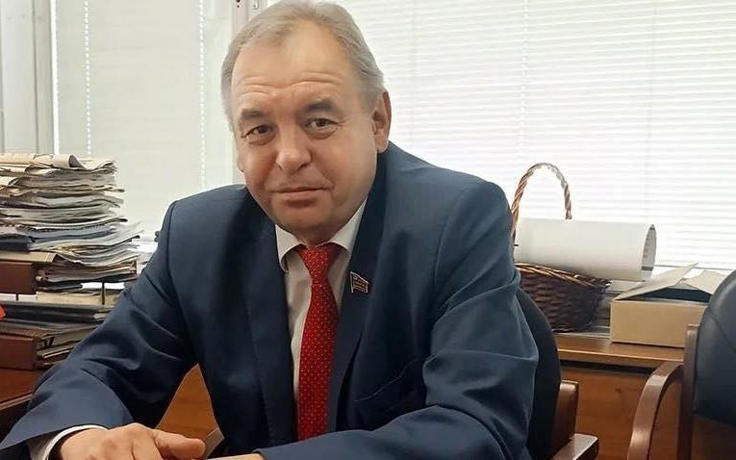
MOSCOW — In a historic fracture of the Kremlin’s tightly controlled political facade, a sitting member of the Russian parliament has publicly broken ranks with President Vladimir Putin. Renat Suleymanov, a prominent State Duma deputy representing the Communist Party of the Russian Federation (KPRF), has issued an unprecedented demand for the “swiftest possible end” to the war in Ukraine, sounding an alarm that Russia’s heavily militarized economy is on the brink of total exhaustion.
According to Agentstvo, an independent Russian investigative media outlet, Suleymanov’s remarks mark the very first time a active member of the State Duma has openly acknowledged that the Russian Federation cannot financially or structurally sustain the ongoing war.
The 40% Deficit Trap: "Tanks and Shells Have No Consumer Value"
Suleymanov, who represents the heavily industrialized Novosibirsk region, dropped the political bombshell during an unfiltered interview with the regional news outlet Kontinent-Sibir. The lawmaker pointed directly to the massive distortion of the federal budget, where war funding has cannibalized domestic growth.
"Officially, 40 percent of the federal budget is being spent on defense and security," Suleymanov revealed. "What development, investment, or capital spending can we even talk about in these circumstances? It is absolutely obvious that the economy will not withstand a prolonged continuation of the special military operation."
The lawmaker launched into a critical macroeconomic breakdown, explaining that while military manufacturing creates an illusion of stability, it actively destroys the local market.
"Tanks and shells have no consumer value," Suleymanov argued. "The economy produces them, but they cannot be consumed by the population. They are pure expenditure. Yes, they support employment and wages in the defense sector, acting as a kind of driver. But at the same time, they drive inflation and crowd out other spending social spending and long-term investment."
The Impending Post-War Nightmare: 1 Million Soldiers Demobilized
Suleymanov’s dissent goes far beyond current budget lines; the politician raised harrowing questions regarding the structural fallout of an eventual demobilization. He warned that simply winding down the war machine could trigger a catastrophic domestic social crisis if the state is unprepared.
"Adopting a budget with reduced military spending is far from the hardest part," the deputy emphasized. "But what happens to the people employed in the defense industry? To those who are under arms right now? A million people will return to civilian life. Where are the jobs, the decent wages, and the social reintegration? The problems won't get any smaller."
Furthermore, Suleymanov cast deep doubt on Russia's financial capacity to absorb and rebuild the Ukrainian territories it has brutally leveled and annexed. "I saw Mariupol in 2022 and the steppes of the Kherson region in 2023: there are no houses left, no Soviet-era irrigation. Reconstruction has begun, but it will require enormous, unsustainable budget expenditure going forward."
The remarks are particularly stunning given Suleymanov’s hawkish political history. In April 2022, the 61-year-old MP publicly declared that negotiations with Kyiv should only occur on the strict condition of Ukraine’s total "capitulation," and he previously lauded the Kremlin's mass mobilization as a "painful necessity." His dramatic u-turn comes ahead of upcoming State Duma elections, where he is strategically positioning the KPRF as the country's "only real opposition."
Deep Strikes and Economic Stagnation Dent Putin’s Stature
Independent economists have long warned that the rapid, state-funded boom of Russia’s military-industrial complex was masking deep structural decay. Hit hard by skyrocketing central bank interest rates, spiraling commodity prices, severe manufacturing labor shortages, and the delayed, grinding impact of Western sanctions, the Kremlin’s war chest is under immense strain. The economic squeeze recently forced Moscow to slash its official GDP growth projections from 1.3% down to a dismal 0.4%.
Simultaneously, the domestic reality of the war is finally hitting home. For the first time, state pollster VTsIOM recorded that Russian citizens are more anxious about incoming Ukrainian long-range drone strikes than battlefield developments. A recent massive wave of Ukrainian drones successfully penetrated the heavily fortified airspace of the Moscow region, shattering the capital's sense of immunity.
"There is no sense of war in Russia until it is felt in Moscow," wrote Alyona Getmanchuk, Ukraine’s ambassador to NATO, in a foreign policy analysis. "Nothing reveals Russian vulnerability more vividly than the inability to protect even what is allegedly the most protected place in the country its capital. What Ukraine is doing through its deep strikes is making the war completely unwinnable for Russia."
With state polls showing Putin’s domestic popularity dipping to pre-war lows and public happiness hitting a 15-year nadir, dissent is bubbling up in unexpected corners. From viral, 18-minute anti-war rants by prominent elites like Monaco-based influencer Victoria Bonya, to high-profile pro-Kremlin figures breaking down under the strain, Suleymanov's parliamentary rebellion is the clearest indicator yet that the elite consensus supporting Moscow's war effort is beginning to splinter.