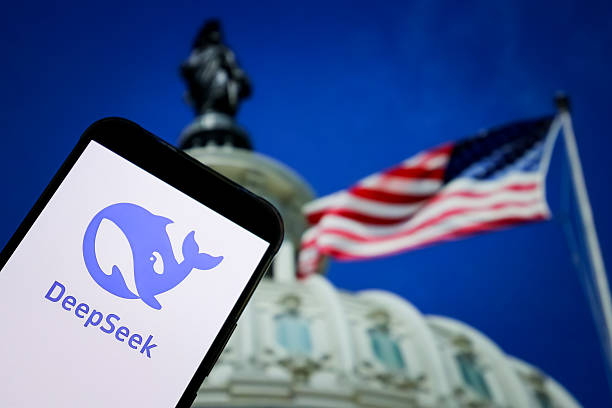
The United States has ordered federal civilian agencies to remove DeepSeek, the Chinese artificial intelligence platform, from government information-technology systems, escalating Washington's efforts to limit the use of Chinese technology over national-security concerns.
The order, issued by the US Department of Homeland Security (DHS) and published in the Federal Register on October 20, requires civilian federal agencies to remove DeepSeek and affiliated products from their IT systems. It also blocks agencies from purchasing DeepSeek products and services, as well as third-party products and services built using DeepSeek's technology.
The decision represents another significant step in the growing technological rivalry between Washington and Beijing, particularly over artificial intelligence. The two countries are competing for leadership in AI while simultaneously restricting each other's access to sensitive technologies, data and advanced computing capabilities.
DHS said DeepSeek's models present “multiple threat vectors”, including the possibility that sensitive information could be transferred to China when the technology is used by US government employees or contractors.
The department also warned that DeepSeek's models could potentially generate actionable intelligence about US individuals or government agencies and could contain malware or other security vulnerabilities.
What the US government order does
The measure is broader than simply telling federal employees not to download the DeepSeek chatbot.
Under the DHS order, civilian federal agencies must remove DeepSeek products and products developed by DeepSeek-affiliated entities from their IT environments.
The restriction also extends to third-party products and services that use DeepSeek implementations.
Federal civilian agencies are prohibited from acquiring those products and services, although the order provides for the possibility of exceptions under certain circumstances.
The Federal Register notice states that the order applies to federal civilian executive-branch agencies.
That distinction matters because DHS does not directly control every part of the US government. The military and intelligence communities have separate authorities and security arrangements, although several individual US agencies had already imposed their own restrictions on DeepSeek.
Reuters reported that agencies including the Department of Commerce and the US Navy had previously prohibited DeepSeek on government devices. Several states, including New York, Tennessee and Virginia, had also taken similar measures.
Why Washington is concerned about DeepSeek
The central US concern is data security.
DeepSeek is a Chinese AI company whose models are developed and operated within China's regulatory environment. US officials have raised concerns that data submitted to DeepSeek systems could potentially be accessible to Chinese authorities.
DHS specifically pointed to the location of DeepSeek's servers in China and China's legal framework, which the department said gives the government extensive authority to access private-company infrastructure.
The US government therefore considers the use of DeepSeek in federal systems to pose risks that go beyond ordinary concerns about the accuracy or reliability of an AI chatbot.
Government agencies routinely handle information involving national security, law enforcement, personal information, government operations and sensitive infrastructure.
If officials use an external AI system to process such information, there is a potential risk that prompts, uploaded documents or other information could leave government-controlled environments.
That concern is particularly significant when the AI provider is based in a country that Washington considers a strategic competitor.
DeepSeek became a major US technology concern after its 2025 breakthrough
DeepSeek became one of the most closely watched AI companies in the world after the release of its R1 reasoning model in January 2025.
The model attracted international attention because DeepSeek presented it as a highly capable alternative to leading Western AI systems while emphasizing comparatively low development costs and the availability of open-weight models.
Its emergence challenged assumptions about the amount of money and computing power required to develop competitive AI systems.
The development also triggered major concern within the US technology sector.
DeepSeek's rise demonstrated that Chinese AI companies could rapidly narrow the gap with leading US developers, even while China faced US restrictions on access to some advanced semiconductor technologies.
The episode became an important part of the broader debate over whether Washington's export controls could prevent China from developing globally competitive AI systems.
US accuses Chinese AI companies of technology theft
The DeepSeek restrictions are also connected to US allegations concerning the way Chinese AI companies have obtained or developed advanced AI capabilities.
Washington has accused DeepSeek and other Chinese AI companies of using model distillation, a technique through which the outputs of an advanced AI system can be used to help train or improve another model.
OpenAI and Anthropic have separately raised concerns about unauthorized attempts by Chinese AI companies to collect outputs from their models.
The US has also accused Chinese AI firms of attempting to extract capabilities from American AI systems. Beijing has rejected such allegations.
These disputes have added another layer to the US-China technology conflict.
The disagreement is no longer limited to computer chips.
It now involves AI models, training data, cloud computing, semiconductor equipment, research talent, intellectual property and the infrastructure required to develop and deploy advanced AI.
China strongly opposes the ban
Beijing has rejected Washington's reasoning and criticised the US decision.
China's Commerce Ministry said on October 20 that the ban harmed the interests of Chinese companies and disregarded understandings reached between US President Donald Trump and Chinese President Xi Jinping.
The ministry called on Washington to immediately correct what it described as wrongful practices and revoke the restrictions.
Chinese Foreign Ministry spokesperson Mao Ning also criticised what Beijing considers the politicisation of technology and trade.
China has repeatedly argued that Washington is using national-security arguments to restrict Chinese companies and prevent them from competing fairly in global markets.
Mao said China opposes the “overstretching” of national security concepts and the politicisation of science, technology, economic and trade issues.
DeepSeek itself had not immediately responded to requests for comment in reports following the announcement.
The ban does not mean DeepSeek is unavailable in America
The latest action should not be interpreted as a nationwide US ban on ordinary consumers using DeepSeek.
The DHS order is specifically focused on federal civilian government agencies and their IT systems and procurement activities.
DeepSeek's models remain widely available outside federal government environments, including through open-source and open-weight implementations.
That distinction is important because the US government has not, through this particular order, prohibited every American individual or private company from using DeepSeek.
Instead, Washington is drawing a security boundary around government systems.
Federal employees and contractors handling government information are the primary concern addressed by the order.
Earlier restrictions had already targeted DeepSeek
The new federal civilian-agency order builds on restrictions introduced over the past two years.
Several US government departments had already moved against DeepSeek.
Reuters reported that the Department of Commerce and Navy had prohibited the AI service on government devices, while several states had introduced similar restrictions.
A US law passed in December 2025 also targeted DeepSeek's use in certain intelligence and national-security systems.
The latest DHS order therefore represents an expansion of restrictions rather than Washington's first attempt to prevent government use of DeepSeek.
It brings the policy across federal civilian agencies and creates a formal procurement and removal framework.
The dispute comes as US-China AI competition intensifies
The DeepSeek decision comes at a particularly sensitive moment in US-China relations.
Both countries increasingly view artificial intelligence as strategically important.
AI has potential applications in healthcare, finance, manufacturing, scientific research, cybersecurity, defence and intelligence.
Control over advanced AI systems could therefore have implications extending far beyond the technology industry.
The United States has sought to restrict China's access to advanced AI chips and the equipment needed to manufacture them.
China, meanwhile, has been investing heavily in domestic semiconductor and AI capabilities while seeking to reduce its dependence on American technology.
The DeepSeek controversy illustrates another dimension of that competition: software and AI models themselves are becoming strategic assets.
China is also considering restrictions on advanced AI technologies
The technology dispute is increasingly moving in both directions.
Reuters reported that China has been considering export restrictions on certain advanced AI-related technologies, including chip designs and AI models.
Beijing's position is that China should protect technologies considered strategically important while continuing to develop its own technological ecosystem.
At the same time, Washington continues to expand restrictions affecting Chinese technology companies.
The result is a progressively fragmented global technology environment in which companies increasingly have to navigate separate US and Chinese technology ecosystems.
US and China still maintain an AI dialogue
Despite the growing restrictions, Washington and Beijing have not completely abandoned communication over artificial intelligence.
The two countries recently agreed to establish a communication mechanism for AI-related incidents.
That channel is intended to provide a way for the two governments to communicate about potentially serious AI-related incidents and risks.
The development is significant because it shows that competition and cooperation are occurring simultaneously.
The US and China can restrict each other's technology while also recognising the need to communicate about the risks associated with increasingly powerful AI systems.
Trump and Xi are also expected to meet at the APEC leaders' summit in Shenzhen in November, with AI likely to be among the issues discussed.
The wider impact on the global AI industry
The DeepSeek ban could have consequences beyond US government offices.
As governments become more cautious about foreign AI systems, technology companies may increasingly be required to demonstrate where their models are trained, where data is stored, who can access it and which jurisdictions govern their operations.
That could create additional compliance costs for AI companies seeking to operate internationally.
It may also encourage governments to develop or purchase AI systems that can operate entirely within domestic infrastructure.
For companies, the result could be a growing emphasis on sovereign AI — AI infrastructure controlled within a particular country's legal and technological environment.
The issue is particularly relevant to countries that rely heavily on foreign AI providers.
Governments around the world will increasingly have to decide whether convenience and low-cost access to powerful AI systems outweigh potential concerns about data sovereignty, privacy and national security.
DeepSeek is now at the centre of the US-China AI divide
DeepSeek's rise has transformed it from a relatively obscure Chinese AI startup into one of the most politically significant AI companies in the world.
Its models demonstrated China's ability to produce competitive AI technology while operating under US semiconductor restrictions.
Washington's response has increasingly focused on preventing sensitive government information from being exposed to Chinese AI systems and limiting the use of technology considered a potential national-security risk.
Beijing, meanwhile, says the US is improperly using national-security arguments to restrict Chinese businesses.
Neither side appears ready to abandon its broader AI ambitions.
The latest DeepSeek ban therefore represents more than a software restriction affecting federal computers. It is another visible sign of a much larger contest over who controls the technologies that will shape the next generation of computing.
For now, the immediate impact is clear: US federal civilian agencies must remove DeepSeek and related products from their IT systems and cannot procure them, while Washington continues to assess the broader risks associated with Chinese AI technology.
The move adds another front to an already extensive US-China technology rivalry — one that increasingly extends from computer chips and telecommunications equipment to the AI models themselves.