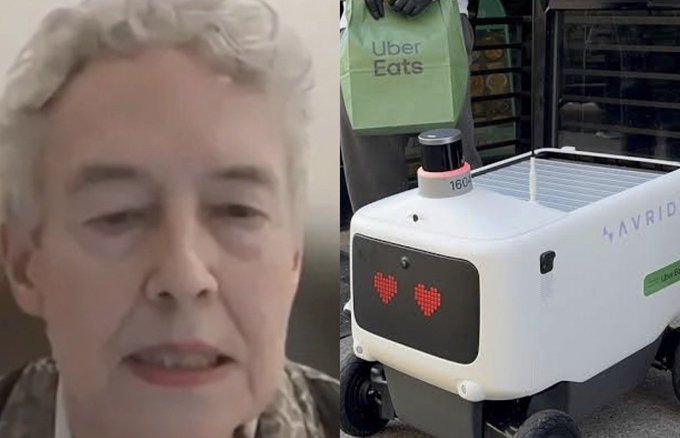
A 78-year-old retired University of Pennsylvania professor has been arrested in Philadelphia after repeatedly standing in the path of an autonomous Uber Eats delivery robot, saying she was protesting the replacement of human delivery workers by machines.
Carolyn Marvin, professor emerita at Penn’s Annenberg School of Communication, was arrested on October 14 after refusing several requests from police officers to move away from the robot and allow it to continue its delivery. She was issued a criminal violation notice for disorderly conduct.
Marvin has described the confrontation as part of a broader protest against automation and what she considers the displacement of workers by technology. She has repeatedly confronted delivery robots on Philadelphia sidewalks for months and says her arrest will not stop her from continuing the demonstrations.
“I know they’re taking the jobs of human delivery workers,” Marvin said in an interview, explaining that whenever she sees one of the machines and has enough time, she stands in front of it to prevent it from moving.
The unusual confrontation has since drawn widespread attention because it brings together several increasingly contentious issues: artificial intelligence, automation, employment, public sidewalks, protest rights and the growing presence of autonomous machines in everyday life.
How the arrest happened
The incident occurred in Philadelphia's Center City, near Reading Terminal Market.
According to Philadelphia police, officers responded to the 1200 block of Filbert Street after receiving a report of a disturbance involving a delivery robot at about 1:16 p.m. Marvin was reportedly standing directly in the robot's path.
Police said officers gave her multiple commands to move so the robot could continue its delivery. Marvin refused.
She was subsequently taken into custody and issued a citation for disorderly conduct.
Marvin has said she intends to challenge the charge, arguing that she was exercising her constitutional right to protest in a public space.
She has also made clear that the arrest has not changed her position.
“If I see a robot, and I have enough time, I’ll probably do the same thing,” she told KYW Newsradio.
Her position has turned what might otherwise have been a minor sidewalk dispute into a wider conversation about whether autonomous machines should be treated differently from traditional pedestrians and what limits can be placed on people who want to protest their presence.
Marvin says robots are taking human jobs
At the center of Marvin's protest is her concern about employment.
The retired academic argues that companies are introducing autonomous delivery machines because they can perform tasks previously carried out by human workers, potentially reducing the need for delivery couriers.
She has particularly focused on food-delivery workers, whom she describes as workers with relatively little bargaining power.
In a statement to The Daily Pennsylvanian, Marvin said she opposed corporations “casting aside human workers” to increase their profits. She argued that the machines' friendly appearance can distract people from considering the workers whose jobs may be affected.
Her concern is not limited to delivery robots.
Marvin has connected the machines to the larger expansion of artificial intelligence and automation, describing AI technologies as having the potential to affect employment and privacy.
She hopes her public demonstrations will make people stop and think about where automation is heading and what it means for workers.
She sees the protest as a First Amendment issue
Marvin's background makes the dispute particularly notable.
Before retiring, she taught at the University of Pennsylvania's Annenberg School of Communication, including a course focused on the history and theory of freedom of expression.
She now argues that her actions on Philadelphia's sidewalks constitute protected public protest.
Marvin has said she deliberately chooses public spaces because she wants to engage people who encounter her while she is protesting.
She told PhillyVoice that conversations with passersby are an important part of what she is trying to accomplish.
“It allows me to talk to people about what’s going on,” she said, adding that she believes public discussion about the technology is valuable.
However, her First Amendment argument does not automatically prevent authorities from enforcing laws governing obstruction or disorderly conduct. Whether her specific actions are protected in the circumstances will ultimately depend on the legal proceedings.
Marvin has indicated that she intends to contest the citation.
Philadelphia has become a testing ground for delivery robots
The confrontation is happening because autonomous delivery robots are becoming increasingly common on Philadelphia's streets.
Uber Eats began offering robot delivery in parts of Philadelphia in March 2026, working with autonomous-vehicle company Avride.
The service initially operated in Center City, with customers able to choose robot delivery when the option was available. The robots travel on sidewalks and carry food in locked compartments that customers open through the Uber Eats application.
The robots are relatively small compared with conventional vehicles but are substantial enough to occupy noticeable space on sidewalks.
According to reporting when the Philadelphia service launched, the robots weigh roughly 150 pounds empty, can carry up to 55 pounds, travel at speeds of up to about 5 mph and can operate for as long as 12 hours between charges. They use technologies including LiDAR, radar, cameras and ultrasonic sensors to navigate their surroundings.
The machines are also monitored remotely, allowing human operators to intervene when necessary.
That means the technology is autonomous in its physical operation but does not necessarily operate without human oversight.
Uber has previously said the robots are not intended to eliminate traditional delivery couriers altogether. The company has argued that autonomous delivery is suitable for only certain types of trips and that human couriers will continue to be needed for deliveries the robots cannot complete.
For Marvin, however, the existence of limitations does not eliminate the broader concern about automation replacing workers.
The robots have already attracted controversy
Marvin is not the first Philadelphia resident to object to the delivery machines.
Since their introduction, some robots have been kicked, sat on or otherwise interfered with on city streets.
One incident reportedly involved a robot bumping into a pedestrian, while other encounters have involved people attempting to interfere with the machines.
The controversy has also expanded beyond individual encounters.
Questions have emerged about how much sidewalk space autonomous delivery devices should occupy, how they should interact with pedestrians and people with disabilities, and how cities should regulate increasingly common robotic devices.
Philadelphia's experience is particularly significant because Pennsylvania law treats qualifying personal delivery devices as pedestrians for certain purposes.
The machines must yield to people and cyclists, while state rules establish where and how they can operate.
That legal framework means the robots are not simply private equipment operating on private property. They are using public infrastructure alongside human pedestrians.
The robot itself is not powered entirely by AI
Although Marvin frames her protest as part of opposition to AI-driven automation, it is worth distinguishing between the robot's autonomous navigation technology and the broader concept of artificial intelligence.
The Avride machines use multiple sensors and onboard systems to understand their surroundings, determine routes and navigate around obstacles.
They are designed to make decisions about how to move through urban environments while avoiding people and objects.
At the same time, the system includes human oversight.
When the robots encounter situations they cannot handle, remote operators can intervene. Avride has said the robots are designed to stop and wait when someone approaches or interferes with them rather than simply forcing their way through an obstruction.
This creates an interesting middle ground between traditional human-operated delivery and completely independent machines.
The debate goes beyond Uber Eats
The Philadelphia controversy is also unfolding as autonomous delivery expands to other platforms.
Avride recently announced an expansion involving Wonder and Grubhub, meaning its robots are set to handle deliveries beyond their original Uber Eats operation in the city.
The expansion includes additional restaurants and delivery areas, showing that autonomous delivery is becoming a broader part of Philadelphia's food-delivery ecosystem rather than a limited experiment.
That expansion gives Marvin's protest additional relevance.
Even if one company were to reduce its use of robots, other companies could continue adopting similar technology.
The underlying question therefore isn't simply whether Uber Eats should use delivery robots.
It is whether society is comfortable with a future in which machines perform an increasing number of tasks once carried out by people.
A wider fight over automation and jobs
Marvin's protest reflects a debate that has become increasingly prominent as artificial intelligence and robotics advance.
Automation has historically eliminated some jobs while creating others.
Machines have replaced workers in factories, warehouses, agriculture and other industries, but technological development has also created new occupations and industries.
The concern surrounding modern AI is different in one important respect: increasingly sophisticated software and robots can perform tasks that previously required human judgment, communication or physical movement.
Delivery robots represent a particularly visible example.
A human delivery worker traditionally has to travel to a restaurant, collect an order, navigate streets and sidewalks, and deliver the food to a customer.
An autonomous robot can perform much of that process without a human courier physically accompanying it.
For customers, the technology can potentially reduce delivery costs and improve efficiency.
For workers, however, the question is whether efficiency gains will come at the expense of available employment.
That is the concern Marvin is attempting to bring into public view.
Marvin says the arrest will not stop her
Despite being arrested, Marvin remains committed to her campaign.
She says she intends to continue blocking delivery robots when she encounters them and has encouraged other people concerned about automation to participate in the discussion.
Her objective appears to be less about damaging the machines than creating a visible confrontation that forces people to ask questions about automation.
She has said she does not block human pedestrians and views her actions as a form of civic engagement.
Whether a court accepts that argument remains to be seen.
For now, her case is an unusual example of the growing friction between emerging technology and public life.
A machine designed to quietly deliver someone's lunch has become the centre of a dispute over workers' rights, corporate power, artificial intelligence, public space and freedom of expression.
And Marvin, at 78, says she is not ready to step aside.