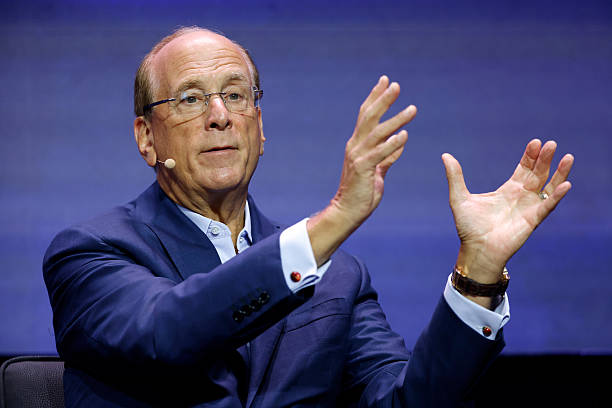
BlackRock CEO Larry Fink has warned that US interest rates could remain structurally high for an extended period, pointing to rising demand for capital from artificial intelligence infrastructure and large government deficits.
Laurence Fink, chairman and chief executive officer of BlackRock, said the United States is entering an environment where competition for capital is increasing, creating conditions for higher borrowing costs even if inflation moderates.
Fink made the comments during BlackRock’s third-quarter 2026 earnings call on October 14, as investors assessed the outlook for interest rates, bond yields, government borrowing and the enormous amount of capital being directed toward AI infrastructure.
AI Investment Is Increasing Demand for Capital
According to Fink, one of the major forces behind the higher-rate environment is the rapid expansion of artificial intelligence infrastructure.
The AI boom has triggered massive investment in data centers, semiconductor infrastructure, electricity generation, power grids and telecommunications. Those projects require substantial amounts of financing from both public and private markets.
Fink argued that the growing financing requirements are arriving at the same time as the US government is issuing large amounts of debt to fund persistent federal deficits.
“The competition for capital is growing,” Fink said during the earnings call, pointing to the combination of federal deficits and expanding private-sector demand for financing.
The implication, according to Fink, is that interest rates may remain elevated even if inflation falls from current levels.
He said the US is likely to experience “structurally higher interest rates for longer,” particularly toward the longer end of the Treasury yield curve.
Federal Borrowing Adds to Pressure
Fink also highlighted the rapid expansion of US federal debt.
During the earnings call, he said federal deficits had reached approximately $40 trillion after growing dramatically over recent decades. The scale of government borrowing means the Treasury needs to continue raising significant amounts of capital from financial markets.
That creates competition between the government and private companies for available investment capital.
At the same time, BlackRock sees increasing opportunities to direct private capital toward major infrastructure projects, including AI data centers and other areas of the economy.
Fink said unlocking private capital could support US economic growth, but it would also mean more financing activity and greater demand for capital.
The combination could keep longer-term borrowing costs higher than investors became accustomed to during the ultra-low-rate era following the global financial crisis.
BlackRock Sees a Different Bond Environment
BlackRock President Rob Kapito also addressed the interest-rate outlook during the earnings call.
Kapito said inflation, energy prices, imbalances between capital supply and demand, government deficits and geopolitical developments could all contribute to continued volatility in financial markets.
He said those factors currently point toward slightly higher rates, particularly at the longer end of the yield curve.
Kapito noted that the 10-year US Treasury yield was above 5%, while real interest rates were close to 3%.
That environment represents a significant change for investors who spent years searching for meaningful income because interest rates were historically low.
With bond yields now substantially higher, investors can potentially earn more income from fixed-income assets without taking the same level of equity risk that was previously required to generate comparable returns.
BlackRock reported $78 billion in fixed-income inflows during the third quarter, while total net inflows reached $205 billion.
Higher Rates Could Change Investment Strategies
A prolonged period of elevated interest rates could have broad consequences for households, companies, governments and financial markets.
For consumers, higher rates can increase the cost of mortgages, automobile loans, credit cards and other forms of borrowing.
For businesses, higher financing costs can make it more expensive to build new facilities, expand operations or refinance existing debt.
The impact could be particularly significant for companies involved in capital-intensive industries.
AI infrastructure is one example. The construction of data centers requires billions of dollars in investment, while additional spending is needed for electricity generation, transmission infrastructure, cooling systems and computing equipment.
If borrowing costs remain elevated, companies and investors may need to demand higher returns before committing capital to those projects.
At the same time, higher yields could make bonds and other fixed-income investments more attractive relative to some riskier assets.
AI Boom Could Keep Reshaping Financial Markets
Fink's comments come as the AI investment cycle continues to reshape global capital markets.
BlackRock itself has been expanding its involvement in financing AI-related infrastructure. The company said in its third-quarter results that its AI Infrastructure Partnership made its first deployment during the quarter. BlackRock also reported raising $68 billion for private-market investments over the previous 12 months.
The asset manager reported $15.49 trillion in assets under management at the end of the third quarter, following $205 billion in net inflows during the quarter.
Fink has increasingly argued that the scale of infrastructure investment required by AI will make access to capital a central issue for the economy.
Earlier this week, Reuters reported that central bankers were also considering whether the AI investment boom could contribute to stronger demand pressures and a higher neutral interest rate, potentially marking a departure from the prolonged era of exceptionally cheap money.
What Fink's Warning Means for Investors
Fink's comments do not represent a Federal Reserve forecast or an official projection of where US interest rates will ultimately settle.
Instead, they reflect the assessment of one of the world's largest asset managers that structural forces could keep long-term borrowing costs elevated.
The distinction between short-term and long-term rates is important.
The Federal Reserve can influence short-term interest rates through monetary policy, but longer-term Treasury yields are also affected by inflation expectations, government borrowing, economic growth, investor demand and the supply of government debt.
Fink's argument is that even if inflation becomes less of a problem, the enormous amount of capital needed by governments and businesses could keep longer-term rates higher.
That would represent a significant change from the investment environment that dominated much of the 2010s and the early years of the 2020s.
BlackRock Reports Strong Third-Quarter Performance
Fink's comments came as BlackRock reported strong financial results for the third quarter.
The company said assets under management reached $15.49 trillion, while revenue increased 19% year over year. BlackRock also reported $205 billion in net inflows during the quarter and $869 billion in net inflows over the preceding 12 months.
The company said its growth was broad-based across exchange-traded funds, systematic active equities, private markets, fixed income and other investment businesses.
BlackRock's results illustrate how the changing interest-rate environment is creating both challenges and opportunities for asset managers.
Higher rates can raise borrowing costs across the economy, but they can also increase the attractiveness of fixed-income products and generate stronger income opportunities for investors.
For BlackRock, which manages money across equities, bonds, private markets and other asset classes, a world of higher and more volatile rates could therefore create demand for a wider range of investment strategies.
Outlook for US Interest Rates
Fink's long-term warning comes at a time when policymakers and financial markets are increasingly focused on whether the era of exceptionally low interest rates has permanently ended.
The combination of heavy government borrowing, AI infrastructure spending, energy requirements and private-sector investment could create sustained demand for capital.
If that demand continues to exceed available capital supply, borrowing costs could remain higher than investors became accustomed to in the years before the recent inflation shock.
For now, however, Fink's view remains an outlook rather than a certainty. Future interest rates will still depend on inflation, economic growth, Federal Reserve policy, fiscal decisions, financial-market conditions and the pace at which AI-related investment translates into productivity.
What has changed is the assumption that interest rates will automatically return to the exceptionally low levels seen during much of the previous decade.
Fink's warning suggests investors and companies may need to prepare for a financial environment in which higher rates are not simply a temporary response to inflation but part of a longer-term shift in the cost of capital.