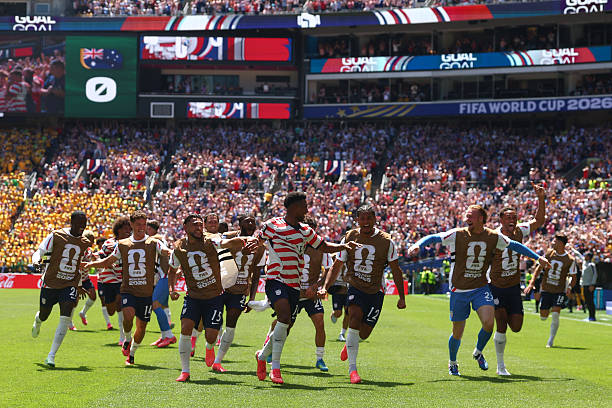
SEATTLE — Co-host nation the United States Men’s National Team (USMNT) has officially confirmed its status as a premier contender in the 2026 FIFA World Cup, securing a clinical 2-0 victory over Australia in a high-stakes Group D encounter at Lumen Field. The win, played out in front of a fervent capacity crowd, officially punched the Americans' ticket to the Round of 32. This result not only maintains the momentum of their campaign but also serves as a potent demonstration of the depth and tactical flexibility that the co-host nation possesses. By securing six points from their first two fixtures, the USMNT has established itself as one of the most organized and efficient teams in the tournament, moving to the top of the group standings and setting the stage for a deep knockout-stage run.
Early Dominance and Tactical Intent
From the opening whistle, the United States signaled a clear intent to dictate the tempo of the match. Recognizing the necessity of an early breakthrough to silence a resilient Australian side, the Americans employed a high-pressing system that hemmed the Socceroos deep within their own half. The breakthrough arrived just 11 minutes into the match, initiated by the sheer athleticism of Folarin Balogun. Capitalizing on an incisive, well-weighted pass from Antonee Robinson, Balogun utilized his blistering pace to drive past Australian defender Alessandro Circati.
His subsequent low cross across the face of the goal created immediate panic within the Australian penalty area. In the ensuing scramble, the pressure forced a catastrophic defensive error, resulting in an own goal by Cameron Burgess that broke the deadlock. The 1-0 lead was a microcosm of the U.S. tactical strategy: utilizing high-energy wing play to force the opponent into high-pressure decisions. The goal shifted the momentum entirely in favor of the hosts, who dominated possession and dictated the flow of the game for the remainder of the first half.
Strategic Execution Before the Break
Australia, known for their defensive grit, attempted to weather the storm and keep the scoreline respectable until halftime. However, the U.S. midfield, anchored by the technical range of Sergiño Dest, proved far too fluid for the Australian structure to track. In the 43rd minute, the hosts doubled their advantage in a moment of opportunistic brilliance. A deflected strike from Dest looped high into the air, creating a chaotic trajectory that defied the Australian backline’s attempts to track the flight of the ball.
Alex Freeman, displaying exceptional spatial awareness, was the first to react to the loose ball. Nodding the header past Australian goalkeeper Patrick Beach, Freeman effectively deflated the Australian spirits just before the whistle. The goal was a testament to the USMNT’s "second-ball" mentality—a commitment to winning contested aerial duels and pouncing on loose defensive clearances. Heading into the break with a 2-0 lead, the Americans had effectively neutralized the Australian defensive strategy, forcing the visitors to chase the game in the second half.
Defensive Resilience and Controlling the Narrative
The second half saw Australia attempt to force the issue, with manager Graham Arnold introducing substitute Nestory Irankunda to provide a spark of pace and creativity off the bench. Irankunda’s entry briefly disrupted the American rhythm, as Australia pushed higher up the pitch to find a pathway back into the game. The Socceroos created a flurry of half-chances through Cristian Volpato and Connor Metcalfe, but the U.S. defense, led by a disciplined back four, refused to yield.
The USMNT managed the game with the composure of a tournament favorite, expertly slowing the tempo when necessary and utilizing tactical substitutions to maintain their defensive shape. By effectively closing down the central channels and denying the Australians any room to build rhythm, the U.S. ensured their unbeaten record at Lumen Field remained intact. The disciplined performance underlined a critical evolution in the American squad: the ability to lock down a lead against an aggressive opponent in the knockout stages of a major tournament.
Tournament Outlook and Future Ambitions
With the victory, the United States joins fellow co-host Mexico in the Round of 32, a fact that has energized the fan base and added weight to their campaign. The path forward remains challenging, but the squad’s confidence is palpable. For the Australian side, the defeat serves as a difficult reality check, adding immense pressure to their final group stage match against Paraguay. They must now secure a result to salvage their qualification hopes.
For the Stars and Stripes, the work has only just begun. The victory over Australia is a signal that this iteration of the USMNT is not merely participating; they are competing with the tactical maturity required to navigate the world’s biggest stage. As they turn their attention to the next phase of the tournament, the USMNT will continue to draw upon the raucous support of their home crowds, fueled by the conviction that they possess the necessary clinical edge to go as far as any team in the 2026 FIFA World Cup.