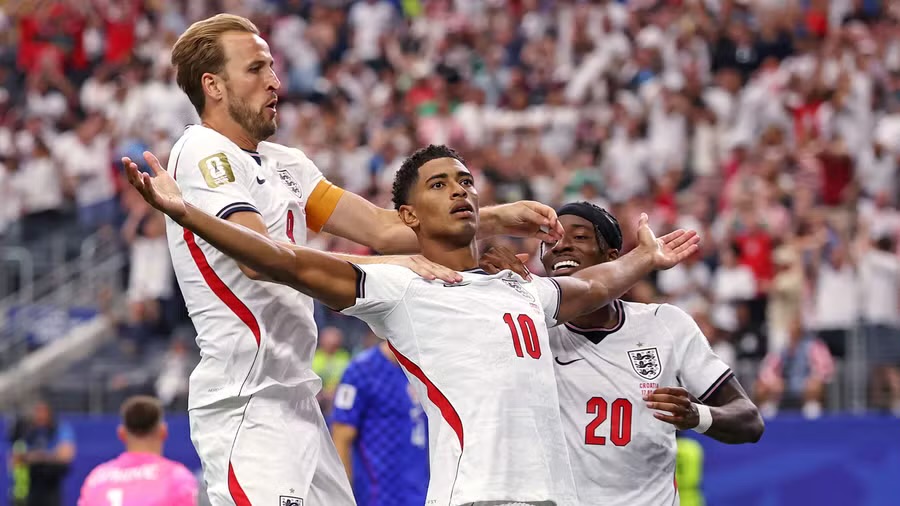
DOHA — England officially launched their 2026 FIFA World Cup campaign with a performance that blended tactical discipline with clinical attacking flair, securing a 4-2 victory over a formidable Croatian side. In what was the opening marquee fixture of the tournament, the Three Lions proved that under new manager Thomas Tuchel, they are ready to transcend the psychological barriers that have haunted the national team for decades. This victory was not merely a three-point gain; it was a resounding statement of intent from a side hunting their first major men’s trophy in 60 years.
A Dramatic First Half of High Stakes
The atmosphere at the stadium was electric, and the match began with the frenetic pace expected of two elite footballing nations. Croatia, known for their ability to dictate tempo through legendary veteran leadership, immediately looked to exploit early English nerves. The tide shifted, however, when referee Clément Turpin pointed to the penalty spot after a foul on Noni Madueke by Luka Modrić.
The ensuing drama was a quintessential World Cup moment. Harry Kane’s initial effort was expertly saved by Dominik Livaković, but VAR intervention caught the goalkeeper off his line, and defensive encroachment forced a retake. Kane, demonstrating the composure that has defined his career, hammered the ball home on his second attempt. This goal was a landmark event, marking Kane’s 30th appearance in a major international tournament—a new record for the English game.
Croatia’s response was immediate and characteristic of their fighting spirit. Martin Baturina leveled the score with a technical masterclass, finding the net with a strike that left Jordan Pickford with no chance. Yet, the ebb and flow continued. Before the interval, Kane once again etched his name into the history books, rising highest to head home a pinpoint corner from Declan Rice. With this goal, Kane equaled the legendary Gary Lineker’s record of 10 goals for England in World Cup finals. Just as the Three Lions thought they would head into the dressing room with the advantage, a lapse in concentration allowed Petar Musa to capitalize on an Ivan Perišić knockdown, sending the teams into the break deadlocked at 2-2.
Second-Half Dominance and Tactical Maturity
The second half showcased the evolution of Tuchel’s England. The manager clearly demanded a higher intensity and a more fluid transition game during the halftime break. The response was near-instantaneous. Within 120 seconds of the restart, Jude Bellingham made history by becoming the youngest European player to appear in four major international tournaments. He capped that milestone by firing England back into the lead from a near-impossible angle, latching onto a brilliant creative pass from Elliot Anderson.
With the lead restored, England controlled the game’s rhythm. Dominik Livaković, despite the eventual scoreline, was immense in the Croatian goal, forced into a series of heroic saves to deny Declan Rice, O'Reilly, and Anthony Gordon. While there was a moment of vulnerability when Jordan Pickford was forced to scramble to parry a late effort from Marco Pašalić, the English defense—anchored by Tuchel’s disciplined structural adjustments—remained largely untroubled.
The final flourish came courtesy of Tuchel’s bench. Bukayo Saka, introduced to provide width and pace, orchestrated a clinical counter-attack that caught the Croatian defense retreating. His precise ball found Marcus Rashford, who calmly slotted the finish home to seal a 4-2 scoreline.
Tournament Outlook and Historical Significance
This opening victory serves as the perfect launchpad for England’s tournament ambitions. For Tuchel, the match provided a roadmap for how this squad can handle adversity, maintain composure during high-VAR-frequency moments, and utilize squad depth to close out high-pressure games.
For Croatia, while the result was undoubtedly frustrating, the performance of veterans like Modrić and the sheer resilience of their attacking play confirmed that Zlatko Dalić’s side remains a dangerous proposition in any group. However, the onus is now on the Vatreni to regain their form and secure points in their remaining group-stage fixtures to avoid an early exit.
As England looks ahead to the remainder of the group stage, the performance of the younger core—specifically Bellingham, Anderson, and Saka—suggests a bridge has been built between the proven experience of Kane and the blistering pace of the new generation. If this level of intensity can be sustained throughout the knockout phases, the Three Lions are well-positioned to challenge for the highest honors. The 4-2 win in Doha will be remembered not just for the goals, but for the resilience shown by a team that is finally embracing the weight of expectation.