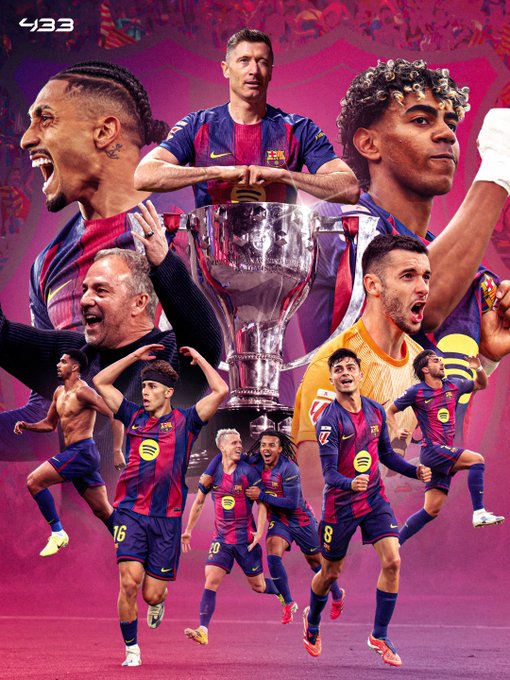
BARCELONA — There are league titles that serve as mere relief, usually arriving to break a frustrating silverware drought. Then, there are championships that serve a entirely different purpose: marking territory and establishing a footprint. FC Barcelona’s spectacular 2025/2026 La Liga triumph firmly belongs in the latter category.
By securing back-to-back Spanish league titles under the tactical stewardship of Hansi Flick, the Blaugrana have done something far more profound than simply collecting medals. In an era still shadowed by institutional hurdles and strict financial compromises, they have officially set the tactical benchmark for Spanish football.
A Cinematic Coronation in El Clásico
The domestic race was officially brought to a close in the most cinematic script imaginable. Barcelona sealed the championship on the pitch of their fiercest rivals, defeating Real Madrid 2-0 in a high-stakes El Clásico. Goals from Marcus Rashford and Ferran Torres mathematical pushed the Catalans out of reach, opening up a commanding 14-point lead at the top of the table with three games left to spare.
This was not a tired squad crawling across the finish line; it was an elite team stepping over it with absolute authority. With just two games remaining in the campaign, Barcelona sits comfortably on 91 points from 36 matches. Their underlying metrics tell the true story of their dominance: a staggering 91 goals scored against just 32 conceded. This massive goal difference does not merely decorate the La Liga table it completely explains it.
The Art of Suffering and Calculated Risk
While the final points tally suggests a smooth, unbothered march to victory, Barcelona’s season was forged in the fires of resilience. The squad was repeatedly stretched by a relentless wave of first-team injuries, testing the depth of an incredibly young roster. Managing a title defense under the heavy emotional weight of the Catalan spotlight is difficult enough, but doing so while navigating institutional rebuilding makes Flick's achievement monumental.
The defining characteristic of Flick’s system is its unapologetic, high-octane risk. Barcelona employs a defensive line so daringly high that it borders on the suicidal, leaving vast ocean-like spaces behind the center-backs. To sustain this, the team relies on a brutal, suffocating counter-press.
Under Flick, this high-wire act is not recklessness; it is a highly calculated formula. Barcelona defends by attacking, choosing to starve the opposition of oxygen rather than dropping into a low defensive block. When the team occasionally lost control of games during the winter months, they bent without snapping, consistently relying on their structural principles to navigate high-pressure moments.
Spending vs. Structure: The Great Spanish Contrast
The chasm between Barcelona and their cash-flush domestic rivals has provided a glaring contrast this season. For the second consecutive summer, Atlético Madrid wore the crown of Spain's biggest spenders, splashing out an astronomical €230.95 million to overhaul Diego Simeone’s squad with elite talent like Alex Baena, David Hancko, Johnny Cardoso, and Thiago Almada.
In terms of raw transfer market activity, Atlético spent roughly 8.4 times more than Barcelona's financially constrained board could manage. Yet, despite the massive capital injection, Atlético sits adrift in fourth place with 66 points a crushing 25 points behind the newly crowned champions.
Similarly, Real Madrid, despite boasting the Galáctico star power of Kylian Mbappé, found themselves entirely unable to match the relentless, weekend-to-weekend consistency maintained by the champions.
La Masia and the Exuberance of Youth
What makes this title terrifying for the rest of Europe is that Barcelona is not an aging champion squeezing one final trophy out of a decaying core. This is a project in its infancy. Earlier in the campaign, Flick fielded a starting lineup with an average age of just 23.34 years making it the youngest official Barcelona side featured in La Liga since 1930.
The youth ecosystem at the Spotify Camp Nou is the fundamental engine of the club's success:
-
Lamine Yamal: At just 18, he has already evolved into a world-class winger, terrorizing full-backs with an maturity that defies his age.
-
Pau Cubarsí: The teenage center-back anchors the defensive line with an icy composure, reading passing lanes like a veteran sweeper.
-
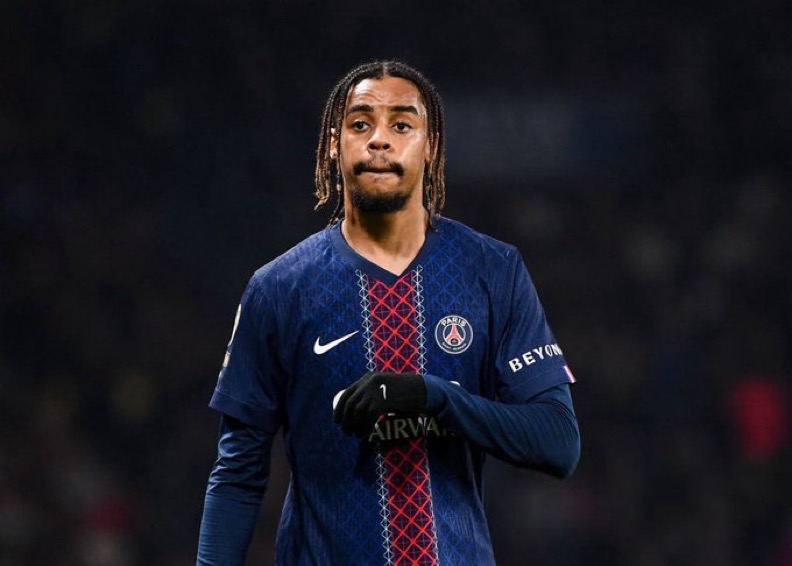
Marc Bernal: Following a devastating ACL injury earlier in his development, the young midfielder made a remarkable comeback, solidifying the base of the midfield.
-
The Core Guard: Pedri and Gavi, despite being seasoned international stars, are still years away from entering their physical primes, while breakthrough stars Marc Casadó and Gerard Martín have seamlessly integrated into the first-team rotation.
This heavily reliance on La Masia graduates provides an emotional and tactical shortcut. These players do not need time to learn pressing cues or positional angles; those habits have been structurally ingrained in them since childhood. This shared upbringing has built a rare dressing-room chemistry, creating a family-like bond where the players are completely willing to run through brick walls for Hansi Flick.
The European Asterisk and What Lies Ahead
For all of Barcelona's domestic perfection, a significant question mark still lingers over their continental exploits. The UEFA Champions League remains an examination that this young group has yet to fully master. The identical high-defensive line that allows them to bully mid-table La Liga teams can look exposed when targeted by Europe’s elite, hyper-fast transition sides.
True football dynasties are not declared over back-to-back domestic crowns; they are forged through repetition, European conquest, and long-term tactical adaptation. Having thoroughly tasted blood in Spain, the next logical step for Flick’s young brigade is transferring this dictatorial style of play onto the grand European stage.
Real Madrid will undoubtedly rearm in the summer, and Atlético will spend heavily once again to close the gap. But as the curtain falls on the 2025/2026 Spanish season, the trajectory in Catalonia is undeniable. Barcelona are champions of Spain once more, and the most uncomfortable reality for the rest of the footballing world is that they might only just be getting started.