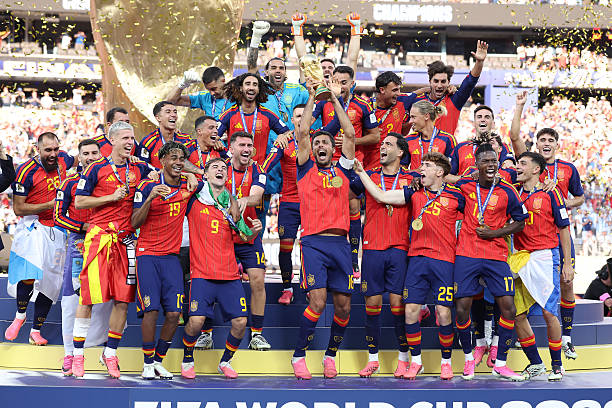
NEW YORK NEW JERSEY METLIFE STADIUM — In a historic clash that combined tactical discipline with high-stakes international drama, Spain defeated Argentina 1-0 in extra time to capture the FIFA World Cup 2026 championship. A decisive 106th-minute strike from forward Ferran Torres broke a grueling stalemate, cementing La Roja’s position at the absolute pinnacle of global football.
Beyond securing their second coveted World Cup trophy, the victory allows head coach Luis de la Fuente’s squad to establish an all-time European record by extending their unbeaten international run to an astonishing 38 matches.
The highly anticipated fixture, held before a packed stadium in East Rutherford, New Jersey, brought together the top two ranked nations in world football. While the match did not feature the open, high-scoring nature of the tournament's earlier knockout rounds, it provided an intense tactical battle between European structure and South American defensive resilience.
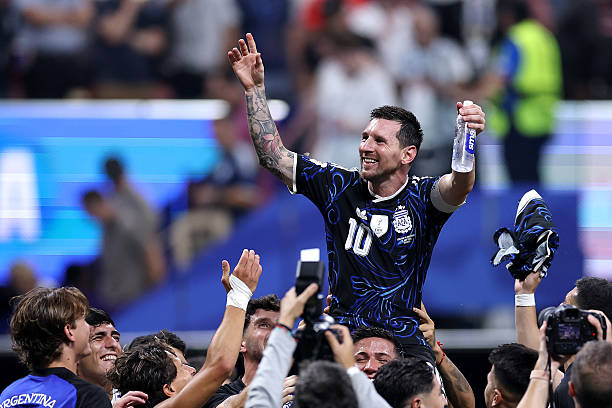
For Argentina, the defeat marked the end of an era, as Lionel Messi’s bid to secure consecutive world titles fell just short in what is widely expected to be his final appearance on the international stage.
Cagey Beginnings: A Strategic Stalemate in New Jersey
World Cup finals are traditionally defined by intense tactical caution, and the opening 45 minutes of this encounter followed that script perfectly. Despite the massive stakes, Spain looked to assert their front-footed, possession-based style early in the match.
The European champions generated the first real opening of the game through 19-year-old winger Lamine Yamal. Cutting inside from his familiar position on the right flank, the young playmaker opened up a yard of space and unleashed a powerful, deflected strike that forced a quick reaction save from Argentinian goalkeeper Emiliano Martínez.
Aside from that early scare, clear-cut scoring opportunities were rare during the opening half-hour. The match quickly turned into a physical battle in the midfield, characterized by strict defensive positioning and several controversial officiating decisions from referee Slavko Vinčić.
The Spanish bench expressed significant frustration when Argentinian midfielder Alexis Mac Allister escaped a caution following a heavy, full-blooded challenge on Dani Olmo.
Martínez remained the more active of the two goalkeepers throughout the first half, though the defensive structure ahead of him kept Spain's attempts to routine saves. Five minutes before the interval, the Aston Villa shot-stopper comfortably gathered a long-range effort from Mikel Oyarzabal.
Moments later, Spanish fullback Marc Cucurella saw a powerful drive whistle just wide of the target. The low-risk approach from both teams resulted in a historic statistical low, with the teams registering a record-low combined total of just three shots during the first half.
Intensified Pressure: Martínez Stands Firm Against the Spanish Vanguard
The second half saw a clear shift in momentum, as Spain began to move their defensive line higher and press the Argentinian midfield with greater intensity. In the 64th minute, a moment of uncharacteristic hesitation from Martínez almost gifted Spain the opening goal.
Olmo let fly with a powerful long-range strike that the Argentinian goalkeeper uncharacteristically spilled in the six-yard box. Fortunately for the defending champions, Martínez managed to scramble backward and turn the loose ball just wide of the post for a corner.
This close call triggered a sustained period of Spanish pressure. Moments later, Ferran Torres met a precise cross with a firm header from close range, forcing another smart reaction save from the Argentinian keeper.
Spain continued to commit bodies forward, finding an unlikely attacking threat in young center-back Pau Cubarsí. The defender drove out of the backline and unleashed a powerful shot from distance that Martínez had to beat away with both hands.
Throughout this second-half surge, Argentina focused heavily on maintaining their defensive low-block, relying on the veteran leadership of Nicolás Otamendi to organize the penalty box. However, this defensive focus limited their attacking options, leaving Lionel Messi isolated against Spain's central defenders.
The Red Card Turning Point and Extra-Time Drama
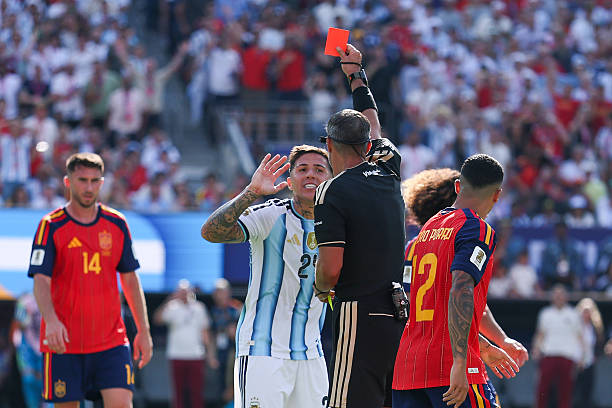
The tactical balance of the final shifted completely during second-half stoppage time due to a significant disciplinary infraction. Having already received a yellow card for dissent earlier in the half, Argentinian midfielder Enzo Fernández committed a late challenge on Pau Cubarsí.
Referee Slavko Vinčić immediately issued a second yellow card, making Fernández just the sixth player in football history to be sent off during a World Cup final.
Despite playing with ten men, Argentina managed to survive until the end of regulation time. A brilliant late save from Martínez denied Lamine Yamal what would have been a 90th-minute winner, forcing the match into a grueling 30 minute extra time period.
However, the statistical reality painted a difficult picture for the South American champions, who became the first team in World Cup final history to fail to register a single shot toward goal during the opening 90 minutes of play.
Five minutes into the extra period, Spain believed they had finally broken the deadlock. Nico Williams reacted quickest to a loose ball in the penalty box, turning it into an empty net to spark wild celebrations on the Spanish bench.
However, the joy was cut short when Vinčić disallowed the goal, spotting an administrative foul by Mikel Merino on Otamendi during the aerial build-up.
The Decisive Breakthrough: Ferran Torres Secures the Crown
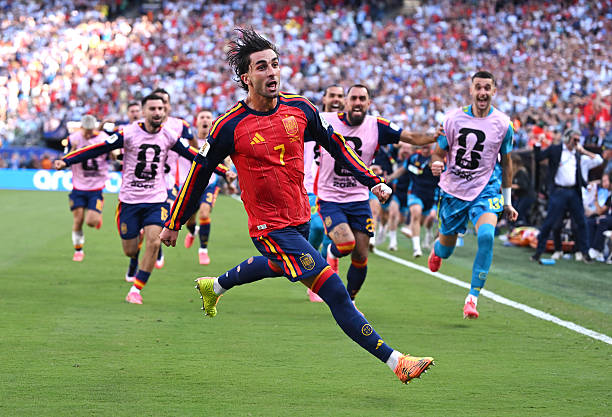
The tireless Spanish pressure finally reaped its reward in the 106th minute, just after the brief extra-time interval. Shifting their attack down the left flank, Spain capitalised on their numerical advantage.
Nico Williams delivered a precise, cushioned header back into the center of the penalty area. Ferran Torres anticipated the bounce perfectly, finding space between the tired Argentinian defenders to latch onto the ball and power a definitive volley into the roof of the net.
[ FIFA World Cup 2026 Final: Match Summary Ledger ]
Scoreline: Spain 1 - 0 Argentina (After Extra Time)
Decisive Goal: Ferran Torres (106')
Disciplinary Action: Enzo Fernández (Red Card - 90+2')
Historical Benchmark: Spain extends unbeaten streak to 38 matches
Down a goal and a man, Argentina attempted a desperate late push, throwing players forward in search of an equalizer. However, the Spanish midfield line, anchored by Rodri, maintained strict possession to close out the remaining minutes of play.
The final whistle confirmed Spain's sixth victory in their last seven major international tournament finals, establishing a modern standard of excellence in European football.
A Changing of the Guard in International Football
As the Spanish squad celebrated their historic achievement on the pitch, the contrast between the two footballing projects became clear. Under Luis de la Fuente, Spain has successfully integrated a young generation of talents led by Lamine Yamal, Pau Cubarsí, and Nico Williams into a cohesive unit that maintains the country's traditional possession style while adding dynamic pace on the wings.
For Argentina, the defeat represents a difficult conclusion to a highly successful international cycle. La Albiceleste missed the chance to become the first team in 64 years to successfully defend a World Cup title, a feat last achieved by Brazil in 1962.
As Lionel Messi walked off the pitch, football analysts noted the significance of the moment, viewing the final as a symbolic passing of the torch from the legendary playmaker to the rising stars of the sport. Spain’s second World Cup title establishes a new benchmark for international consistency, setting up an intriguing path forward as the global game transitions into a new era.