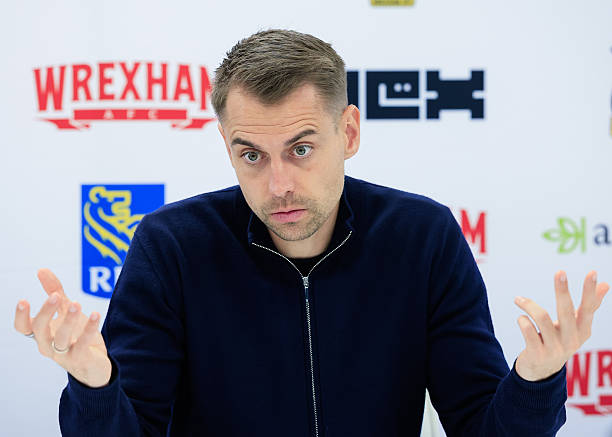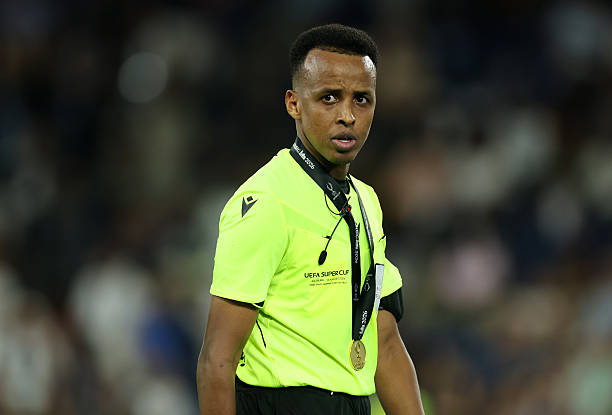
An extraordinary intersection of international sports diplomacy, geopolitical tension, and personal triumph, Somali referee Omar Artan took center stage at the UEFA Super Cup in Salzburg, Austria. Officiating the marquee clash where Paris Saint-Germain secured a 2-1 victory over Aston Villa, the 34-year-old official transformed a moment of profound personal setback into a landmark career milestone.
The assignment followed a devastating turn of events weeks prior, when Artan was denied entry to the United States despite his official selection by FIFA for the global tournament. Upon arriving at Miami International Airport, American border authorities turned Artan away under controversial circumstances. In the aftermath of his officiating performance in Salzburg, Artan inscribed a poignant statement on the official match ball, writing that the Super Cup was his World Cup. This powerful souvenir, shared widely by European football's governing body, highlights both the resilience of an elite match official and the deepening rift within global sports governance.
Starting From Airport Rejection to European Showcase
The road leading to Artan’s high-profile European appearance reflects a turbulent period marked by intense international scrutiny. Selected as part of an elite panel of international match officials by FIFA, Artan had spent years climbing the refereeing hierarchy within the Confederation of African Football (CAF). His inclusion on the World Cup roster was celebrated across East Africa as a major institutional achievement for Somali athletics.
However, the trajectory altered dramatically upon his landing in Florida. United States State Department officials cited national security protocols, claiming association with individuals linked to suspected terror groups—allegations that rendered him ineligible for entry under domestic immigration laws. Artan and the Somali football community categorically rejected these assertions, prompting public outrage across Somalia, where Artan was received as a national figure upon his return. Recognizing the diplomatic and sporting implications, European football leaders intervened by extending an extraordinary invitation for Artan to oversee one of UEFA’s flagship fixtures.
Deciphering FIFA and UEFA Institutional Mechanics
To understand the weight of Artan’s assignment, it is essential to clarify the distinct structures that govern professional football globally. FIFA serves as the worldwide governing authority responsible for international tournaments such as the World Cup, operating through six regional confederations. UEFA represents European football, while CAF oversees the African continent.
The deployment of a non-European referee for the UEFA Super Cup—a match traditionally reserved for European officials that pits the winners of the Champions League against the Europa League champions—was facilitated through a formal inter-confederation agreement signed between UEFA and CAF. This operational framework allows for cross-border exchange programs, sharing technical expertise, neutral officiating, and collaborative tournament management. By utilizing this administrative mechanism, UEFA bypassed traditional jurisdictional boundaries to provide Artan an elite platform following his exclusion from the FIFA roster.
Governance Friction and Political Subtext in Global Sports
Beyond the immediate human story, UEFA’s decision to appoint Artan carries significant political resonance within the higher echelons of sports administration. The gesture unfolds against a backdrop of escalating friction between UEFA leadership and FIFA management. Tensions have intensified following contentious proposals regarding the commercial restructuring of international tournaments, including debated plans to introduce private investment capital into FIFA properties.
UEFA’s vocal opposition to these commercial initiatives has led to unprecedented administrative friction, with European football leaders openly challenging the institutional direction of global football governance. By stepping in to host Artan after his exclusion from a FIFA-administered tournament in the United States, UEFA signaled its capacity to act independently, turning an administrative crisis into a showcase of cross-continental solidarity with CAF.
Economic and Regional Impact: Elevating African Officiating on the World Stage
Artan’s successful management of the Salzburg fixture carries profound implications for sports development across Africa. Elite officiating remains a critical area of growth for regional sports federations, where access to high-intensity matches directly impacts long-term professional development, FIFA ranking metrics, and representation at international competitions.
Following the match, Artan expressed deep gratitude on social media platforms to both UEFA and CAF for their structural support, acknowledging the trust extended to him by European officials. The public endorsement from major sporting bodies provides crucial validation for African officiating standards, demonstrating that elite referees from the region possess the technical precision required to handle fast-paced, high-value European club fixtures.
The Broader Context of International Mobility for Global Athletes
Artan’s ordeal highlights persistent challenges regarding visa access, immigration policy, and international transit for athletes and sports officials from developing nations. Despite holding official credentials issued by global governing bodies, sports professionals frequently encounter administrative barriers, heightened security screening, and sudden border rejections when traveling to foreign host countries.
As major multi-nation sporting events become increasingly common, the integration of foreign athletes and match officials relies heavily on streamlined border protocols and clear diplomatic channels. Artan's journey from a high-profile rejection at Miami International Airport to the center pitch in Salzburg underscores the ongoing need for synchronized international policies to protect the integrity of global sporting events and ensure fair treatment for accredited professionals worldwide.