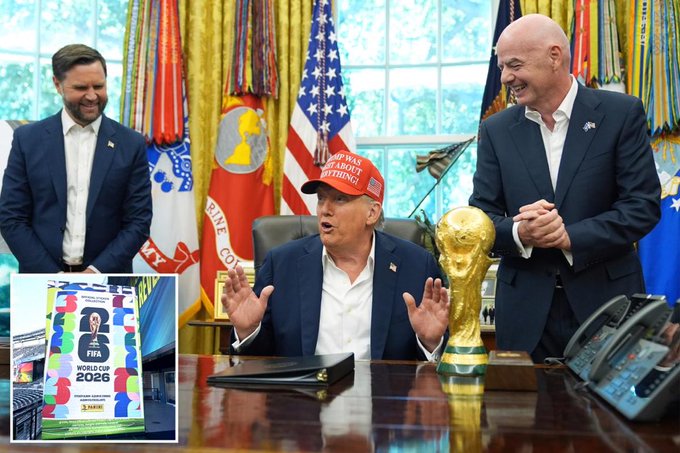
LOS ANGELES — United States President Donald Trump has publicly taken aim at FIFA over the astronomical ticket prices for the upcoming 2026 World Cup. Expressing shock at the four-figure sums ordinary fans are being asked to shell out, Trump admitted that even he would refuse to pay the standard asking price to watch the United States Men's National Team (USMNT) open their campaign.
The tournament, which is being co-hosted by the United States, Canada, and Mexico, kicks off on June 11, 2026. The U.S. team is scheduled to play its highly anticipated Group D opening match against Paraguay at SoFi Stadium in Los Angeles on June 12.
Trump Defends Working-Class Fans
In an exclusive interview with The New York Post, President Trump expressed genuine surprise when informed that base-level seats for the opening match are clearing the $1,000 threshold, with some upper-deck resale packages climbing past $2,700.
"I did not know that number," Trump stated plainly. "I would certainly like to be there, but I wouldn't pay it either, to be honest with you."
The President expressed immediate concern that working-class Americans, who form a core part of his political base, are effectively being locked out of the historic sporting event. "If people from Queens and Brooklyn and all of the people that love Donald Trump can't go, I would be disappointed," he added. "I would like to be able to have the people that voted for me to be able to go. But, you know, at the same time, it's an amazing success."
FIFA Defends "Dynamic Pricing" Strategy
Trump’s critical remarks put immense pressure on his long-time associate, FIFA President Gianni Infantino, who had spent the week fiercely defending the tournament's aggressive financial strategy.
For the 2026 edition, world football's governing body abandoned its traditional flat-rate pricing for group-stage matches. Instead, FIFA implemented a controversial "dynamic pricing" mechanism—a market-driven system commonly used in American concert tours and sporting events, where ticket costs fluctuate rapidly based on team popularity and real-time demand.
Speaking at the Milken Institute Global Conference in Beverly Hills, Infantino dismissed the backlash, arguing that the ticket prices are entirely aligned with the premium U.S. entertainment market. "You cannot go to watch a college game in the U.S., not even speaking about a top professional game of a certain level, for less than $300. And this is the World Cup," Infantino asserted.
Infantino also claimed that high pricing is a deliberate defense mechanism against independent scalpers, reasoning that if FIFA prices the tickets too low, secondary market flippers will simply pocket the profit. Under FIFA’s official resale platform, the organization collects a 30 per cent transaction fee splitting the cost by taking 15 per cent each from both the buyer and the seller.
Regional Pushbacks and Transit Adjustments
The ticketing crisis has triggered massive political resistance across host cities. In New York, Mayor Zohran Mamdani’s administration confirmed it is in active negotiations with FIFA to secure more affordable ticket access for working-class residents, especially given that tickets for the July 19 World Cup Final in East Rutherford, New Jersey, are currently averaging an astronomical $13,000.
Meanwhile, parts of North America are taking legal action to shield consumers:
-
The Toronto Cap: In Canada, matches played at BMO Field in Toronto are strictly capped. The Ontario provincial government enforced a ban preventing any World Cup tickets from being resold above their original face value.
-
New Jersey Transit Cuts: In New Jersey, public outcry successfully forced transport authorities to roll back a controversial 1,100 per cent price hike. A round-trip train ticket from Manhattan's Penn Station to MetLife Stadium had been aggressively hiked from its standard $12.90 up to $150. Following a direct intervention by Governor Mikie Sherrill, New Jersey Transit CEO Kris Kolluri secured private sponsorships to slash the transit fare by 30 per cent, dropping the final cost down to $105.
In response to the mounting international PR disaster, FIFA announced a last-minute release of a limited batch of lower-tier tickets priced at roughly $60 (£45) spread across all 104 matches. However, with the tournament less than a month away, football enthusiasts are finding that experiencing the beautiful game on American soil has become an luxury reserved strictly for the highest bidder.