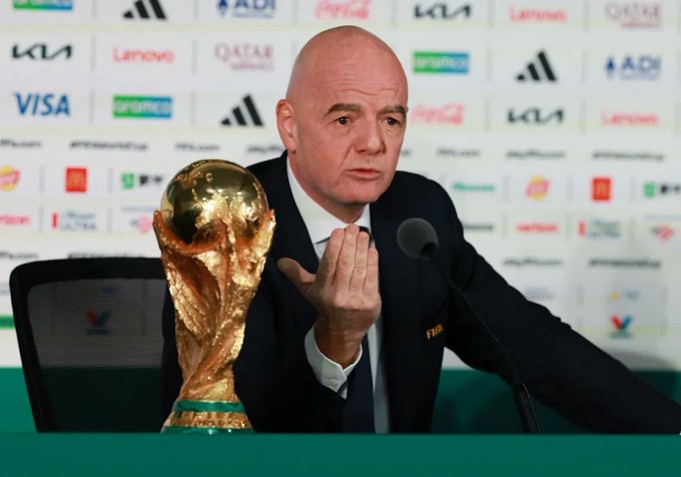
ZÜRICH, Switzerland — FIFA President Gianni Infantino has officially confirmed that the governing body is preparing to "examine and discuss" the potential expansion of the FIFA World Cup to a staggering 64 team format. This announcement, delivered via a sit-down interview with Swiss outlet Bluewin, has reignited the intense debate regarding the balance between commercial growth, inclusive development, and the sporting integrity of the world’s most prestigious athletic event.
While the football world is currently gearing up for the 2026 edition in North America—the first to feature 48 teams—FIFA’s gaze is already fixed on the 2030 centenary tournament. Originally slated to be hosted by Morocco, Portugal, and Spain, with celebratory opening matches in Uruguay, Argentina, and Paraguay, the 2030 event is now the centerpiece of a geopolitical and logistical struggle over the future of the sport.
The Philosophy of Inclusion: Infantino’s "Global Dream"
Gianni Infantino has long championed a vision of football that transcends the traditional "powerhouse" corridors of Europe and South America. His argument for a 64-team tournament is rooted in the belief that the World Cup serves as a primary catalyst for footballing development in emerging markets.
"Every nation should be allowed to dream of participating in the World Cup," Infantino stated. "You can see that the quality of the teams is extremely high—and it’s getting higher and higher all over the world." Infantino said.
From Infantino’s perspective, the World Cup is not merely a tournament; it is a mechanism for infrastructure investment. When smaller nations have a realistic path to qualification—or even the dream of it—national governments and local federations are more likely to invest in coaching education, grassroots programs, and stadiums. By expanding the field to 64 teams, FIFA aims to provide these "smaller" associations with the tangible incentive needed to foster talent.
Infantino cites the 2026 expansion to 48 teams as an unequivocal success. He argues that the performance of lower-ranked teams in recent qualifiers and tournaments has silenced critics who claimed that expansion would "dilute" the quality of play. Instead, he points to tactical sophistication and increased competitiveness across all confederations as proof that the global talent pool is deep enough to sustain a larger field.
South American Ambitions and the 2030 Logistical Puzzle
The 64-team proposal gained significant momentum due to an aggressive push from CONMEBOL. In the current plan for 2030, Uruguay, Argentina, and Paraguay are scheduled to host only the opening centenary matches before the tournament shifts to the primary hosts (Morocco, Portugal, and Spain). For South American officials, this is a bittersweet arrangement.
CONMEBOL President Alejandro Dominguez has been a vocal proponent of a more substantial role for the continent. He has described a larger, 64-team tournament as a "dream" that would "unite the world, just once." Under the current FIFA rotation policy, South America would effectively be sidelined from bidding for a full World Cup hosting role until at least 2042. By pushing for a 64-team format in 2030, CONMEBOL hopes to secure the right to host entire group stages, thereby providing their domestic economies with a larger share of the tournament’s revenue and prestige.
The logistical implications of a 64-team event are, however, staggering. A tournament of that size would require a minimum of 80 to 90 matches. Hosting this across three continents—with the added complications of trans-Atlantic travel for players and fans—would present a logistical challenge unlike anything in sports history.
The Voice of Dissent: Quality vs. Quantity
Despite the high-minded rhetoric from FIFA HQ, the proposal has encountered stiff resistance from key stakeholders in the game. The core criticism is that a 64-team World Cup risks turning the "pinnacle" of sport into a "vulgar" exercise in commercial expansion.
Ghana head coach Carlos Queiroz, a veteran of several World Cup cycles, has been among the most vocal critics. He famously suggested that moving toward such large formats renders the tournament "ordinary," arguing that the qualification process is the crucible that gives the finals their prestige. If almost half of the world's footballing nations are represented, the exclusivity that defines the World Cup begins to vanish.
This sentiment is echoed by UEFA President Aleksander Ceferin. For Ceferin, the World Cup is a luxury product. By saturating the market with more games and lower-ranked matchups, FIFA risks "diluting" the value of the television rights and the interest of the casual global viewer. Critics argue that FIFA is prioritizing short-term revenue gains—selling more tickets, broadcasting more hours of content, and securing more sponsors—over the long-term health of the sport.
The Economic and Sporting Impact
To understand the gravity of this debate, one must look at the economics of modern FIFA. The organization is a non-profit in name, but its operations are fueled by the massive revenues generated by the World Cup. Expansion is, at its core, a financial strategy.
-
TV Revenue: More teams mean more matches. More matches mean more inventory to sell to broadcasters, particularly in emerging markets like Asia and Africa, where national interest in the World Cup spikes drastically when the home team is involved.
-
Sponsorship: A 64-team tournament opens up new inventory for global partners. The longer the tournament lasts, the longer sponsors can leverage the "World Cup" brand in marketing campaigns.
-
Geopolitical Soft Power: Hosting even a portion of a World Cup is the ultimate branding tool for a nation. By spreading the tournament across six countries (or potentially more), FIFA effectively distributes the "soft power" benefits of hosting to a wider array of political leaders.
However, the sporting cost could be high. There is a genuine concern regarding player welfare. In an era where elite players are already playing 60 to 70 matches per season, the burden of an extended tournament, coupled with the travel requirements for a cross-continental 64-team event, could lead to a decline in physical performance and an increase in long-term injuries.
The Road to 2030: What Happens Next?
Infantino’s comments suggest that the gears of FIFA’s committee system are already turning. The process for 2030 is likely to follow this trajectory:
1. Committee Review: Following the conclusion of the 2026 World Cup, FIFA’s relevant committees—including the Competitions Committee and the FIFA Council—will analyze the feasibility of a 64-team format. This will involve technical studies on stadium requirements, infrastructure for teams, and the impact on the international match calendar.
2. Confederation Consultation: FIFA will need to navigate the competing interests of UEFA, CONMEBOL, CAF, AFC, and Concacaf. Since each confederation will want a larger share of the new slots, the internal negotiations will be as complex as the tournament itself.
3. The Sustainability Check: A 64-team tournament requires a level of infrastructure that few countries can provide alone. This will likely necessitate a permanent shift toward multi-nation hosting, which raises questions about the "soul" of the tournament. Can a tournament truly have a host "identity" if it is spread across dozens of cities and countries?
Conclusion: A Turning Point for Global Football
The push for a 64-team World Cup is a defining moment for the Gianni Infantino era. It is a decision that pits two competing philosophies against one another: the "Football for All" model, which prioritizes inclusion and the democratization of the sport, and the "Elite Product" model, which values quality, scarcity, and prestige.
If FIFA opts for expansion, they are gambling that the global appetite for football is effectively bottomless. They are betting that fans in Vietnam, Nigeria, or Peru will tune in for a 64-team tournament with the same fervor they currently reserve for the 32-team classic. If they are wrong, they risk turning the World Cup into just another tournament in a crowded global calendar, stripping away the unique aura that has made it the world's most-watched event for nearly a century.
As the international community awaits the findings of the post-2026 study, the debate continues. For the fans, the dream of seeing their national team on the world stage is an alluring one. But for the purists, the question remains: when does the quest for inclusion cross the line into the destruction of excellence?
The 2030 World Cup was intended to be a celebration of the past—a centenary nod to the tournament's history. Instead, it is shaping up to be a defining battle over the future. Whether it features 48 teams or 64, the decision made in Zürich will shape the trajectory of global football for generations to come.
Do you believe that the increase in participating nations genuinely fosters growth in developing countries, or does it primarily serve to inflate FIFA’s commercial revenue at the expense of tournament prestige?
Share Your Opinion in The Comments