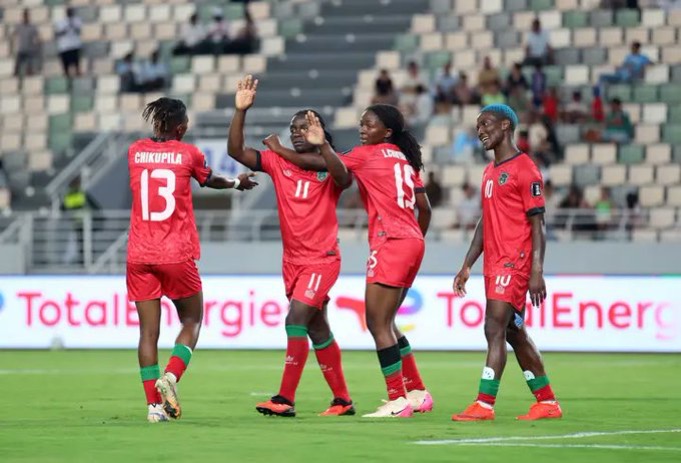
In one of the most compelling narratives in modern African sports history, debutants Malawi have booked a historic spot in the final of the TotalEnergies CAF Women’s Africa Cup of Nations (WAFCON) Morocco 2026. The Scorchers delivered a commanding performance on Wednesday night, overpowering a ten-woman Algeria side 3-1 in a dramatic semi-final encounter. World-class forward duo Tabitha and Temwa Chawinga once again proved to be the ultimate difference-makers, combining seamlessly to score all three goals for their nation and orchestrating one of the greatest fairy-tale runs in continental football history.
The victory marks the very first time Malawi has reached the championship match of Africa's flagship women's football tournament. Facing a tactical and physically assertive Algerian team, the Scorchers demonstrated remarkable tactical composure, capitalizing on a crucial first-half red card issued to Algerian defender Morgane Belkhiter before deploying their trademark high-speed counter-attacking system to seal a famous victory.
The Chawinga Sisters Masterclass: How the Semi-Final Was Won
The contest swung dramatically in Malawi’s favor early in the first half when Algeria’s tactical setup was disrupted by the dismissal of Morgane Belkhiter. Shown a direct red card following a high-stakes defensive challenge, Belkhiter left the North Africans playing with ten team members for over an hour of football. Malawi capitalized on the numerical advantage in the 33rd minute through a moment of extraordinary individual brilliance. Scorchers captain Tabitha Chawinga unleashed an acrobatic strike that rattled off the underside of the crossbar before crossing the goal line, giving her side a deserving lead.
Before Algeria could readjust their defensive shape, Malawi doubled their advantage on the stroke of halftime. Temwa Chawinga demonstrated elite composure inside the penalty box, latching onto a precise through-ball, cleverly rounding the Algerian goalkeeper, and calmly slotting the ball into an empty net to send the Scorchers into the break with a commanding 2-0 lead. Temwa nearly added a third early in the second half following a breathtaking fifty-yard solo run past three defenders, though her final effort drifted inches wide of the far post.
Algeria refused to surrender without a fight and dragged themselves back into the contest in the 60th minute. A dangerous set-piece delivery from Marine Dafeur caused panic in the Malawian penalty box, allowing Ikram Adjabi to react fastest to the loose ball and volley home to reduce the deficit to 2-1. However, the hope of a North African comeback was short-lived. Tabitha Chawinga effectively ended Algerian resistance minutes later, outmaneuvering her marker on the edge of the area before drilling a powerful left-footed strike into the bottom corner to complete her brace. Despite a late scare in the 87th minute when Algerian substitute Laura Muller rounded the keeper only to be denied by a goal-line recovery tackle, Malawi held firm through stoppage time to secure their place in the continental final.
The Unprecedented Rise of the Scorchers
Malawi’s path to the WAFCON 2026 final represents years of grass-roots reform, targeted institutional investment, and the international maturation of its star players. Historically, Malawian women's football struggled for visibility and financial resources compared to established regional powerhouses in West and North Africa. For decades, tournament qualification eluded the national team as structural barriers and limited international friendly fixtures hindered squad development.
The turning point occurred over the past five years through a coordinated effort by the Football Association of Malawi to professionalize the women's game, expand national scouting networks, and support domestic league structures. Central to this transformation has been the trailblazing international careers of sisters Tabitha and Temwa Chawinga. Having established themselves as dominant goalscorers across major professional leagues in Europe and North America, the duo brought invaluable high-level tactical experience back to the national setup. Their leadership helped Malawi capture the 2023 COSAFA Women's Championship, providing the blueprint and confidence required to navigate the rigorous qualification phases for WAFCON 2026.
Deciphering Red Cards, Tactical Width, and Transition Play
To understand how Malawi dismantled a highly disciplined Algerian team, one must examine the specific tactical mechanics that governed the match. The early red card served as the primary tactical inflection point. In professional football, a direct ejection forces the penalized team into a severe spatial deficit, requiring them to drop into a deep defensive block to cover open territory.
Malawi’s technical staff exploited this numerical superiority by maximizing tactical width—the practice of stretching the opposition's defensive line across the entire breadth of the pitch. By keeping their wide players touching the touchlines, Malawi forced Algeria’s ten players to cover much larger distances, creating massive vacant channels between the full-backs and central defenders.
Furthermore, Malawi utilized devastating transition play, which refers to the rapid phase of movement when a team recovers possession of the ball and immediately transforms from a defensive posture into a full-scale attack before the opponent can set their defensive structure. With the immense raw pace and spatial awareness of the Chawinga sisters operating in transition, Malawi transformed every Algerian turnover into an immediate, high-probability goalscoring opportunity.
Socio-Economic Impact and the Transformation of Women's Sport
Malawi’s historic march to the WAFCON final carries profound socio-economic and cultural significance that extends far beyond the perimeter of the football pitch. On a national level, the team’s success has united the country, sparking widespread public celebrations and elevating women's sports to unprecedented heights in public discourse. The visibility of female athletes excelling on the grandest continental stage provides a powerful, inspiring template for young girls across East and Southern Africa, challenging traditional gender norms and encouraging increased youth participation in organized athletics.
From an industry perspective, the Scorchers' run underscores the rapidly expanding commercial viability of African women's football. High viewership numbers across global broadcast networks, combined with viral international coverage of the Chawinga sisters, demonstrate a growing appetite among global sponsors and media houses for women's sports content in emerging markets. This exposure is expected to drive increased commercial sponsorship, higher performance bonuses, and greater infrastructure grants from regional bodies, fundamentally altering the financial landscape for Southern African sports federations.
Rebalancing the Power Dynamics of African Football
For decades, the power structure of African women's football was defined by the overwhelming dominance of West African nations—most notably Nigeria's Super Falcons—and more recently, the rise of North African giants like Morocco and South Africa's Banyana Banyana. Smaller nations from the COSAFA (Council of Southern Africa Football Associations) region were frequently viewed as peripheral contenders during major continental tournaments.
Malawi’s emergence as a finalist at WAFCON 2026 signifies a major rebalancing of this regional hierarchy. By defeating established North African opposition like Algeria in high-pressure knockout fixtures, Malawi has proven that dedicated talent development pipelines can bridge the historical gap between emerging football nations and traditional continental heavyweights. As the Scorchers prepare for their historic final, their journey stands as a beacon for underdog sports programs across the globe, proving that vision, unity, and elite individual excellence can rewrite sports history.