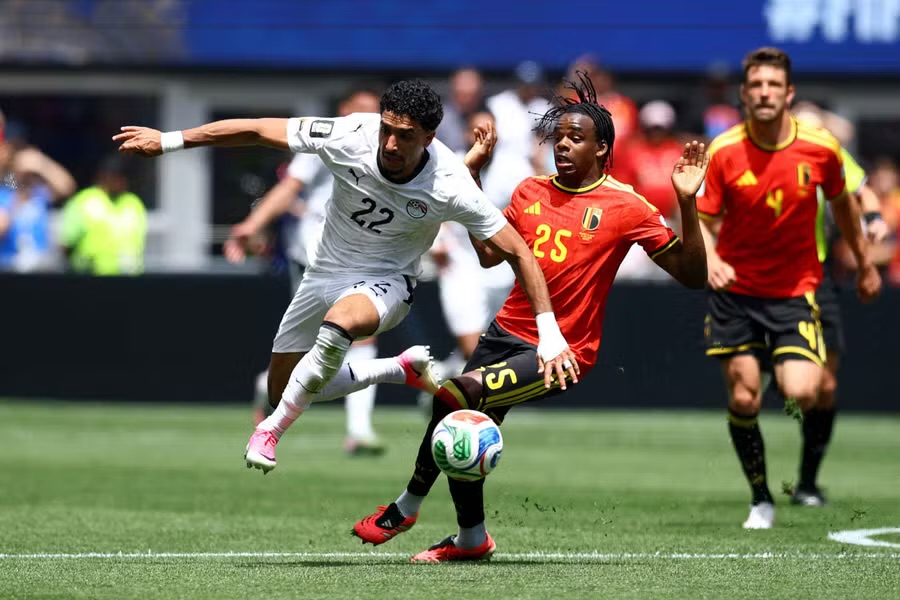
SEATTLE — The 2026 FIFA World Cup Group G stage opened with a compelling tactical narrative at Seattle Stadium, where a resilient Egypt side held European heavyweights Belgium to a 1-1 draw. In a contest played under sweltering conditions—with temperatures hitting 30 degrees Celsius—the match was defined by intense discipline and moments of individual brilliance. While Belgium managed to extend their enviable record in group-stage play, the result served as a statement of intent from an Egyptian team determined to prove they can compete with the sport’s elite.
Ashour Stuns the Red Devils
The match began with an aggressive tempo, as both sides looked to gain an early psychological advantage. Egypt, fueled by the tactical vision of Mohamed Salah, appeared to have a clear game plan: absorb the Belgian pressure and exploit the space left behind by Belgium’s high defensive line.
The strategy paid off spectacularly in the 20th minute. Salah, drawing the attention of multiple defenders, delivered a clinical pass that found Emam Ashour in space just outside the penalty area. Ashour did not hesitate, unleashing a powerful right-footed strike from distance that swerved past the outstretched hand of Thibaut Courtois. The ball nestled perfectly into the bottom corner, sending the Egyptian supporters in the stadium into a frenzy and leaving the Belgian squad visibly stunned.
For the remainder of the first half, Belgium struggled to find their rhythm. Manchester City winger Jérémy Doku, tasked with providing width and creative spark, found his path consistently blocked by a compact Egyptian defensive block. Despite holding the majority of possession, the Red Devils appeared disjointed, struggling to connect with their forward line as Egypt’s defensive discipline held firm through the halftime whistle.
The Turning Point: The Lukaku Effect
Belgium emerged from the tunnel for the second half with palpable urgency. Managerial adjustments seemed to breathe new life into the squad, and Kevin De Bruyne began to dictate the pace of the game from midfield. Shortly after the restart, De Bruyne nearly leveled the score with a trademark curling free-kick, but the ball rattled the woodwork, serving as a warning that the momentum was shifting.
As the match opened up, the intensity surged. Both teams traded high-stakes opportunities; Courtois was called upon to deny a dangerous, goal-bound header from Salah, while Youri Tielemans narrowly missed the target with a spectacular long-range volley that had the Egyptian goalkeeper beaten.
The definitive turning point arrived in the 66th minute when manager Domenico Tedesco introduced Romelu Lukaku. The striker’s immediate physical presence and relentless movement created chaos within the Egyptian penalty area. The pressure proved too much to handle; in his attempt to clear a dangerous cross, Egyptian defender Mohamed Hany was forced into a defensive error, inadvertently knocking the ball into his own net to level the score at 1-1.
A Hard-Earned Point and Group G Implications
The final stages of the match were defined by Belgium’s desperate, high-pressing search for a winner. They dominated the closing minutes, but Egypt’s defensive resolve remained unshakeable. The most significant moment of the finale came when Belgian defender Brandon Mechele rose to head a corner toward the top corner, only for Egyptian goalkeeper Mostofa Shobeir to produce a spectacular flying one-handed save to preserve the draw.
The final whistle confirmed a share of the points, a result that brings a complex set of implications for Group G. For Egypt, despite the disappointment of conceding the lead, the performance was a massive morale boost. It demonstrated that they possess the tactical structure and individual talent to cause an upset against any opponent, signaling that they will be a formidable hurdle for the remainder of the group stage.
For Belgium, the draw maintains a consistent, if unspectacular, start to their tournament journey. The Red Devils have now lost only one of their last 16 group-stage matches—a period that includes eight wins and seven draws—highlighting their propensity for remaining difficult to defeat even when not playing at their peak. As the dust settles on the Seattle match, both nations now look ahead to their next fixtures, with the understanding that every point will be vital in the pursuit of a spot in the knockout rounds. The match in Seattle was a vivid reminder that in the 2026 World Cup, there are no easy games, and that the gap between the favorites and the field is narrower than ever.