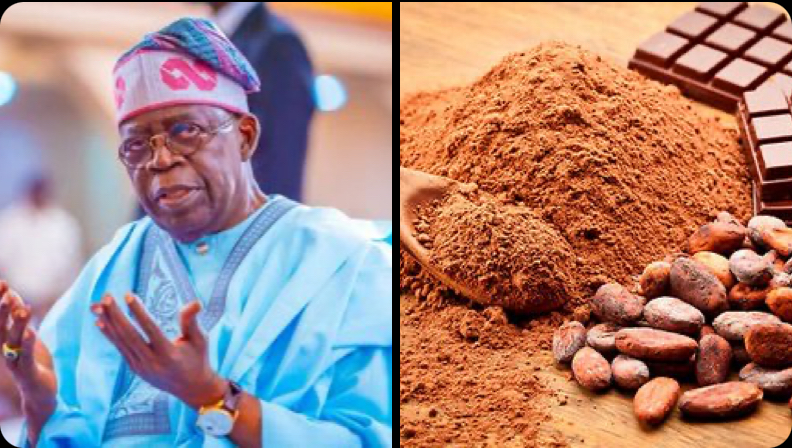
ABUJA, NIGERIA — President Bola Ahmed Tinubu has declared a definitive end to the unrefined exportation of Nigeria’s cocoa wealth. Speaking at the high-level Cocoa Value Addition Summit 2026 in the nation's capital, the President announced an aggressive transition toward domestic processing, industrialization, and localized value addition, vowing that Nigeria will no longer remain a passive supplier of raw agricultural commodities while importing expensive, finished confectionery products.
Represented at the summit by the Minister of Agriculture and Food Security, Senator Abubakar Kyari, President Tinubu made it clear that the era of exporting raw cash crops without capturing their secondary and tertiary market value is officially over. The bold policy shift comes at a critical juncture as Nigeria accelerates its macro-economic diversification strategies to maximize non-oil foreign exchange earnings, create sustainable manufacturing jobs, and stimulate domestic investments.
The summit, organized under the resonant theme “From Bean to Brand: The Bean in My Hand, The Brand in Our Future,” brought together an influential coalition of state governors, federal ministers, international development partners, financial institutional leaders, and agricultural investors. Together, they aim to implement a radical, comprehensive roadmap designed to rewrite the economic narrative of Africa's multi-billion-dollar cocoa sector.
Dismantling the Global Chocolate Disparity
A central theme of the summit was the stark economic imbalance defining the global cocoa value chain. While West Africa forms the literal backbone of the global confectionery market, the financial returns flowing back to the continent remain minimal.
President Tinubu highlighted that although Africa is collectively responsible for approximately 70% to 77% of the world’s raw cocoa production, the continent traps less than 10% of the wealth generated within the massive global chocolate economy—an industry currently valued at over $130 billion and projected by recent financial assessments to reach $165 billion by the end of the decade.
“Seven of every ten cocoa pods on this earth ripen under the African sun,” President Tinubu stated in his address. “They are grown by African hands on African soil with African knowledge passed down through generations. And yet, of a global chocolate economy now valued at well over $130 billion, Africa receives a pittance. Nigeria will no longer export raw beans while importing finished value. We will grind our beans at home, we will press our butter at home, we will make our chocolate at home, brand it at home, and sell it to the world on our own terms.”
To contextualize this economic discrepancy, the following table illustrates the stark realities of the global cocoa value chain and where the real economic margins are captured:
The Global Cocoa Value Chain Split
| Value Chain Segment | Primary Geographic Hub | Estimated Share of Global Value Captured | Key Output / Commodities |
| Upstream (Cultivation) | West Africa (Côte d'Ivoire, Ghana, Nigeria, Cameroon) | 6% – 8% | Raw Cocoa Beans, Wet Pods |
| Midstream (Processing) | Europe, North America, Emerging Domestic Hubs | 20% – 25% | Cocoa Liquors, Cake, Butter, Powder |
| Downstream (Manufacturing) | Western Europe, USA, Asia-Pacific | 35% – 40% | Premium Chocolates, Industrial Confectionery |
| Retail & Branding | Global Multinational Brands | 30% – 35% | Marketing, Retail Distribution, Consumer IP |
Moving Beyond Rhetoric: Real Estate and Grinding Capacity
Addressing skepticism regarding previous, unfulfilled industrial promises, the President emphasized that concrete structural expansions are already taking shape across Nigeria's industrial zones.
In Sagamu, Ogun State, private Nigerian investors are currently constructing a massive 70,000 ton capacity cocoa processing facility, slated to become the largest single agro-industrial plant of its kind in the country. Concurrently, the nation’s aggregate domestic grinding capacity has successfully crossed the 120,000 ton per annum milestone and continues to climb.
This infrastructural pivot is designed to safeguard and empower the more than 300,000 Nigerian farming families who currently cultivate cocoa across an expansive 1.4 million hectares of arable land. Nigeria currently commands roughly six to seven percent of global cocoa output, generating over ₦3 trillion in export earnings during recent historic market surges when international cocoa prices cleared the $10,000-per-tonne threshold.
However, the administration maintains that relying purely on the volatility of raw commodity pricing is an unsustainable economic model.
[Raw Bean Export Model] ----> High Market
Volatility & Minimal Job Creation
       VS.
[Local Value Ecosystem] ----> Grinding -> Butter
/Liquor Extraction -> Domestically Branded
Chocolate (Maximized Revenue)
The Financial Engine: Bank of Industry Deploys Strategic Capital
A critical pillar supporting this industrial transition is the financial backing of the Bank of Industry (BOI). Speaking at the event, the Managing Director and Chief Executive Officer of the BOI, Dr. Olasupo Olusi, confirmed the bank’s total alignment with the federal government's value-addition directive, offering long-term, concessionary capital to qualified agro-processing enterprises.
Dr. Olusi reminded attendees of the historical precedent where agricultural wealth directly built Nigeria’s foundational civil infrastructure. In the post-independence era, it was cocoa revenues that financed iconic landmarks like the Ibadan Cocoa House, funded the Western Region’s free education initiatives, and laid the groundwork for early public utilities.
To catalyze a modern industrial renaissance, Dr. Olusi disclosed that the BOI systematically disbursed more than ₦164 billion in 2025 alone to support over 3,500 agro-processing and food-production businesses. These funds directly financed modern processing factories, automated mills, sophisticated pack-houses, and temperature-controlled cold-chain logistics, successfully integrating nearly 48,000 smallholder farmers into structured industrial value chains.
New European Financing Injection
Building on this momentum, the BOI chief announced that the institution has successfully secured a fresh €60 million credit facility from the European Investment Bank (EIB). This specialized fund will be utilized to construct a robust financial ecosystem for the domestic cocoa sector, featuring dedicated windows for:
1. Large-scale industrial grinding plants.
2. Specialized food-ingredient manufacturing.
3. High-grade eco-friendly packaging lines.
4. Artisanal and commercial-scale chocolate production houses.
Aligning with the Nigerian Industrial Policy
Integrating the agricultural strategy with broader industrial goals, the Minister of State for Industry, Senator John Owan Enoh, explained that the summit represents a core operational phase of the Nigerian Industrial Policy. The policy focuses on aggressive import substitution and the systematic expansion of domestic manufacturing capabilities to support the presidency's long-term goal of building a $1 trillion national economy.
Senator Enoh, who shared reflections on his youth working within the cocoa-producing communities of Cross River State, noted that generations of local farmers have labored under intense physical strain without ever realizing the true economic value of their harvests. He observed that despite Cross River State remaining one of the premier producers of premium cocoa beans in West Africa, it still lacks a flagship, world-class processing hub—a structural deficiency the current administration is actively working to correct through public-private partnerships.
The Abuja Declaration: Forging a Pan-African Cocoa Alliance
Nigeria's domestic industrial drive is also set to integrate into a broader regional strategy. The Federal Government is spearheading diplomatic and economic collaborations with its West African neighbors—specifically Côte d’Ivoire, Ghana, and Cameroon.
By aligning these four dominant nations, Africa can establish a unified trade bloc controlling roughly 75% of global cocoa production. This collective bargaining unit would possess the leverage necessary to influence international market pricing, dictate sustainability standards, and resist unfair trade practices imposed by international buyers.
The Chief Executive of the Ghana Cocoa Board (COCOBOD), Ransford Abbey, delivered a compelling goodwill message supporting this cross-border integration. He called for the formal expansion of the existing Ghana-Côte d'Ivoire cocoa partnership to officially include Nigeria and Cameroon under the upcoming Abuja Declaration.
“We do not need charity; we deserve equity,” Abbey asserted strongly. “The time has come for Africa to process its own wealth, protect its smallholder farmers from exploitation, and negotiate with a singular, unyielding voice in the global marketplace.”
The summit concluded with the formal adoption of the Cocoa Value Addition Accord, alongside the framework for the Abuja Declaration. These agreements commit member states to synchronized regional processing goals, strict product traceability compliance, joint investment packaging, and harmonized farm-gate pricing frameworks.
Through this unified strategy, Nigeria and its regional partners are positioning themselves to transition from simple primary producers into dominant, self-contained industrial leaders of the global food economy.
While the shift toward domestic processing offers massive economic benefits, structural bottlenecks like electricity deficits and specialized logistics have historically hindered Nigerian manufacturing. What specific infrastructure concessions or specialized industrial zones do you believe the government should introduce to ensure these new multi-million-dollar processing facilities remain globally competitive?