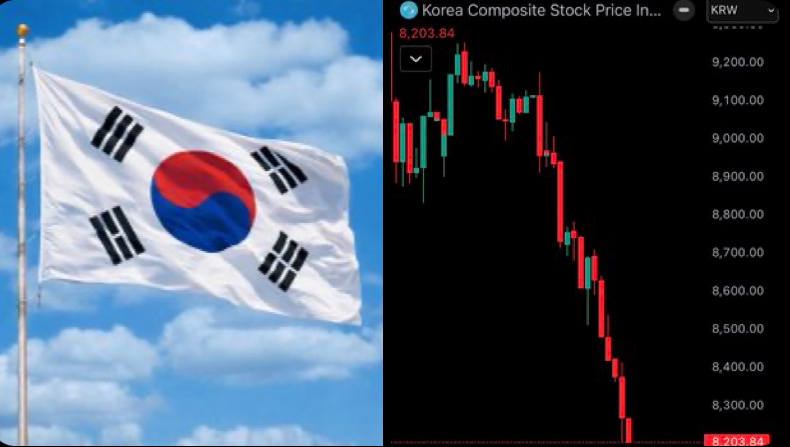
SEOUL — The financial landscape in South Korea faced a dramatic reality check on Tuesday, June 23, 2026, as the Korea Composite Stock Price Index (KOSPI) recorded its most significant single-day decline in over three months. The benchmark index, which had only one day earlier celebrated a historic climb past the 9,100-point threshold, plunged by a staggering 9.99%. Closing at 8,203.84, the index shed 910.71 points in a sell-off that triggered an automatic, bourse-wide trading halt for 20 minutes during the afternoon session. This sharp correction marks the most intense downward movement since March 4 and has sent shockwaves through regional and global financial markets.
The immediate trigger for this volatility was an aggressive, broad-based exit by overseas investors who had been the primary architects of the index’s record-breaking ascent. The focus of the sell-off was the nation’s semiconductor sector, specifically the market heavyweights Samsung Electronics and SK Hynix. These two companies alone currently account for more than half of the entire KOSPI’s total market value. When both firms saw their valuations tumble by more than 12% within a single session, the impact on the broader index was catastrophic, effectively wiping out billions in market capitalization and shattering the sense of invincibility that had characterized the market’s performance throughout June.
Market analysts have been quick to dissect the underlying causes of this volatility, pointing toward an index that many feel has become dangerously overheated. Alexander Redman, the chief equity strategist at CLSA, noted that the market’s current state is "dangerously overstretched." Redman and other institutional observers have raised significant alarms regarding the structure of the recent rally, specifically citing the role of heavy retail investor engagement and the emergence of volatile financial instruments. A primary concern among analysts is the recent introduction of leveraged single-security ETFs, which allow investors to amplify their exposure to the price movements of the nation’s most volatile chip stocks. Redman described the adoption of these products as "pouring fuel onto the fire," as they have introduced a level of reflexive, algorithmic selling pressure that traditional market mechanics are ill-equipped to handle.
Read Also: South Korea Makes History: Market Cap Crushes 6,000 Trillion Won Milestone
The situation has moved rapidly from a market concern to a regulatory crisis. On Monday, Lee Chan-jin, the head of South Korea’s market watchdog, made a candid admission that has drawn significant attention from the international financial community. Lee conceded that the government may have been "too hasty" in approving these highly leveraged funds tied to volatile technology assets. As margin debt reached record highs throughout the month of June, regulators have been forced into a defensive position, issuing a series of repeated, increasingly urgent cautions to retail investors. The FSS is now under intense pressure to re-evaluate the regulatory framework governing retail access to high-leverage products, with industry insiders speculating that further restrictions on these ETFs may be imminent.
Despite the intensity of the Tuesday correction, the broader macroeconomic context for the KOSPI remains complex. Even after the nearly 10% decline, the index remains up by 94.67% year-to-date, suggesting that the recent sell-off is not necessarily the beginning of a total systemic collapse, but rather a profound revaluation of high-growth technology assets. The South Korean won has also played a role in this volatility, having weakened by approximately 6.5% against the U.S. dollar, adding further complexity to the investment environment for foreign capital.
In the immediate wake of the equity market turmoil, institutional investors sought a classic "flight to quality," moving capital into safer, interest-bearing assets. September futures on three-year treasury bonds gained 0.14 points to close at 103.01. Simultaneously, the yield on the most liquid three-year Korean treasury bond fell by 3.1 basis points to 3.772%, while the benchmark 10-year yield dropped by 1.8 basis points to 4.179%. This inverse movement in bond yields relative to equity prices confirms that the market shift was a deliberate move toward risk aversion rather than a panicked liquidation of all asset classes.
Ultimately, the events of Tuesday appear to represent a healthy, albeit painful, correction for a market that had perhaps grown too optimistic in its valuation of AI and semiconductor demand. While the long-term outlook for South Korean industry remains strong due to its foundational role in the global supply chain, the immediate future will likely be defined by a more cautious approach to risk management. The era of unchecked, high-leverage retail growth has faced its first true stress test, and the resulting volatility serves as a stark reminder of the inherent dangers of speculative trading. As the market attempts to find its footing, the focus will remain on whether these regulatory interventions can stabilize the landscape without stifling the innovation and investment that have historically driven South Korea’s economic expansion. For retail traders who have utilized leverage to chase the market’s record highs, the message is clear: they have been playing with fire, and Tuesday’s correction was the consequence of that risk.