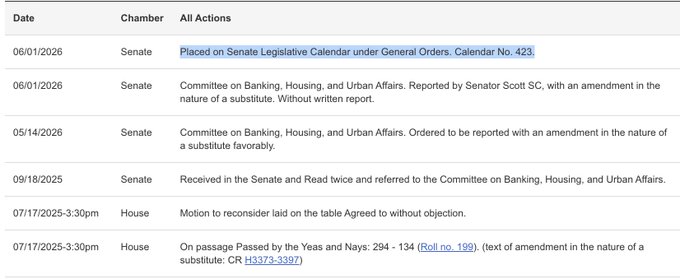
WASHINGTON, D.C. — In a development that has sent ripples of optimism through the corridors of Washington and the boardrooms of the global fintech industry, the Digital Asset Market Clarity (CLARITY) Act has officially been placed on the United States Senate Legislative Calendar. This transition, confirmed on June 1, 2026, marks the most significant procedural progression for digital asset regulation in the United States since the legislation’s inception.
A Foundation Built on Bipartisan Consensus
The momentum behind the CLARITY Act was cemented on May 14, 2026, when the Senate Banking Committee delivered a decisive 15-to-9 bipartisan vote in favor of the bill. This committee-level approval served as a vital validation of the legislation's core mission: to provide a robust, predictable regulatory environment for the burgeoning digital asset sector.
The act’s placement on the Senate Legislative Calendar is a critical procedural milestone. It effectively moves the legislation out of committee-level deliberations and into the queue for full Senate consideration. For industry observers and market participants, this move signals that the bill has overcome its first major bureaucratic barrier, positioning it for potential floor debate.
Understanding the Legislative Journey
While the bill’s arrival on the Senate calendar is a cause for celebration among proponents, seasoned observers in Washington are quick to provide a measured outlook. Placement on the calendar signifies eligibility; it does not constitute a guarantee of an immediate floor vote. The scheduling of such a vote now rests in the hands of Senate leadership, who must balance the CLARITY Act against a crowded legislative agenda and the competing priorities of the current congressional session.
The CLARITY Act has already navigated five of its nine foundational steps toward becoming federal law. The road to the President’s desk remains complex and requires the completion of the following procedural hurdles:
-
Full Senate Deliberation: The legislation must undergo a comprehensive floor debate. This stage is expected to be contentious, as lawmakers introduce potential amendments designed to refine or alter the bill's regulatory scope.
-
The Floor Vote: Following the conclusion of debate, the bill must face a formal Senate floor vote. To clear this hurdle and overcome potential procedural obstruction, the legislation will require a minimum of 60 votes.
-
Bicameral Reconciliation: As the Senate committee introduced specific changes and amendments to the version originally passed by the House of Representatives in July 2025, the two chambers must engage in a reconciliation process to ensure the House and Senate versions are identical.
-
Executive Enactment: Only after successfully passing both the House and the Senate in unified form can the bill be presented to the President of the United States for a final signature, officially enshrining it into law.
The Quest for Regulatory Clarity
The driving force behind the CLARITY Act is the urgent need to resolve the "jurisdictional friction" that has plagued the digital asset sector for years. Currently, the industry operates in a state of regulatory ambiguity, caught between the divergent enforcement priorities of the Securities and Exchange Commission (SEC) and the Commodity Futures Trading Commission (CFTC).
Senator Cynthia Lummis, a vocal and consistent proponent of the legislation, has framed the bill as a necessary step for the United States to maintain its position as a global leader in financial innovation. By providing a statutory mechanism to distinguish which agency holds oversight authority over specific types of digital assets, the CLARITY Act aims to eliminate the "regulatory by enforcement" model that has hampered industry growth.
The goal is a structural transition toward a stable, transparent marketplace where firms can innovate with the certainty that they are in compliance with federal guidelines. By clarifying the oversight roles of the SEC and CFTC, the legislation is designed to mitigate the risks that have historically deterred institutional entry into the digital asset space.
Market Reaction and Institutional Confidence
The legislative progress of the CLARITY Act is being monitored with intense scrutiny by both domestic and international market participants. The confidence of major institutional players is already beginning to manifest in market behavior. Notably, Galaxy Digital recently demonstrated its conviction regarding the bill's prospects by executing a $10 million institutional trade based on the prediction that the Act will secure passage within 2026.
Simultaneously, leadership at Coinbase has voiced strong, continued optimism. In recent communications, they have noted that the bill is nearing its final form, suggesting that the primary friction points have been largely identified and are currently being navigated through bipartisan negotiation.
Navigating Market Volatility
This legislative progress is unfolding against a backdrop of broader market volatility. As of June 2026, Bitcoin has experienced price fluctuations that have seen it trade below the $68,000 mark. While such volatility is a hallmark of the digital asset market, analysts at Standard Chartered have highlighted an interesting shift in investor behavior.
Some analysts suggest that Ethereum may be positioned to outperform Bitcoin in the near term as investors pivot their strategies. During this period of regulatory transition, market participants are actively seeking new opportunities, looking for assets that may benefit from the establishment of a clear legal framework. This reallocation of capital is a sign of a maturing market, one that is becoming increasingly responsive to both macroeconomic indicators and legislative developments.
The Path Forward
For now, the digital asset industry remains focused on the next major milestone: the announcement of an official date for the Senate floor vote. Whether the CLARITY Act proceeds to a vote this summer or is pushed into the fall will be a decisive factor in the industry's trajectory for the remainder of the year.
As Congress deliberates, the stakeholders—from institutional investors to software developers—remain in a state of watchful anticipation. The outcome of this legislative push will likely define the structure of the U.S. digital asset economy for years to come, marking the transition from an experimental frontier to a regulated, integrated component of the global financial system.