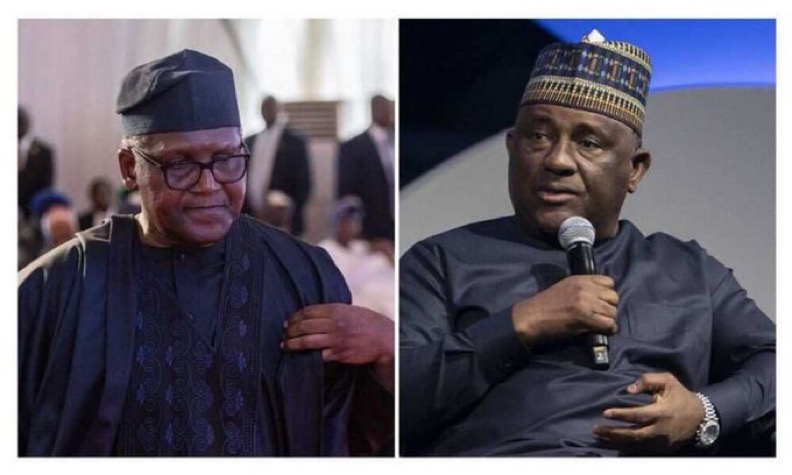
Nigeria’s premier business magnates, Aliko Dangote and Abdulsamad Rabiu, have expanded their collective personal wealth by approximately $9.53 billion since the beginning of 2026. Data tracked by Nairametrics from the Bloomberg Billionaires Index reveals that this remarkable wealth accretion has been propelled by robust rallies across the Nigerian Exchange (NGX), alongside critical milestones achieved within their respective mega-scale manufacturing, food, energy, and infrastructure enterprises.
The financial data underscores how domestic equities and targeted industrial investments continue to compound equity value for the continent’s most prominent industrial leaders. Through the first eight months of the year, Dangote’s net worth advanced by $5.26 billion, reflecting a 17.5% year-to-date increase. Concurrently, Rabiu achieved a staggering percentage growth rate, expanding his personal fortune by 42.2% with the addition of $4.27 billion. Together, the two industrial heavyweights hold a combined net worth of approximately $49.6 billion, consolidating Nigeria's status as the primary wealth engine of Sub-Saharan Africa.
Comprehensive Wealth Breakdown: Dangote Retains Continental Supremacy While Rabiu Surges
As of August 20, 2026, Aliko Dangote’s total net worth reached an authoritative $35.2 billion, firmly cementing his status as Africa’s wealthiest individual. The primary driver of his public equity expansion remains Dangote Cement Plc, where he maintains an overwhelming equity stake of approximately 86%. Shares of the building materials conglomerate experienced a dramatic upward trajectory on the NGX, rising from N609 per share at the start of the year to close at N1,034 per share on Wednesday, August 19. This 69.8% year-to-date share price surge significantly lifted the valuation of Dangote's equity portfolio, generating multi-billion-dollar capital appreciation.
Meanwhile, Abdulsamad Rabiu, founder and executive chairman of BUA Group, recorded even steeper percentage gains. His total fortune climbed to $14.4 billion, largely anchored by his near-total ownership of BUA Cement Plc and BUA Foods Plc. Rabiu controls approximately 98% of BUA Cement directly and through affiliated corporate entities, according to the group's 2026 semi-annual financial filings. BUA Cement's share price surged by 77% year-to-date, rising from N178.50 in January to N316 per share in mid-August. Although BUA Foods experienced a minor temporary valuation pullback of –4.79% in recent trading sessions, the net appreciation across Rabiu’s overarching portfolio delivered an unprecedented surge in his personal balance sheet.
Beginning From Mid-Year Volatility to Mega-Infrastructure Capitalization
The financial trajectory of both billionaires throughout 2026 offers a compelling study in market momentum and corporate expansion. Earlier in the year, Rabiu experienced an explosive mid-year market rally. In May, data indicated that his net worth had briefly touched $18.7 billion, representing a phenomenal 80% surge that added over $8.54 billion to his portfolio in less than five months. Subsequent market recalibrations and share price corrections across the consumer goods sector led to a moderate retreat from that peak, stabilizing his current fortune at a highly robust $14.4 billion.
Conversely, Dangote’s wealth narrative in 2026 has become increasingly interconnected with the operational maturation and financial restructuring of the Dangote Petroleum Refinery in Lekki, Lagos. Recognized by Bloomberg as his single most valuable strategic asset, Africa’s largest oil refinery began operational rollout in 2024 and has rapidly accelerated toward full operational capacity. Ahead of its highly anticipated $5 billion Initial Public Offering (IPO), the refinery secured a major financial landmark on August 18 by obtaining a $400 million underwriting commitment. This development followed a successful $2.5 billion private placement completed in July, injecting substantial institutional liquidity and cementing the infrastructure asset's multi-billion-dollar valuation ahead of its public market listing.
Capital Structure, Equities Rally, and Strategic IPO Underwriting
To understand how $9.53 billion in wealth was created within eight months, one must examine the mechanisms of equity illiquidity premium, market float, and underwriting commitments in emerging capital markets. On the Nigerian Exchange, both Dangote Cement and BUA Cement feature exceptionally tight free floats, meaning a vast majority of total issued shares are closely held by their respective founders. When institutional demand for building materials and infrastructure equities increases, the limited supply of traded shares accelerates price discovery, driving rapid market capitalization expansion that directly inflates the net worth calculations of the principal owners.
Furthermore, the recent $400 million underwriting commitment secured by the Dangote Petroleum Refinery serves as an essential corporate finance mechanism. An underwriting commitment represents a binding guarantee by investment banks or financial syndicates to purchase any unsubscribed shares during an offering, thereby guaranteeing that the entity raises its target capital regardless of broader market fluctuations. By securing $2.5 billion through private placements and backing it with formal underwriting commitments, Dangote has established a validated institutional baseline for the refinery, laying the groundwork for one of the largest corporate equity listings in African history.
Economic Transformation, Infrastructure Autonomy, and Industrial Impact
The unprecedented wealth expansion of Nigeria’s primary industrial titans holds profound implications for the wider West African economic landscape. Industrial manufacturing and energy refining represent high-capital, long-gestation sectors that dictate national productivity, import dependency, and foreign exchange stability. The massive capital appreciation enjoyed by Dangote and Rabiu reflects investor confidence in Africa's domestic capacity to produce essential commodities—namely cement, refined petroleum, fertilizer, and processed foods—internally rather than relying on costly foreign imports.
Moreover, the successful operational scaling of major assets like the Dangote Refinery directly alleviates chronic balance-of-payment pressures on the Nigerian economy. By shifting the country from a net importer of refined petroleum products to an exporting energy hub, these industrial investments help stabilize local currency valuations, lower logistics expenses for domestic businesses, and foster downstream industrial clusters. The financial success of these conglomerates demonstrates that large-scale, long-term capital investments in African real assets can generate world-class investment returns.
African Capital Markets on the Global Stage
In a broader global context, the expansion of fortunes tied to the Nigerian Exchange highlights the growing maturation and resilience of African capital markets amidst global economic rebalancing. While international equity indices have navigated shifting interest rate environments and commodity volatility throughout 2026, the strategic investments made by African conglomerates in basic materials and energy infrastructure have delivered exceptional alpha.
The upcoming public listing of the Dangote Petroleum Refinery is poised to attract unprecedented international institutional investment into the West African region, enhancing market depth, liquidity, and governance standards across the regional exchange. As both Dangote and Rabiu continue to expand their industrial footprints into neighboring African nations under the African Continental Free Trade Area (AfCFTA) framework, their corporate balance sheets serve as pivotal instruments for cross-border trade integration, regional infrastructure development, and sustained economic growth across the continent.