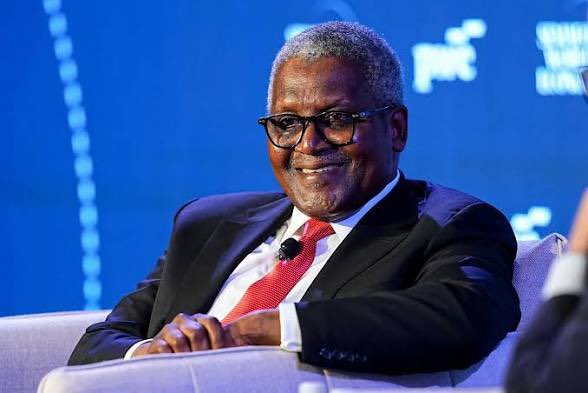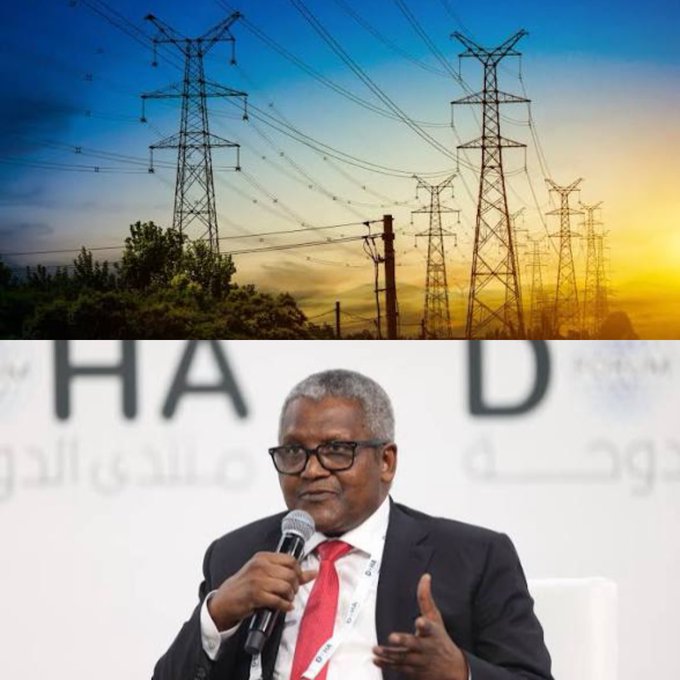
Aliko Dangote says the Dangote Group could redirect funds from planned ventures, including steel, into power projects across Africa over the next three to four years.
Aliko Dangote, President of Dangote Group, has announced plans to invest more than $10 billion in Africa’s power sector over the next three to four years, saying reliable electricity is essential to the continent’s industrial and economic development.
The billionaire businessman disclosed the plan during an interview with Al Jazeera, where he described electricity as one of the biggest requirements for Africa to achieve sustained economic growth.
Dangote also revealed that his conglomerate could cancel one or two planned businesses and redirect the capital into power, specifically mentioning the group’s steel ambitions.
“There is one or two businesses that we might cancel, like steel, and we will put in the money. We want to invest over $10 billion alone in power.”
Dangote considers power more critical to Africa’s growth
Dangote said the proposed investment is linked to what he expects to be a significant transformation across Africa during the next three to four years.
He argued that the continent cannot achieve substantial economic growth without addressing its electricity challenges.
“Power is key; we will never ever create growth without power,” Dangote said, emphasizing that by power he meant electricity.
His comments come against the backdrop of Africa’s long-running electricity-access deficit. Dangote cited a figure of more than 600 million Africans without access to electricity, describing the situation as one the continent needs to address.
“We Africans should not really allow over 600 million of our people to remain in darkness.”
Steel business could be sacrificed
One of the most notable elements of Dangote’s announcement was his suggestion that the group could abandon its steel plans to free up capital for electricity-related investments.
He did not provide details about the exact steel project that could be cancelled, nor did he identify the specific power projects or countries where the proposed $10 billion would be deployed. Reports on the interview indicate that the precise investment structure and implementation timetable have not yet been disclosed.
The possibility would represent a significant shift in the conglomerate’s planned expansion priorities, with electricity infrastructure being placed ahead of at least some prospective manufacturing investments.
Dangote has long maintained interests across sectors including cement, fertiliser, petroleum refining and manufacturing. The group’s growing energy footprint has already included substantial electricity generation for its industrial operations.
Dangote already generates power for its businesses
The proposed continental investment would build on Dangote Group’s existing involvement in power generation.
The group operates power facilities supporting its industrial businesses, including its major operations around the Lekki refinery and fertiliser complex.
Recent reporting has highlighted the scale of the electricity infrastructure supporting Dangote’s operations, reflecting the broader reality that large industrial facilities in Nigeria often require dedicated power arrangements because of the limitations of public electricity supply.
The new proposal, however, appears to be considerably broader than simply supplying electricity to Dangote-owned factories.
Dangote's latest comments point toward power becoming a major area of investment across Africa, although he has yet to publicly outline the individual projects that would make up the proposed $10 billion programme.
Electricity and industrialisation
Dangote linked Africa’s electricity shortage directly to the continent’s ability to industrialise and create jobs.
His argument is that unreliable or insufficient electricity makes manufacturing more expensive and can discourage investment, while dependable power can support factories, businesses and other productive activities.
He also argued that Africa needs to reduce its dependence on imported products by increasing domestic production.
The issue extends beyond household electricity access. For businesses, inadequate electricity can mean higher operating costs when companies have to rely on generators or develop alternative power sources.
For industries operating at scale, dependable electricity is particularly important because interruptions can affect production schedules, equipment and operating costs.
A potential shift in Dangote Group’s strategy
Dangote’s proposed investment comes at a time when the conglomerate is expanding its presence across several strategic sectors.
The Dangote Refinery has become one of the group’s most prominent projects, while the company has also developed major interests in fertiliser and other industrial activities.
The decision to potentially cancel one or two planned ventures in order to direct funds toward electricity suggests that the group sees power infrastructure as having wider economic significance.
Dangote said the broader objective includes spreading wealth, bringing more people into business and strengthening corporate governance, according to reports of the interview.
However, the proposed investment remains a plan rather than a completed investment programme. Details such as the countries involved, specific generating capacity, financing structure, construction partners and project timelines have not yet been announced.
Africa’s electricity challenge
Africa's electricity-access problem has remained a major development issue for years, with significant differences between countries and regions.
The lack of reliable electricity affects households, schools, hospitals, businesses and industrial facilities. It also creates difficulties for companies seeking to establish manufacturing operations in areas where grid supply is inadequate.
Dangote's comments therefore place the proposed investment within a much wider debate about how Africa can mobilise the capital required to expand electricity generation and infrastructure.
Private investment can play an important role, but large-scale power projects also depend on regulation, financing, transmission infrastructure, distribution networks and systems that allow investors to recover their costs.
What happens next
For now, Dangote has not disclosed a detailed roadmap for the proposed $10 billion-plus power investment.
The most immediate question is how much of the money would come from businesses that the group decides not to pursue, including the steel project he mentioned, and how much could come from other sources.
It also remains unclear whether the investment would focus primarily on electricity generation, transmission, distribution or a combination of different parts of the power value chain.
What Dangote has made clear is that electricity is becoming a major priority for the group.
If the proposed investment is implemented at the scale described, it would make power one of the largest areas of Dangote Group's future expansion. For now, however, the announcement should be understood as an investment plan whose specific projects and financing arrangements are still to be detailed.