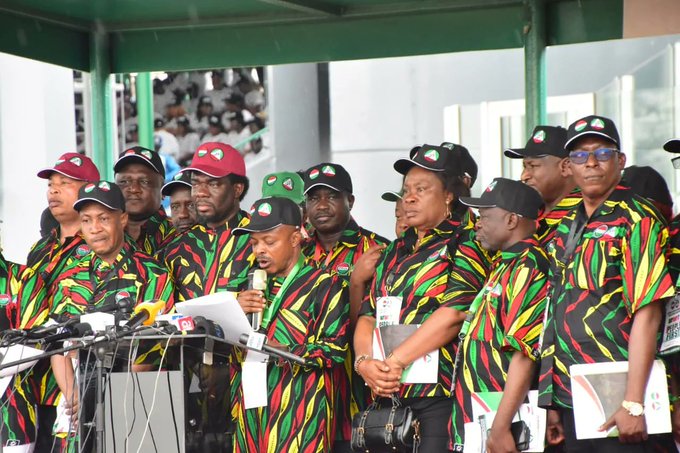
The Nigeria Labour Congress (NLC) has called on the Federal Government to abandon what it described as “insensitive policies” that have allowed repeated increases in the price of petroleum products, warning that the rising cost of fuel is worsening economic pressure on Nigerian workers and households.
The position was contained in a communiqué issued after a joint meeting of the NLC’s National Executive Council (NEC) and Central Working Committee (CWC) at Labour House in Abuja. The document was signed by NLC President Joe Ajaero.
NLC demands immediate reduction in petrol prices
The labour union renewed its demand for an immediate reduction in the price of Premium Motor Spirit (PMS), commonly known as petrol.
The NLC said the Federal Government should work with relevant agencies to bring petrol prices down to the level at which the current national minimum wage was signed into law in 2024.
The union argued that high petrol prices have a wider effect on the economy because increases in transportation costs feed into the prices of food, housing and other essential goods and services.
The NLC also demanded tax relief for workers and immediate wage awards to help cushion the impact of rising living costs.
According to the labour body, workers are being asked to absorb the consequences of economic reforms without receiving sufficient relief from the government.
Two-week ultimatum issued to government
The NLC has given the Federal Government a two-week ultimatum beginning Friday, October 9, 2026, to address its demands.
Beyond petrol prices, the union wants the government to begin the process of renegotiating the national minimum wage before the end of October.
It also demanded implementation of outstanding agreements involving the Joint Health Sector Unions and Assembly of Healthcare Professionals (JOHESU), as well as demands submitted by the Joint Public Sector Negotiating Council.
The NLC warned that failure to meet the demands could lead to further action by the labour movement.
Government introduces temporary fuel relief
The labour demands come as the Federal Government takes steps to cushion consumers from the recent surge in international crude and petrol prices.
On October 8, the government proposed a mechanism that would effectively place a ceiling of about ₦1,350 per litre on petrol's ex-gantry or landing cost, with the arrangement subject to periodic review. The measure is designed to prevent international crude-price and exchange-rate movements from immediately producing equivalent increases at filling stations.
The government subsequently announced additional relief through NNPC Retail.
The company said it would forgo its petrol retail profit margin for 30 days and sell fuel at cost in an effort to reduce the immediate impact of the global petrol price shock, particularly for vulnerable households and commercial transport operators.
The Presidency stressed that the measures do not amount to a return to the former blanket petrol subsidy.
It argued that restoring a general subsidy could recreate problems associated with fuel scarcity, smuggling, currency pressure and fiscal costs. Instead, the government said its measures are intended to provide temporary relief while maintaining the broader reform programme.
Labour says temporary relief is not enough
Despite the government's measures, the NLC maintains that a broader policy response is required.
The union said the cost of living has continued to put pressure on wages, with the depreciation of the naira and higher prices reducing workers' purchasing power.
It said the current minimum wage has effectively lost value as the prices of basic necessities have risen, making renegotiation necessary.
The labour movement has therefore linked the petrol-price dispute to a wider demand for improved wages and implementation of existing agreements between government and organised labour.
Petrol prices remain a major economic pressure point
The latest confrontation comes after another sharp increase in petrol prices in September.
The NLC said in September that petrol was selling for around ₦1,430 per litre in major cities, with prices higher in less accessible locations. It called for wage awards, greater crude allocation to local refineries and increased national fuel-storage capacity as measures to protect households and businesses from international energy-market shocks.
The union has argued that Nigeria's status as an oil-producing country should allow the government to provide some protection when international prices rise sharply.
The Federal Government, however, has maintained that the removal of the blanket fuel subsidy was a necessary reform and that returning to the old system would create significant fiscal and economic problems.
With the NLC's two-week deadline now beginning, the response from the government will determine whether the dispute remains a negotiation over fuel prices and wages or develops into a broader confrontation between organised labour and the Federal Government.