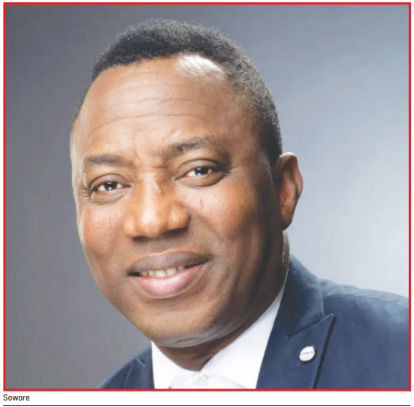
ABUJA — The courtroom at the Federal High Court in Abuja has become the epicenter of a high-stakes political drama. Omoyele Sowore, the human rights activist and prominent presidential candidate for the African Action Congress (AAC), has publicly characterized his ongoing trial as a strategic legal maneuver designed to secure a conviction that would effectively disqualify him from participating in the 2027 general elections. Following a tense session on Friday, Sowore did not mince words, arguing that the proceedings initiated by the Department of State Services (DSS) are deeply rooted in political motivations aimed at dismantling his presidential ambitions.
The Escalation of the Trial
The trial reached a critical juncture on Thursday, June 4, when Justice Mohammed Umar issued a directive for Sowore to immediately open his defense. This move signaled a significant acceleration in the judicial process, leaving little room for the defense to maneuver. During the proceedings, Sowore’s legal counsel, Marshall Abubakar, moved for an adjournment, requesting that the court pause the case until after the upcoming judicial vacation. However, Justice Umar rejected this application. Citing the provisions of the Administration of Criminal Justice Act (ACJA), the judge mandated that the trial proceed on a daily basis, commencing immediately on Friday, June 5.
This transition to daily hearings has placed immense pressure on the defense team and the defendant himself. The urgency mandated by the court contrasts sharply with the defense's desire for a more measured pace, setting the stage for a period of intense legal scrutiny that will determine the immediate future of Sowore’s political career.
Roots of the Prosecution: The 2025 Social Media Posts
At the heart of this legal storm are social media posts made by Sowore in August 2025. Following a state visit to Brazil where President Bola Ahmed Tinubu made public remarks regarding the state of corruption within Nigeria, Sowore took to his official X (formerly Twitter) and Facebook accounts to voice his dissent. In his posts, he explicitly referred to President Tinubu as a "criminal."
The Department of State Services (DSS) contends that these posts transcended the boundaries of protected political speech. The prosecution argues that the terminology used was not only defamatory but that it actively threatened public safety and violated the Cybercrimes (Prohibition, Prevention, etc.) Amendment Act, 2024. For the DSS, the case is a matter of maintaining order and upholding the legal standards governing digital conduct in Nigeria. For Sowore, the prosecution is a clear-cut case of the state using legislative tools to silence one of its most vocal critics.
Allegations of Judicial Hostility
Throughout the duration of the trial, Sowore has steadfastly maintained his innocence, consistently challenging both the merits of the charges and the fairness of the judicial environment. His frustration boiled over on Friday, as he described a hostile atmosphere within the courtroom. Sowore alleged that the judicial process has been marked by intimidation rather than impartiality. One of the most inflammatory claims he made during his post-session remarks was that at a specific point in the trial, his legal counsel was ordered by the judge to kneel.
While such allegations are serious and underscore the volatile nature of the proceedings, the court has remained firm in its stance. Justice Umar has consistently maintained that the case is being conducted strictly according to the evidence and the relevant laws, insisting that the trial is focused solely on the specific charges of criminal defamation. The court has repeatedly emphasized that the defendant's political aspirations and his status as a presidential candidate are outside the purview of the courtroom and will not influence the legal adjudication of the alleged crimes.
Political Ambition Under Legal Siege
Despite the mounting legal hurdles and the threat of a conviction that could render him ineligible for the 2027 ballot, Sowore appears determined to keep his political campaign alive. His team continues to prepare their defense, arguing that the court’s focus on the technicalities of the Cybercrimes Act ignores the broader constitutional rights to freedom of expression and political participation.
For the activist, this trial is not just a personal defense; it is a battle for the integrity of Nigeria’s democratic process. He contends that if the state can successfully use defamation charges to sideline a political candidate, it sets a dangerous precedent for the future of political opposition in the country. Conversely, the prosecution maintains its duty to protect the reputation of the office of the President and ensure that digital communication does not incite public disorder.
As the court-mandated daily hearings continue, the nation watches to see whether the judiciary will uphold the government's position on cybercrime or if it will find that Sowore’s actions fall within the realm of legitimate political dissent. For the AAC candidate, the trial is a gauntlet, and his ability to navigate the upcoming days in court may well determine whether he will remain a viable contender in the 2027 general elections. The outcome remains uncertain, but one thing is clear: the collision between digital accountability and political activism has reached a defining moment.