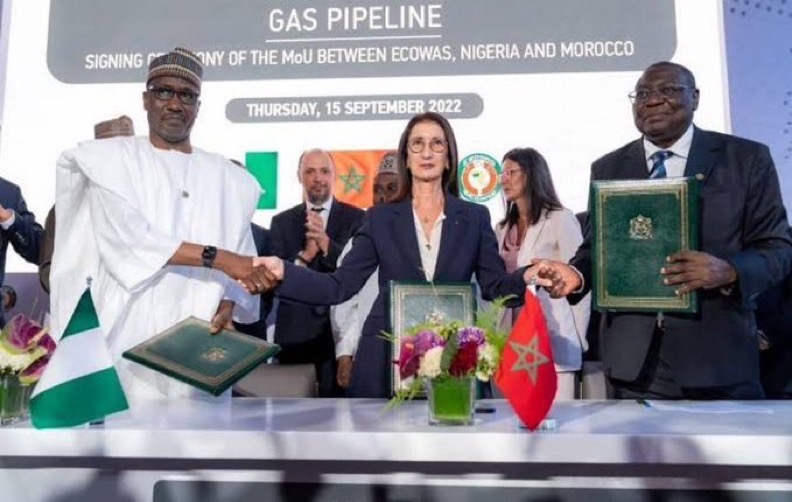
The Economic Community of West African States (ECOWAS) has officially signed the Intergovernmental Agreement (IGA) for the execution of the African Atlantic Gas Pipeline (AAGP). The signing ceremony took place during the 69th Ordinary Summit of the Authority of Heads of State and Government held in Freetown, Sierra Leone, establishing the sovereign and binding legal framework required to move the ambitious multi-billion-dollar energy project into its active implementation phase.
The African Atlantic Gas Pipeline, commonly known as the Nigeria-Morocco Gas Pipeline (NMGP), represents a transformative 6,900-kilometer offshore-onshore energy corridor designed to connect West Africa's vast natural gas reserves to North African and European markets. Passing through 13 coastal nations in West Africa, the pipeline is engineered to transport approximately 30 billion cubic meters (bcm) of natural gas annually, providing a crucial power source to spur industrial growth, enhance energy security, and expand cross-border economic cooperation across the sub-region.
Establishing the Sovereign Legal Framework
The signing of the Intergovernmental Agreement in Freetown represents the legal realization of a mandate granted by ECOWAS leadership during their December 2024 summit in Abuja, Nigeria. The agreement provides the necessary intergovernmental guarantees, tax harmonizations, transit rights, and regulatory protections required to de-risk the complex megaproject for international institutional investors, commercial lenders, and multilateral development banks.
The project is being jointly spearheaded and developed by the Nigerian National Petroleum Company Limited (NNPC Ltd.) and Morocco’s Office National des Hydrocarbures et des Mines (ONHYM). According to official statements from both state entities, the signing in Sierra Leone creates the institutional baseline needed to transition from decades of preliminary feasibility studies to physical construction and commercial execution.
Several vital technical and environmental prerequisites have already been finalized ahead of the Freetown summit. Engineering consortia have completed comprehensive Front-End Engineering Design (FEED) Phase II studies, detailed marine and land route surveys, and rigorous Environmental and Social Impact Assessments (ESIAs). Additionally, the foundational legal, commercial, and tariff-setting models have been structured to ensure fair access for participating West African sovereign nations along the pipeline route.
Executive Leadership Alignment: NNPC and ONHYM Directives
Reaffirming the strategic necessity of the pipeline, the Group Chief Executive Officer of NNPC Ltd., Engr. Bashir Bayo Ojulari, emphasized that the Intergovernmental Agreement serves as the bedrock upon which the entire engineering, procurement, and construction (EPC) framework will be built.
Ojulari highlighted that the pipeline directly advances the Federal Government of Nigeria's gas monetization strategy, aligning with President Bola Ahmed Tinubu’s mandate to optimize the nation’s vast natural gas deposits. The pipeline is projected to deliver approximately three billion cubic feet (bcf) of natural gas per day into both domestic domestic processing networks and international export corridors.
Similarly, the Director-General of ONHYM, Mrs. Amina Benkhadra, characterized the agreement as a historic victory for South-South cooperation, noting that the initiative reflects the unified vision of His Majesty King Mohammed VI of Morocco and President Bola Tinubu to foster African energy independence.
To ensure seamless operational oversight, the project framework outlines the upcoming establishment of two dedicated governance institutions:
-
The Pipeline Higher Authority: To be headquartered in Abuja, Nigeria, serving as the supreme regulatory body overseeing sovereign compliance, environmental standards, and cross-border security.
-
The AAGP Project Company: To be incorporated in Casablanca, Morocco, acting as the commercial operating entity tasked with managing construction logistics, private capital raising, and day-to-day pipeline operations.
Morocco and Mauritania are scheduled to execute separate bilateral supplemental agreements to complete the full intergovernmental matrix, paving the clear path toward the anticipated Final Investment Decision (FID).
Strategic Ministerial Perspective: Leveraging 215 Trillion Cubic Feet of Reserves
Speaking on behalf of the Nigerian delegation which was led to the summit by Vice President Kashim Shettima the Minister of State for Petroleum Resources (Gas), Rt. Hon. Ekperikpe Ekpo, underscored the immense economic potential the project holds for the African continent.
Minister Ekpo emphasized that Nigeria holds proven natural gas reserves estimated at 215.19 trillion cubic feet (tcf)—the largest on the African continent and among the top ten globally. Transitioning from heavy fossil fuels to natural gas is viewed by regional leaders as the primary driver for industrialization, power generation, and economic diversification.
The Minister noted that the pipeline will serve as a catalyst for economic growth across all 13 transit countries, providing cheap, reliable natural gas to power heavy industrial manufacturing, support large-scale agricultural fertilizer production, expand petrochemical processing, and resolve chronic electricity deficits that have historically hindered regional trade.
Ekpo commended the unified resolve of ECOWAS member states, describing their unanimous endorsement in Freetown as a testament to regional solidarity and a shared commitment to building a resilient, self-sustaining African energy market.
Socio-Economic Impact and Geopolitical Significance
Beyond its immediate industrial applications, the African Atlantic Gas Pipeline holds significant geopolitical weight within the global energy landscape. By creating a direct physical connection between West Africa, the Sahel, North Africa, and potentially the European Union's pipeline grid, the project positions West Africa as an essential long-term partner in global energy security.
For participating West African coastal states—including Benin, Togo, Ghana, Côte d'Ivoire, Liberia, Sierra Leone, Guinea, Guinea-Bissau, The Gambia, Senegal, and Mauritania—the pipeline offers a stable supply of natural gas without the need for individual nations to construct costly standalone Liquefied Natural Gas (LNG) regasification import terminals.
As the governance frameworks take shape in Abuja and Casablanca, the signing of the Intergovernmental Agreement stands as an important turning point. The project transitions from an ambitious regional vision into a fully realized infrastructure development, setting a new precedent for continental cooperation and economic self-determination in Africa.