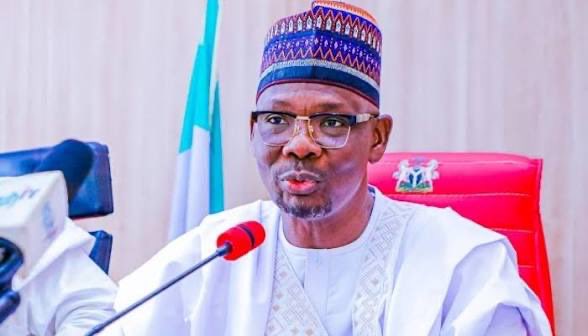
ABUJA — Challenging the long-held institutional reliance on volatile foreign loans, the Governor of Nasarawa State, Engr. Abdullahi Sule, has asserted that Nigeria possesses more than enough domestic liquidity to aggressively bridge its multi-trillion-dollar infrastructure gap. The Governor maintained that foreign debt is unnecessary if governments systematically establish transparent, trust-driven fiscal structures capable of securely absorbing local institutional investments.
Governor Sule dropped these economic insights while delivering his headline keynote address at the 2026 Infrastructure Dialogue in Abuja. Organized under the theme, “Building Nigeria’s Future: The Strategic Role of DFIs and Capital Markets in Infrastructure Financing and Economic Development,” the high-level summit brought together premium policymakers, development finance institutions (DFIs), and private sector titans to align local capital with pressing national development priorities.
Drawing from his high-profile corporate pedigree as the former Group Managing Director of the Dangote Petroleum Refinery, Sule pointed to the private sector's massive absorptive capacity as indisputable evidence that substantial, untapped capital is sitting right within Nigeria's financial ecosystem.
"Nigeria has so much money. The easiest way to know this is to look closely at the Dangote Refinery," Governor Sule stated frankly. "If the management decides tomorrow to sell just 30 percent of a 20-billion-dollar enterprise to the capital market, that required six billion dollars will be oversubscribed at least three times over by PENCOM, local commercial banks, and domestic hedge funds."
According to the Governor, modern institutional investors are rarely preoccupied with the physical scale of an asset itself. Instead, their primary investment thresholds are strictly governed by predictability, transparency, verified trust, and guaranteed, competitive returns on investment (ROI).
The Nasarawa Blueprint: Zero Foreign Loans and a 400% IGR Surge
Defending his economic thesis with practical state milestones, Governor Sule detailed how his administration aggressively deployed these exact principles to transition Nasarawa State from a sleepy, civil service-dependent economy into an emerging West African industrial powerhouse.
Faced with massive infrastructure demands, the state government took a hardline policy stance against soliciting foreign loans, explicitly citing the severe macroeconomic and foreign exchange (FX) risks that have historically crippled sub-national balance sheets across the federation.
"We did not take foreign loans because of the associated foreign exchange risks," Sule explained. "Instead, our strategic focus was to aggressively block administrative leakages and systematically build premium infrastructure roads that intentionally opened up our core mining and agricultural corridors."
The state’s industrialization drive was heavily accelerated by a landmark executive order mandating that all solid mineral exploration firms must process raw materials locally within Nasarawa rather than exporting unprocessed earth. This structural intervention successfully attracted some of the largest lithium processing infrastructure plants on the African continent.
As a direct consequence of these localized industrial operations and tight internal controls, Nasarawa State's Internally Generated Revenue (IGR) skyrocketed from a modest ₦7 billion annually in 2019 to an unprecedented ₦36 billion today representing a massive growth spike of over 400 percent.
Quantifying the Gap: Private Capital Must Fund Commercial Infrastructure
Earlier in the plenary sessions, the Convener of the dialogue and Managing Partner of Deutsche Partners Holdings, Dr. Onuoha Nnachi, provided a sobering analytical baseline for the summit, noting that a comprehensive 2024 assessment placed Nigeria’s overarching infrastructure deficit at a staggering $30.1 trillion.
Forensic breakdowns of the data show that 62 percent of this gargantuan deficit is concentrated entirely within economic infrastructure such as deep-sea ports, cargo rail systems, energy grids, and digital networks. Nnachi argued that because these specific assets are naturally commercially viable and capable of direct tariff collection, they should be entirely unbundled and handed over to private sector funding structures.
"Budgetary provisions of the federal and state governments simply cannot fund this massive gap," Nnachi remarked bluntly. "We must allow governments to strictly focus their limited sovereign revenues on social infrastructure such as public schools and state hospitals, while the organized private sector completely drives the execution of economic infrastructure."
Nnachi highly commended the Nasarawa State Government as a stellar national model, noting it stands out as one of the very few sub-nationals to legally codify its own dedicated Infrastructure Fund through binding state legislation, ensuring a fixed percentage of state revenue is structurally insulated for long-term development assets.
Blended Finance, Green Bonds, and Tech-Driven Security
Aligning with the call for innovative financing, the Chairman of the occasion and Governor of Taraba State, Dr. Agbu Kefas, characterized infrastructure as the irreplaceable foundation upon which modern economic and social life is built.
In a speech delivered on his behalf by the Taraba State Commissioner for Agriculture, Prof. Nicholas Namessan, Kefas urged African leaders to rapidly pivot away from traditional, constrained sovereign budgets toward sophisticated blended finance models and climate-backed green bonds to help satisfy Africa's estimated $100 billion annual infrastructure financing gap.
However, the dialogue recognized that no amount of capital injection could survive without a secure operational environment. Addressing the gathering, the Inspector-General of Police, Olatunji Disu, speaking through Commissioner of Police CP Justin Obiora, maintained that sustainable economic development cannot thrive in an atmosphere of unchecked insecurity.
The police chief disclosed that the Nigeria Police Force is undergoing a major technological shift, deploying advanced electronic surveillance hardware, drone corridors, and intelligence-backed policing along critical transport and industrial networks to shield multi-billion-naira infrastructure installations from targeted vandalism, theft, and economic sabotage.