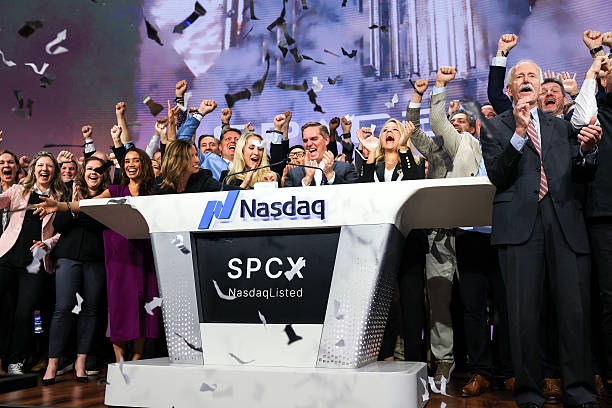
NEW YORK — The global financial markets were electrified on June 12, 2026, when SpaceX, the aerospace and AI-integration giant, officially debuted on the NASDAQ under the ticker symbol SPCX. The listing was heralded as the most significant public offering of the decade, a "blockbuster" event that briefly propelled the company’s market capitalization toward the staggering $3 trillion mark. However, just one week into its public life, the euphoria has encountered a sobering reality check.
After reaching a dizzying intraday high of over $225 during its opening week, SpaceX shares have experienced a sharp 20% pullback. As of the market close on Thursday, June 18, 2026, the stock settled at $185.00. While this figure remains comfortably above the initial offering price of $135, the rapid descent from its peak has erased significant paper gains for those who chased the stock during its initial surge, leaving a wide segment of the investor base in a precarious position.
The Anatomy of a Market Correction
In the high-stakes world of technology IPOs, volatility is rarely unexpected, yet the speed of the SpaceX correction has caught many off guard. Market analysts point to the convergence of the current share price with the Volume-Weighted Average Price (VWAP)—a critical metric used by institutional traders to gauge the "true" average cost of a stock—as evidence of a market seeking equilibrium.
With the current VWAP hovering around $181.71, it is clear that the average investor who entered the market after the IPO is now effectively hovering at the break-even point. This technical alignment often acts as a pivot, suggesting that the initial speculative fervor has transitioned into a more disciplined, value-focused phase of trading.
Retail Impact and the "IPO Hype" Cycle
The pullback has been particularly testing for the surge of retail investors who gained access to the IPO through platforms like Robinhood, Fidelity, and SoFi. In the days following the June 12 debut, social media sentiment was overwhelmingly bullish, fueled by the narrative of SpaceX as a "once-in-a-generation" investment.
However, the divergence between institutional investors—who secured allocations at the $135 offering price—and retail investors, many of whom bought in at levels north of $200, is now stark. The "early-bird" institutional participants remain in a position of considerable profit, while the late-stage retail entrants are facing the psychological strain of a market adjustment. This gap often defines the "volatility tail" of high-profile IPOs, where the retail sentiment that drives the initial price explosion eventually clashes with the profit-taking strategies of institutional whales.
The Valuation Debate: Beyond the Launchpad
As the stock stabilizes, the central question for Wall Street has shifted from "How high can it go?" to "What is the fundamental growth case?" The core of the current debate involves the company's aggressive integration of its xAI division into its existing aerospace infrastructure.
Investors are now recalibrating their expectations based on several fundamental factors:
-
Capital Intensity: SpaceX operates in sectors—reusable rocketry, global satellite internet, and advanced AI—that require astronomical capital expenditure (CapEx). While the company’s vision is unmatched, the ability to generate consistent free cash flow to justify a $3 trillion valuation is a long-term hurdle.
-
Technological Milestones: The market is pricing in near-perfect execution on future Starship missions and the successful deployment of next-generation AI models. Any operational delay or regulatory bottleneck will inevitably exert downward pressure on the stock.
-
Macroeconomic Headwinds: With the broader tech sector facing scrutiny over high valuations, SpaceX is not immune to general market sentiment. Investors are increasingly demanding proof of operational efficiency rather than just the promise of innovation.
Looking Toward the Future
The stabilization of SPCX marks the end of the "hype" phase and the beginning of the "performance" phase. Whether SpaceX can maintain its status as a premier technology and aerospace entity will depend on its upcoming quarterly earnings reports and the transparency of its disclosures regarding xAI’s integration.
For the company, this correction may actually prove healthy. A share price that aligns more closely with broader market fundamentals is often more sustainable than one built on the shifting sands of speculative retail trading. If SpaceX can continue to hit its technological milestones while managing its massive capital requirements, the current correction may be viewed in hindsight as a necessary consolidation—a brief dip before the stock finds its long-term floor.
As we look toward the remainder of 2026, the focus for investors remains clear: watch the fundamentals. The "blockbuster" IPO narrative has ended, but the real work—the work of scaling a company that aims to reshape both our planet and our place in the galaxy—is only just beginning.