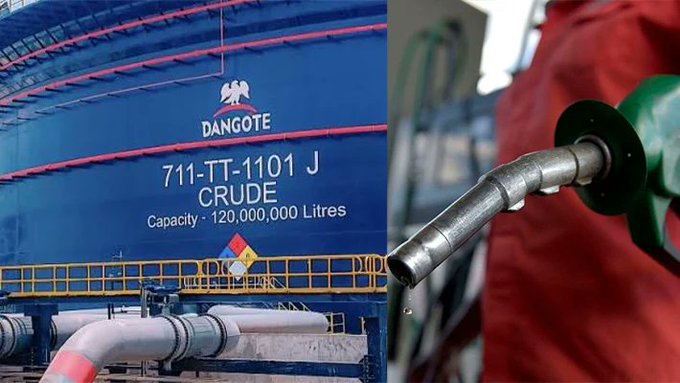
The 650,000-barrel-per-day Dangote Petroleum Refinery and Petrochemicals facility has officially adjusted its wholesale gantry price for Premium Motor Spirit, raising the rate from N1,185 to N1,200 per litre. The price recalibration, which took formal effect on August 26, 2026, marks the second upward adjustment by the Lekki-based mega-refinery within a single week, following a previous tick upward from N1,165 per litre just five days prior.
In an official circular issued by the refinery's Group Commercial Operations division to major petroleum marketers and distribution partners, the company outlined revised depot pricing structures covering both gantry loading and coastal vessel deliveries. According to the internal communication, titled PMS Price Change Communication (N1,185 per Litre To N1,200 Per Litre), coastal delivery rates simultaneously advanced from N1,562,265 to N1,582,380 per metric tonne, reflecting broader operational realignments across the downstream supply chain.
Operational Directives and Market Response Across Nigerian Depots
To facilitate the commercial transition, executive management instructed registered off-takers and petroleum marketers to submit existing loading documentation for immediate price re-evaluation. The refinery directed customers to return all active Authorisation to Collect certificates, confirming that fresh volume contracts would be issued swiftly to ensure uninterrupted truck loading operations at the facility's extensive loading bays.
Downstream distribution networks and independent depot operators across the Lagos axis began implementing the recall of documentation shortly after receiving the circular. Independent petroleum marketers indicate that the N15-per-litre advance at the refinery gate will inevitably filter through to retail pumps across West Africa. With regional transport overheads, municipal bridging tariffs, and local distribution margins factored into final pump pricing calculations, industry analysts project domestic retail petrol prices will likely settle around an average of N1,250 per litre at independent filling stations nationwide.
Divergence Between Domestic Fuel Pricing and Benchmark Crude Movements
The timing of the refinery's price adjustment presents a notable divergence from short-term movements in international benchmark crude contracts. Global oil indicators recorded sharp downward pulls, with West Texas Intermediate crude declining by 3.39 per cent to trade at $82.13 per barrel. Simultaneously, Brent crude futures pulled back by 4.12 per cent to $88.37 per barrel, while Murban crude experienced a steeper drop of 8.61 per cent, settling at $92.71 per barrel.
Energy market economists point out that domestic refining pricing models often operate on a lag, incorporating long-term crude acquisition costs, local currency exchange dynamics, and secondary chemical processing inputs rather than immediate spot market movements. Consequently, short-term drops in global benchmark crude prices do not always translate into instant relief at regional gantry gates, as refining complexes balance foreign exchange exposure and local inventory carrying expenses against broader operational overhead.
Global Geopolitical Tensions and Supply Route Bottlenecks
The domestic price increase unfolds against a backdrop of complex geopolitical developments across major global energy corridors, particularly surrounding evolving conflict dynamics between the United States and Iran. While international oil markets experienced temporary price pullbacks after financial markets assessed recent sanctions packages as less immediate than direct military escalation, structural risks across key maritime transit points remain extremely heightened.
Vessel tracking metrics confirm severe shipping bottlenecks across the strategic Strait of Hormuz, where daily commercial transit volumes dipped to just two commodity vessels—the lowest daily operational count recorded since early May. Given that approximately twenty per cent of global liquid petroleum consumption routinely passes through this narrow maritime choke point, ongoing security concerns leave global supply chains exceptionally sensitive to sudden operational disruptions, compounding the broader economic pressures faced by domestic energy refiners and consumers alike.