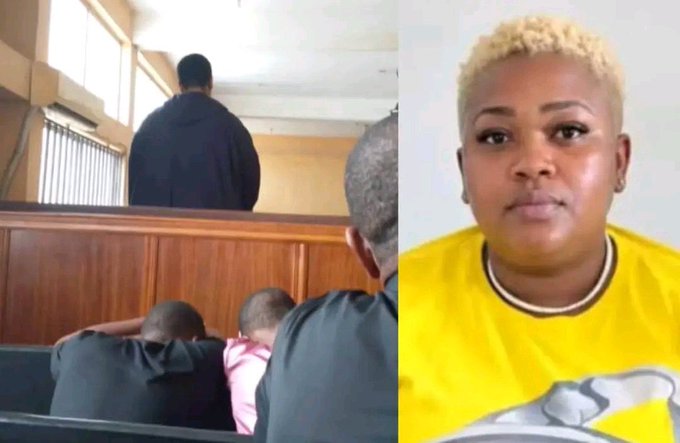
LAGOS — Striking a firm blow against international illicit financial flows, the Economic and Financial Crimes Commission (EFCC) has successfully pushed forward the money laundering trial of an Austrian national caught smuggling a massive cache of foreign currency out of Nigeria. Appearing before Justice Yelim Bogoro at the Federal High Court in Lagos, a key immigration witness described how routine security support for an allegedly "ill" passenger quickly unraveled into one of the largest single-passenger cash seizures at the Murtala Muhammed International Airport (MMIA).
The defendant, identified as Kavlak Onal, is facing a rigorous two-count criminal charge bordering on deliberate non-declaration of foreign currencies totaling $800,575 and €651,505 amounting to a cumulative valuation of over $1.45 million. Onal was intercepted by alert operatives of the Nigeria Customs Service (NCS) on December 16, 2025, just as he was preparing to board an outbound Emirates Airline flight bound for Dubai, United Arab Emirates.
The Drama in Court: Prosecution Blocks Defense Delay Tactics
During the latest court proceedings, a tense legal battle erupted over the pace of the trial. The defense attorney, Omon Omofona, moved an application seeking an immediate adjournment, arguing that the lead defense counsel was concurrently trapped handling another high-stakes matter in an entirely separate court. Omofona urged Justice Bogoro to halt proceedings temporarily to safeguard the defendant's constitutional right to a fair hearing.
However, the EFCC principal prosecutor, Bilikisu Buhari, fiercely opposed the delay tactic. She reminded the court that the high-profile case had already been explicitly granted an accelerated hearing status due to its international financial implications.
"The prosecution witness currently on the stand is on an urgent official assignment but left his duty post specifically to be present for this trial today," Buhari argued robustly. "It is entirely proper that the co-counsel already present in court be briefed by his team to proceed accordingly. This is a critical criminal trial, and the sovereign image of the country is heavily at stake."
In a decisive mid-trial ruling, Justice Bogoro upheld the prosecution’s objections, declaring that the defense counsel present in the room possessed sufficient competence to take detailed notes and brief the lead attorney. She ordered the trial to proceed immediately, subsequently fixing July 13 for the formal cross-examination of the witness.
The Interception: How an Act of Assistance Exposed the Cash
The prosecution subsequently led its second key witness, Sani Ibrahim, an officer of the Nigerian Immigration Service (NIS) attached to the MMIA departure terminal, to give his eyewitness account. Ibrahim testified that his encounter with the Austrian national began under the guise of medical assistance.
"My colleague requested that I assist the defendant into the departure hall after he had collected his boarding pass, informing me that the passenger was traveling to Dubai but was visibly ill," Ibrahim explained to the court.
Ibrahim met Onal at the Emirates counter, took custody of his passport and boarding documentation, and escorted him past initial checkpoints. Because the defendant claimed he was too unwell to stand, the officer cleared him through to the Aviation Security (AVSEC) scanning point to fast-track him to the airport lounge.
The breakthrough occurred the moment the Austrian's carry-on luggage passed through the high-resolution AVSEC x-ray scanners. Intrigued by dense, anomalous blocks blocking the screen, aviation security personnel flagged the bag for physical inspection.
"When I directly asked the defendant what was inside the bag, he claimed they were only his personal medications and basic travel belongings," Ibrahim testified. "He completely hid the fact that he was transporting bulk currency."
"Amounts I Had Never Seen in My Life"
Suspicious of the passenger's evasive answers, Officer Ibrahim escorted Onal to the Nigeria Customs Anti-Money Laundering and Currency Declaration Desk. A customs officer, Yusuf Suleiman, directly asked the Austrian if he had any physical cash or negotiable instruments to declare to authorities. The defendant answered flatly in the negative.
With the passenger's formal consent, customs officials zipped open the luggage. An initial search yielded a thick envelope tightly packed with high-denomination United States dollars. Sensing a wider breach, officers initiated a exhaustive structural teardown of the bag.
"In the process, they discovered a huge, staggering amount of money, the likes of which I have never seen before in my entire life," the immigration officer stated under oath.
Onal was immediately detained, stripped of his boarding privileges, and moved to the airport's inner customs holding facility, where he was forced to issue a written statement before being handed over to the EFCC for formal interrogation and subsequent January 9 arraignment.
The Legal Framework: Violating the Money Laundering Act
The structural architecture of the EFCC’s criminal charge relies heavily on Nigeria’s stringent anti-money laundering regulations.
-
Count One: Accuses Kavlak Onal of failing to declare the exact sum of $800,575 to the Nigeria Customs Service at the MMIA currency desk, directly violating Section 3(5) of the Money Laundering (Prevention and Prohibition) Act, 2022.
-
Count Two: Alleges the matching non-declaration of €651,505, an offense punishable under the identical provisions of the same legislative act.
Under prevailing Nigerian financial laws, while citizens and foreign nationals are entirely permitted to transport large volumes of cash across borders, any sum exceeding a threshold of $10,000 (or its equivalent) must be legally declared to customs authorities. Failure to declare results in automatic seizure and criminal prosecution, as the state aggressively monitors outflows to prevent international terrorism financing and global tax evasion. With the first two witnesses dropping damaging testimonies, the defense faces a steep uphill battle ahead of the July cross-examination date.